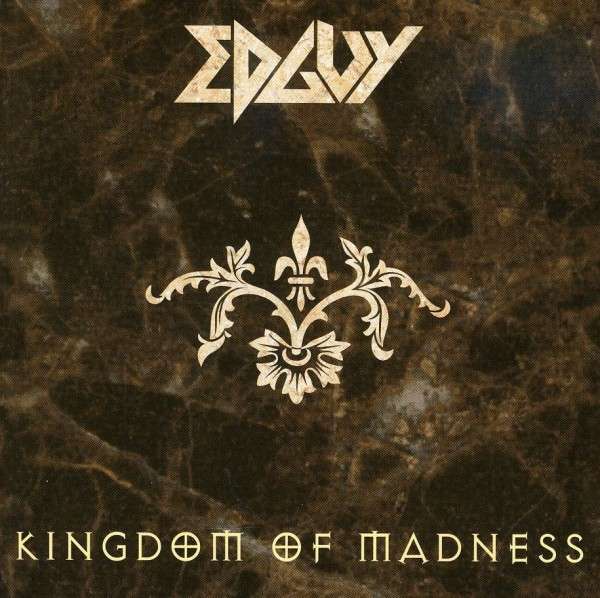
I came into Edguy on the Mandrake album about 15 years ago, and it was that album and Hellfire Club that made me a fan of the band. So when it came to going backwards to discover the earlier albums there is always that doubt in the back of your mind, wondering if anything could be as good as the albums are where you actually discovered the band. Such is the case here for me with Kingdom of Madness, which depending on your view of the situation is either the official debut of the band or ranks second behind the original release of Savage Poetry. In any case, it is an undeveloped sound compared to the two albums I knew so well.
More than anything else, it is the song structure here that still has unsanded edges on them. The basics all sound good, but there is a definite difference in the maturity of the song writing and the structure of the songs as they are played. Perhaps what it is mostly is that the band itself seems unassured of its own place in the music world. The drums, while technically proficient throughout with that typical power metal double kick, are nonetheless for the most part just a timekeeping device rather than coming into their own. They are also very forward in the mix, much more so than the guitars, which is a little disconcerting. The fact that the guitars of Jens Ludwig and Dirk Sauer are not as prominent as they could be isn’t a huge factor but it does seem unusual given the history of power metal bands and what drives them to fans. It mightn’t have been such an issue for me if the drums had been more technical, but they aren’t. Even Tobi’s keyboards often seem higher in the mix that the two guitarists.
I get the feeling that these issues help to make the songs sound more simplistic and stagnant than they really are. The opening salvo of “Paradise”, “Wings of a Dream” and “Heart of Twilight” all have their moments, without any particular part of them jumping out at you and grabbing your undivided love of the track. Perhaps it was that there were other bands out there doing these kinds of songs better, with more emotive impact both musically and vocally that Edguy do here. You can decipher the bones of the songs and see and hear what they perhaps could have been, but they just don’t reach those lofty heights. They are good solid power metal songs that don’t get beyond that. The instrumental “Dark Symphony” seems a strange implement here to move into “Deadmaker”, which then changes tempo between the vocals and solo section in a combination that startles until you can get used to it. This is followed by “Angel Rebellion” which after a slow start picks up by the end to a satisfying conclusion.
“When a Hero Cries” is what makes power metal so difficult to completely embrace as a genre. The power ballad is a great stink on the face of metal, and this truly is one of the worst examples of such a song. Just keyboard with silent mournful vocals over the top. For goodness sakes, there is a place for this kind of garbage, and it isn’t on an album from a band that is purporting to make its way in the metal industry. It completely bombs out the momentum of the album, and truly makes you question why you decided to pick up and listen to this album in the first place. It is an abomination, a terrible piece of music that does not befit this or any release.
The closing track is the perhaps the first instalment of Tobi’s grandiose vision for the future, with “The Kingdom” stretching out beyond eighteen minutes in length. It does however have an unusual structure, with the laughing statement that breaks up the middle of the song. It then fades in and out of style, with the quiet reflection session coming out of a faster paced double kick pattern. Tobi is looking for the epic finale, the one that the punters will love and remember, similar to Helloween’s “Keeper of the Seven Keys” or Iron Maiden’s “Rime of the Ancient Mariner”. It doesn’t approach either of those songs, but you can sense it is the direction he wished to head for.
Kingdom of Madness is still a good listen, with enough of the familiar sounds to make it worth your while. I tried to work out if I would enjoy this album more if I had come into Edguy at the beginning, and moved through their discography from the start rather than coming in at album number five and discovering them in reverse. My feeling is that yes, that would be the case. Despite that, for those that are power metal fans of this era, this is an album worth enjoying.
Rating: “In the silence there’s a fear”. 3/5
One middle-aged headbanger goes where no man has gone before. This is an attempt to listen to and review every album I own, from A to Z. This could take a lifetime...
Podcast - Latest Episode
Monday, June 12, 2017
Friday, June 09, 2017
993. Adrenaline Mob / We the People. 2017. 4/5
Adrenaline Mob’s sound is different from what the individuals in the band have done before with the other bands they are a part of. Here there is a real heavy groove about the guitars, the drums thump along in rhythm and the vocals are overall in a lower register with the attitude turned up to eleven. This was what the project was striving for when it was first conceived, to have these individuals come together to do a traditional heavy metal album rather than the various styles of the other bands they were a part of. I thought the first album was terrific not just because of the people involved in the project but because they pushed themselves and produced an album that was indeed different from their other bands. The follow up album I was less enthusiastic about because it felt like they were trying too hard. Here on We the People though it feels like they have that right balance back again, and the difference again rises to the top.
Russell Allen and Mike Orlando have this time brought in bassist David Zablidowsky and drummer Jordan Cannata to join them, and both are impressive here. As are the opening three tracks to the album. “King of the Ring” is a solid opener, and followed by the hard hitting title track “We the People” and the mid-tempo but surprisingly catchy “The Killer’s Inside” these three songs happily set the record straight on the direction the album is heading.
“Bleeding Hands” may not technically be a ballad, but it certainly covers that territory both lyrically and musically for the most part. I’m sure I could be argued about this falling into that genre, but peel back the thin outer layer of harder drums and guitar solo and what you have here is a rock ballad, and you just aren’t going to drag me in playing material like this. It’s a shame to have the album hijacked after a solid beginning. “Chasing Dragons” is a redeemer following it, with a much more pleasing vocal remedy from Russell, driven along by those double kick drums and solid rhythm from the guitar and bass.
The run of songs through the middle of the album are where the strength of this band lies in my opinion, and especially where this album shows off its worth. “Til the Head Explodes”, “What You’re Made Of” and “Raise ‘Em Up” all have that Orlando groove that he likes to perpetuate, but both the drums and the bass are stylistically able to individualise themselves so that they are noteworthy and relevant. While “Til the Head Explodes” sits into its mid-tempo, “What You’re Made Of “ busts out at a pleasingly faster pace without compromising the heavy sound (this is a ripper), and “Raise “Em Up” wants to be the anthem track of the album. Then in “Ignorance & Greed” Russell really utilises every part of his vocal range that he can, starting off as a deep growl, into his normal mid-range vocals before then reaching for the heights (but not the limits) of his higher range capacity. The rhythm track is low end and a really heavy thump to it, before coming to the final minute of the track where it slows to a hard and heavy hand while Mike Orlando solo’s over the top. Terrific song.
Whereas “Bleeding Hands” acts as the front bookend to these great middle album tracks, “Blind Leading the Blind” acts as the end bookend. Like the first track it is not what you would consider an out-and-out ballad, with the heavy drum parts morphing well with Russell’s hard edged vocals rather than a ballad-like soft vocal track, but it does have a slower feel to the song that evokes those kind of emotions listening to the track, and a solo that could almost fit into those types of tracks that you know I’m talking about – though it is also a bit edgier than those would be. As I said, I think those two songs frame the better part of the album with what comes between them.
“Violent State of Mind” returns to the heavier equation, and is the site of some indulgence from Orlando at the end of the song. “Lords of Thunder” almost feels like two styles of tracks sewn together, with the heavier chunking in the chorus lightening up during the verses. This gives the song two distinct sounds, one where the verses appear to be driven by Russell’s vocals in the same way he does for other bands with that beautiful soaring voice, into the heavier harder sound he generally uses with Adrenaline Mob tracks. I love Orlando’s solo here too. Another great track.
It wouldn’t be Adrenaline Mob without a cover song somewhere in the mix, and this time they have taken on Billy Idol’s “Rebel Yell” with gusto. Now while you are never likely to find anyone who can replicate the awesome energy of Billy Idol’s vocals and Stevie Stevens’ guitar on the original version, this is a fun and raucous version that ends the album on an upward note, and is worthy of the praise of ‘tribute’.
This is a terrific return to form for the band. The sound here again has been refined and matured before letting it loose and seeing what it can produce. The band sounds fantastic, and Russell’s vocals top it off. Welcome back Adrenaline Mob, it’s good to hear you out and about again.
Rating: “You look surprised as hell to see this ugly face”. 4/5
Thursday, June 08, 2017
992. Foo Fighters / Run [Single]. 2017. 4/5
So, 20-odd years on from Foo Fighters entering the music
scene, what can we surmise from the release of this single. Is this a taste of
what is to come from the next album, that is in the process of being recorded
and for which a release may well be imminent? Or is this a one-off single,
taking advantage of their schedule to remind everyone that they are still out
there and working together?
Whatever is the case, it is an interesting single. In many
ways it harks back to Dave’s early influences. It starts off in a quiet
fashion, before Taylor’s drums jump in, followed by some very punk rock oriented
guitar, and even more fashionably those famed screaming vocals from Dave
himself that haven’t appeared as often in recent times. Can you, like me, hear
bits and pieces of that old Seattle sound in there? Nirvana, Alice in Chains,
Soundgarden. I can hear them all. The fact that this tends to hail back to
those grunge and punk roots more than the hard rock and even soft rock that has
been the staple of recent years is interesting to me because I admit I would
like to hear an album based around this kind of writing and performing. I don’t
believe we’ll get it, but I know that Taylor is hitting those drums and cymbals
bloody hard, and the three guitars distorted riffing together with Nate’s
familiar bass line running underneath beautifully also mix well with the
keyboards that are beginning to find their way into the band’s music.
Is Dave writing a metal/punk Foo Fighters album? Again, I’m
guessing not. But this song is an enjoyable thought in the process.
Wednesday, June 07, 2017
991. Queen / Jazz. 1978. 4/5
The pressure of writing an album, recording an album and then touring an album, only to start the whole process over again, all in the span of 12 or so months, must be an enormously difficult thing to do. The fact that Queen did this most of the way through the 1970’s and early 1980’s, producing a new album every year from their self-titled debut album “Queen” right through to “Hot Space”, is a remarkable achievement, and the fact that the quality is generally of the highest order is even more remarkable. Opinions on how high that quality is on some albums does tend to shift around, and this period of the band is one of those instances.
After the magnificence of what had been the “A Night at the Opera” album, the follow up of “A Day at the Races” had been mixed, some iconic tracks alongside others that seemed to want to head in the same direction but didn’t quite match up. This was then followed by “News of the World”, the episode on which you can find in Season 3 of this podcast. Written and released at the start of the dominating punk movement in the UK, it is an album that held its own as the band remained true to their own music rather than look to change with the times, and it has held up because of this fact.
Coming to this album the following year not a lot had changed in the music world with punk still making its presence felt and the AOR movement in the US also holding firm to the radio airwaves. The band had decided to record outside of the UK for tax purposes, and settled on Montreux as their main port of call for the album that became known as “Jazz”, where the Montreux Jazz Festival was being held and which the band attended, and likely inspired the name of the album.
It is interesting to read reviews of this album from the time it was released, with many big time American publications such as Rolling Stone and Creem being particularly derogative of the final product. It is difficult to decide whether or not this was an honest review of the album, or just an ongoing diatribe from these particular publications over the style of music Queen chose to write and record. From the language used in those reviews it appears that there was a personal affront in their composition rather than any true effort to critique what the band had released, something that these two magazines in particular were not adverse to doing when they wanted to bring a band back to heel.
The opening track “Mustapha” bounds along in an excited chanting of lines in various languages that at least all sound like they rhyme together and fit together in sentences, but to be honest I have pretty much zero idea what is being said or what the song is about. Despite this, it’s hard not to like Freddie’s enthusiasm and pronunciation of whatever it is he’s saying. I wonder if the band knew what the song was about? This is followed by the well-rounded and often sung “Fat Bottomed Girls”, which has a great rhythm line underneath the song, a great chorus track and guitar riff to go along with the grin hidden behind a hand of teenage boys everywhere as they sang it.
“Jealousy” rises and falls on Freddie’s vocals, manipulating the mood of the track simply in the nuances of his vocals. Along with the backing vocals, it is a beautiful song. The relative gentleness of the track allows it to transition into “Bicycle Race” without losing integrity. “Bicycle Race” morphed nicely with “Fat Bottomed Girls” by mentioning it within the song, but it also has lyrics that reference the era that the song was written, and as such became a fun song to learn and then sprout the lyrics back at the people around you as you sang. These two short-but-sweet songs were always a popular part of Queen’s armoury, and found plenty of airplay due to their short playtime. “If You Can’t Beat Them” is an easy listening sing along track in a typical John Deacon style. It’s catchy and easy to move along with. Brian actually played all the guitars on this song, which was unusual for songs composed by John.
“Let Me Entertain You” closes out the first side of the album and has always been one of my favourite Queen tracks, though it is one I found from their live recording before I had ever heard “Jazz”. It is one of the heaviest tracks written by Freddie, though much of that comes from Brian’s guitar riff and his solo burst. Still, Freddie sings this hard and loud, preaching to the audience as he did so well. This still sounds great today. Side Two then opens up with “Dead on Time”, another of Queen’s most aggressively hard songs led by Brian’s guitar again as well as Roger’s great drumming. These two songs back to back showcase the best of that heavier side of Queen, revealing that part of their personality for the world to hear. It’s a shame that this song was never performed live, I believe it would have sounded great.
The album dials back to that much gentler aspect of the band’s brilliance, with “In Only Seven Days” where Freddie shows how amazing his vocal capacity is, having shown his faster and energetic vocal range in the previous two songs, to slipping into this easy paced song with gentle higher vocals. Amazing. This is followed by “Dreamer’s Ball” which sounds like it could have come from the “A Night at the Opera” album. “Fun It” is a quintessential Roger Taylor track with all of his tricks of the trade thrown it. He again plays most of the instruments and shares lead vocals throughout with Freddie. “Leaving Home Ain’t Easy” is Brian’s quiet ballad, almost Beatles-ish in its composition. Having heard the harder side earlier in the album, these four songs showcase the lighter side of the band, without losing any integrity in the tracks. Terrific stuff.
“Don’t Stop Me Now” is in my opinion one of the five best Queen tracks of all time. Positive lyrics, driving drums and lead bass riff, the piano being the major instrument throughout with Brian’s guitar just coming it to make highlight spots, and of course Freddie’s vocals topping everything off. If you could write one song and play it for eternity, it would quite probably be this one for me. It is a brilliant piece of song writing and musicianship.
The final track “More of That Jazz” is written and almost completely performed by Roger, and it is very much his style of track. It is eclectic, staccato with lots of guitar and vocal lines and harmonies mixed into places that don’t seem to be in any form, but somehow come together to make a great song. Not only do we hear his own amazing vocal range, when you first hear the song you think something has happened to the recording, because suddenly snatches of other songs on the record start coming into the mix. It’s unusual, but became common place amongst Roger’s own solo stuff. Opinions no doubt range on it, but personally I like it.
There is something for everyone on “Jazz” and it all comes together in a perfect way. The musicianship is second to none with each members at the top of their game. The vocals of all three major contributors is superb, with Freddie quite awesomely showing he can sing just about any type of song. And the variety of the songs doesn’t intrude on each other, somehow, they all tend to mesh together perfectly despite the wide range of influences that come into them. It juggles the different nuances of the song catalogue of Queen once again, continuing the 1970's transition of the band from heavily progressive rock in the early days through to more radio friendly hard rock, but without compromising their amazing talents or ingenious song designs.
I didn’t listen to the 1970’s Queen albums until I had left high school and had well and truly been captured by their 80’s albums such as “The Works” and “A Kind of Magic”, and then “The Miracle”. And the difference in styles was immediately noticeable once I began to digest them all at that time. “Jazz” had always been one that attracted me, mostly because of the way it flows along, able to connect songs of different varieties without driving a wedge between them or losing the momentum that is created. It is generally the harder songs on the album that I love, such as "Mustapha", "If You Can't Beat Them", "Let Me Entertain You" and "Dead on Time", and in particular the guitaring of Brian and drumming of Roger that grabs me. But take a listen to Freddie's song "Jealousy", and his vocals throughout. Just magnificent. They are of course brilliant throughout the album, but they are showcased on this song in particular.
I am always interested in discussing Queen albums and where people like to rank them, because this album in particular is one where a large discrepancy of opinion lies. While I have always held it in high regards, others that I talk to are more circumspect, and less forthcoming in praise for it. Not to the point of those magazine reviews from so many years ago, as Queen lovers basically love every album they have released. But the opinions do differ with this one album, which often makes for a lively conversation.
The next few years, with the change of decade and the changes in the music scene worldwide, brought some recalibration from Queen. More factors became involved in their music, and their lives as a whole, as the 80’s approached and moved the goalposts. It may have been different, but they remained as ever, Queen.
Monday, June 05, 2017
990. Queen / News of the World. 1977. 4/5
There will always be a debate over what is the best ever Queen album, and generational change will always be a part of that. Whether it was the albums of the 1970’s that you think are the real deal, or the releases in the 1980’s that hold together best can often be dependent on which era you grew up with. By the time News of the World came around Queen was well established in the music scene, and even in comparison to those albums that had come before it this is an impressive and enjoyable release.
The album leads off with what are still two of the biggest arena anthems ever written. Any major sporting spectacular that you go to, you are a big chance to hear either one or both of these songs sometime within the framework of the event taking place. “We Will Rock You” and “We Are the Champions” surely need to have nothing said by me in regards to their greatness as songs and to their transcendence through all musical genres. They stand alone on their own as pillars, but when played back-to-back create the perfect atmosphere for anyone who needs a pick-me-up before a performance before an audience. Forty years on and surely no better anthems have been written.
The track “Sheer Heart Attack” was apparently only half written when the album of the same name came out, and so it appears here some time afterwards. Roger Taylor wrote the song and sings in the chorus, and plays on most of the instruments as well. It rattles along pleasingly after the opening salvo. “All Dead, All Dead” follows the opening blast triumvirate, and reels the mood back in fiercely, with this soft and slow piano based song written and sung by Brian with Freddie providing backing. It’s a tough ask to place this song after those first three tracks, and also to have it followed by yet another blockbuster in “Spread Your Wings”. As a result it feels a little lost, and perhaps out of place. “Spread Your Wings” is yet another of John Deacon’s amazing contributions to the band, and is highlighted by Freddie’s amazing vocal performance and the short sharp lead burst from Brian, which punctuates the middle of the song.
Following on from this, “Fight From the Inside” is an almost complete Roger Taylor composition - written by him, sung by him, featuring him not only on the drums by he played bass and rhythm guitar as well. Thus it isn’t surprising that “Fight From the Inside” does sound familiar to many songs that appear on Roger’s first solo album “Fun in Space” where he did practically everything. This is followed by Freddie’s “Get Down, Make Love” where he makes a loud statement in uncompromising terms.
“Sleeping on the Sidewalk” is a harmless song that lacks the kind of things that made Queen songs great. There is no great majesty of about the song, and Brian’s vocals are muted most of the way through, such that it is a quite soft and shallow song. “Who Needs You” is another Deacon song with Spanish guitar and maracas, and though it also is a good song with its own character, the softer side of these two songs also seem to change the course that the album was heading.
“It’s Late” almost bounds off the vinyl at you in comparison to the songs that preceded it, loud and proud, not only with Freddie taking centre stage but with the choir vocals filling the mix, and the drums, bass and especially lead guitar pounding out of the speakers. It’s a real theatrical hard rock song, with each member playing their part with boundless enthusiasm. “My Melancholy Blues” closes out the album with some trademark Freddie piano-based softly spoken vocals which sounds like it is being performed in a piano lounge, with just John’s bass and Roger’s drums in accompaniment.
This album flows evenly between the two sides of Queen’s imagery, with the hard rock anthems balanced by the thoughtful and less raucous piano and acoustic settings. It’s what Queen has always been about, combining the individuals styles into an album based on their strengths without compromising on quality. While there is a mix within the content that may be difficult for some to accept, overall this album provides you with the best of each individual without necessarily showing their combined talents together. For some that will make it feel unhinged rather than a group effort.
Rating: “Kicking your can all over the place” 4/5
Friday, June 02, 2017
989. Metallica / Death Magnetic. 2008. 4/5
It had been a long hard road for Metallica the band. Not in regards to popularity, because they still sold out shows and had fans falling over themselves to see them. But the mixed reaction to their releases since 1991 must have caused questioning within the band and their management. Three studio albums that had their core fan base up in arms, a live album with a symphony in support, and a double album filled with cover songs was hardly the track record one would expect from a band of Metallica’s stature. One wondered if there would ever be an album again that could be embraced by the faithful.
In many ways, Death Magnetic was the ‘comeback’ album Metallica had to have.
I have no qualms in admitting that I had written off Metallica forever after the release of St Crapulous. The initial excitement of that album wore off so quickly once the realisation was that it sounded awful and was a completely depressing series of tracks. As a result I had decided I would not be buying the next album, and would have no problem if I never had to listen to it. And this may well have been the case if, at the time the album was released, I had not been working with a 19 year old fan boy who insisted on bringing the album to work and playing it, as well as demanding that I buy it and invest myself in it. From that point I slowly allowed myself to listen to snatches of songs, until eventually I did relent and purchased the disc. Because, as it turned out, Metallica seemed to have found themselves, even if it was in bits and pieces.
What was it that brought all of this on? Was it because on the St Crapulous tour they had begun playing more songs from their halcyon period, including songs from ...And Justice for All that they had abandoned for years, and as such realised not only how good those songs were but how much their fans appreciated them? Was it the introduction of Robert Trujillo to the studio for the first time in the writing and recording process? Was it the jettisoning of Bob Rock as producer for renown metal icon Rick Rubin to take the helm? Is it merely that the band realised the songs need guitar solos from Kirk, and for James to sing as he used to sing? Was it all of these things, or a conglomerate of pieces of them? I don’t know, but whatever it was, it was about bloody time!!!
Given that this is the case, I still think half of the songs are terrific, and the other half average or just above average. It goes without saying that writing and recording a song entitled “The Unforgiven III” is an unforgivable act. Honestly, was it just a bridge too far to expect that the band could completely sever their ties from the 1990’s and leave this behind them? The fact that this is also the most average song on the album is almost incomprehensible. Did Rubin not hear this and strongly advise the band to move in a different direction? They could have replaced this with any of the four songs they later released on Beyond Magnetic and the album would have been lifted. The other songs that I am less than enamoured with here could probably have been improved just by shortening them. The shortest song on the album is the final track at five minutes. The next is “Broken, Beat & Scarred” at 6:25 – one of the songs that would have been improved by a few cuts. “The Day That Never Comes” revisits those ugly days of the 1990’s in the way it sounds as well, and its eight minutes in length becomes unbearable about halfway through. “Cyanide” is better than these three mentioned songs, but both it and “The Judas Kiss” could have used a bit of refining.
The songs that light up the album are the ones that brought new hope for a brave new existence for Metallica fans. Opening with “That Was Just Your Life” and into “The End of the Line”, the album kicks off on the most positive note in years. It’s what first drags you in to the album. It certainly did for me. “All Nightmare Long” is my favourite song on the album, closely followed by the closer “My Apocalypse”, which mimics “Damage Inc” so closely that it has to be deliberate. There is also the instrumental track “Suicide & Redemption”, the band’s first since “To Live Is to Die”, which also is too much of a coincidence not to have been a planned reminder of past glories.
With so much bad blood having flowed under the bridge, it probably wouldn’t have taken a lot to put together an album that could be claimed to be ‘better’ than recent releases. Instead, there had been a major rethink, and the band has come through with the goods. No, it isn’t a return to their glory days. No it is not the next Master of Puppets. What this can claim is that it is a better than average metal record that would probably rate much higher with most people if it had been recorded by another band, but because it is Metallica it will always be judged against those halcyon albums. Put that aside, forgive the creaks that three or four songs offer here, and it is a very enjoyable metal album.
Rating: “Hunt you down without mercy”. 4/5
Wednesday, May 31, 2017
988. Metallica / Reload. 1997. 2/5
I wrote a review for Metallica’s previous album Load about four years ago. You can find it both here on Rate Your Music and on my blog Music From a Lifetime. It was a lengthy piece, where in essence I decried the complete revamping of the band’s sound and standing in the metal world to put out such a disappointing load of old bollocks. You could save yourself some time here by either reading that and applying it also to Reload or by just ignoring both. Because there is no joy here from the rubble of that release.
The fact that this album came out fairly soon after Load, and was titled Reload was a concern. Was it all written together? Whether it was or wasn’t, a mere 16 months passed between the release of the two, whereas five years had passed between Load and Metallica, and there had been talk of releasing the two as a double album. The danger then was always that given they decided against that idea and released them as separate albums the band had chosen the best songs they had written at the time and placed them on the first release, leaving the second choice tunes to be collated here on the second album. If that is indeed the case, it doesn’t say much for the whole writing sessions.
“Fuel” is the one song – the only song – that could hold its place on a Metallica album from the previous decade. Even then, it isn’t as fast and furious here as it is when it is played live, but it opens the album on the right foot, and no doubt there were millions of fans all over the world like me who, when they first put this album on, thought that this was the return of the band they knew, that the previous album was perhaps just an aberration.
But from “The Memory Remains” onwards, there is a real constant groove, and by that I mean it isn’t fast and it isn’t overtly heavy, it is more a pattern where the drums and guitar find their groove and sit with it. Does it sound good? There’s no doubt it is catchy in places, and James’ current vocals suit the style. But is it heavy? My word no. Or is it anything like the kind of stuff that we grew up with? My word no. “Devil’s Dance” takes a similar approach, really focusing on the downward pitch of the vocals to implicate a slow and steady line throughout.
“The Unforgiven II” is most definitely unforgiven. It is an abomination. I don’t care how much they loved the first transition of this song on Metallica. It had already been a running joke in our circle of friends that Metallica would do a sequel to their other brain numbingly boring song “Nothing Else Matters”, and call it “Something Else Matters”. How close were we with the arrival of this song? And this is truly a whole pile of rubbish. There is nothing here that inspires the senses, it really does just make you run screaming for the skip button. “Better Than You” would probably be okay if it had and speed at all, forcing its way through the averageness to be a heavier faster song. Alas no such luck.
“Slither”. Is it a groove? Is it a crawl? I don’t know but it is just a borefest. “Carpe Diem Baby” honestly lulls you off to sleep, such is the lack of inspiration and the soothing flow of guitar and vocals. Yes, soothing flow. Doesn’t sound like a metal record does it? Sounds like an easy listening collection. “Bad Seed” is much like “Better Than You” in that with a burst of energy perhaps it would be better than it turns out to be. “Where the Wild Things Are” is most definitely NOT where the wild things are, because we have a really dull, boring and lifeless rhythm riff throughout the whole song with whatever vocal technique James wants to use here. And it goes on forever! It’s just not an aesthetically pleasing song in any way shape or form.
“Prince Charming” is pretty much the most upbeat song on the album. Not that that is saying much, but after the meandering snoozefest that has come before it, at least you start to wake up once this song comes on. However, “Low Man’s Lyric” fights hard with “The Unforgiven II” for worst song on the album. Honestly, is this what we’ve been reduced to, judging worst songs on a Metallica album instead of how do we choose a favourite? This is rubbish of the highest order. “Attitude” tries to convince us that the band still has it. ‘Born into attitude’ is what James sings to us, but who are they kidding? There’s no grunt here, no high paced drums or guitar, just lyrics over a mid-tempo song without any aggro or bent. Seriously, are they trying to have us buy into this? It’s a groove, not a thrash. It’s not even really heavy, it’s a standard hard rock song that AC/DC could do better. “Fixxxer” closes out this collection of songs in much the same way as the rest of the album. Too long, too slow, reflective not reactive.
This is unrecognisable as a Metallica album. Truly, play it back-to-back with any of their first four albums, and you could only make the assumption that this is two completely different bands. And the length of time between those two eras isn’t that damn long. This came out in 1997, just eleven years after Master of Puppets, and nine years after ...And Justice for All. It is a huge leap between genres in such a relatively short space of time. But this was the way metal was heading in America at the time. Thank goodness for Europe, which was embracing speed and power in their metal rather than head down the track of stripped back Southern influence bluesy groove alternative grunge music. It’s a far cry from the pantheon of metal to the depths that this album dives to. Perhaps even more tragically, the bottom for Metallica’s music (but certainly not popularity) had perhaps not even been reached yet.
Rating: "Give me fuel, give me fire, give me that which I desire" Which isn't this. 2/5
Monday, May 29, 2017
987. Metallica / S&M. 1999. 3.5/5
Unlike some of their contemporaries from the 1980’s, Metallica seemed to power through the 1990’s decade as though the obstacles that seemed to be in the path of many other heavy metal bands did not exist for them. On the back of their studio albums “Load and “Reload”, the band toured the world non-stop, selling out stadiums wherever they went, and though parts of their fan base were not as enamoured with their musical direction as other parts, they continued to pick up new fans on their journey whose new adulation offset any negatives.
Following this they released their double album cover songs compilation “Garage Inc”, which combined their already released cover songs from previous eras and a bunch of newly recorded cover songs, which again sold so well that they even did a short tour promoting just those tracks. Only Metallica it would seem could sell out concerts playing songs of which none of them were actually Metallica songs.
So, what was next? A new album? Well it seems the band was not ready for that step just yet, and instead they and their management came up with the idea that perhaps they could do something else a bit out of character. The covers album and tour had worked. Thankfully, the band did not go as far as to record and release an unplugged album, though that concept did creep into their shows around this time, something that should never see the light on an official album release. Instead, the band went down the path of playing their bombastic heavy music on stage with the accompaniment of a symphony orchestra.
The idea for this had been around for a while. Michael Kamen, who would eventually compose and conduct the orchestral arrangements for this album, had also been involved in the backing for the song “Nothing Else Matters’ from the Black album, and had suggested at that time that the band could possibly perform some of their material in this way. It was not an unusual approach with the concept having been done since the 1960’s, perhaps most famously by Deep Purple with Jon Lord’s “Concerto for Group and Orchestra” in 1969. Although it took some years to come to fruition, the band and Kamen finally put their heads together to knock out the song list and the arrangements and the performance, which became the album “S&M”
One of the highlights of the album is the beginning, with Ennio Morricone's wonderful "The Ecstasy of Gold", which Metallica has always played as their opening music at the start of each concert. Here, of course, it can be played live by the symphony orchestra in attendance, and it sounds amazing. A real treat from the start. When it comes to the combination of the orchestra and the band, then perhaps the lead off track on the album is still its best response. "The Call of Ktulu", the wonderful instrumental that concludes the "Ride the Lightning" album has always been a majestic piece of music, and here the symphony and metal combine beautifully to create what does sound like a masterpiece. The song is pure enough in itself when the band plays it live, and doesn't need the extra behind it. Butas an enhanced feature, its a beauty. And, coming off "The Ecstasy of Gold" it is the perfect way to start this album and experience. And then, the segue straight into "Master of Puppets", the first call on James's vocals, and of course just the utter power and brutality of the track itself. How would the symphony ride along with this? Well as it turns out, pretty bloody well. The combination of strings and brass alongside guitar and drums, and especially how it ebbs and flows through the middle melodic guitar break back into the MASTER MASTER WHERE'S THE DREAMS THAT I'VE BEEN AFTER and then the full blown guitar solo is quite majestic. Once again the band and Michael Kamen have done a terrific job.
And the fun doesn't stop there. "OF Wolf and Man" crashes out of the speakers with band a strings squealing at you, and taking you on the journey of the song in grand style. This was always one of the stars of the 1991 release and the live version here is every bit as good. And then... My goodness... "The Thing That Should Not Be" is such a monster track on its own, and it sounds terrific here. Then we have the "Reload" heavy hitters of "Fuel" and "The Memory Remains", to slightly opposing offerings. "Fuel" is such a furious song that while it sounds good here doesn't benefit as much from the setting it is played in, while "The Memory Remains" seems to grow legs with the backing of the extended instrumental source, and sounds larger and more responsive as a result. The crowds backing chants help it as well. This is followed by a new track, one that is only found on this album, "No Leaf Clover", which does defy the recent releases by sounding very good, and has become a track that has outgrown its appearance on this album.
Orchestrally, the joining of the songs from "Load" and "Reload" seems to be a snug fit, and perhaps that it because of the way those albums were composed with a less intense and aggressive musical tone that instinctively suits the symphonic renditions. "Hero of the Day" and "Devil's Dance" are the perfect examples here. Both have their moods well covered by the orchestra behind them, allowing the flow of the song to meld with the backing created by Kamen for these tracks. "Bleeding Me" also always felt like it had a purpose further than what Metallica perform on the studio version, and those differing musical platitudes sound better filled here with the backing of the orchestra and the parts written for them to exacerbate them.
Not all the songs gain much from the setting. "Nothing Else Matters" is not amplified by having the symphony backing and remains much as it does for how you individually enjoy it. "Until It Sleeps" does sound good with the backing, with it fitting seamlessly around the original track, while "For Whom the Bell Tolls" is hampered by the extra sonics making the rather simplified track a bit overcharged. So too to the second new song prepared for this album, "- Human", which doesn't match the enjoyment of the earlier new track. And yet another track that has its own power and majesty, "Wherever I May Roam", is given a completely different feel by the orchestics added in for this show, and while the song sounds great it has its guitar power drowned out which lessens its impact.
For the most part, I feel the same way about the rest of the songs on the album from this point on. The only possible point of difference is "Outlaw Torn" which cannot be saved from itself no matter what they added or subtracted from it. But "Sad But True", "One", "Enter Sandman" and "Battery" are all songs that have their own ambiance, a gravitas that allows them to hold their own without additional backing. So while the addition of the composed symphony that envelops them here sounds great, and it was always going to be interesting to hear what they did with those songs for this concert, it does perhaps slightly hinder each track rather than make it a special version of itself. That is certainly the case with "One" that has all of its dramatic passages completely nullified by the orchestra pieces that were written to amplify it.
I'm not sure how long it would have taken me to get around to buying this album if it had not been for the kids I was playing cricket with at that time. Being a 30 year old around 16-18 year olds meant that they were often pushing their music on me to insist that I listen and give it the thumbs up. And I hadn't really any early enthusiasm to get this album when it was released, but after being hounded for weeks that 'you've gotta listen to it, it's awesome!!' I relented and bought myself a copy. And... It was fine. The dual CD - and of course the DVD of the performance, which was probably better as you could see everyone playing their part - was worth a listen. And I won't deny that the opening of that first CD, from the first strains of "The Ecstasy of Gold" through to the end of "No Leaf Clover", is still pretty good to this day. But beyond that, I could easily dismiss the rest. And to be fair I probably have. Over the years when I have listened to this album or watched the DVD, I get to the end of "No Leaf Clover" and then look for what is next in the rotation.
And perhaps this is one of my bugbears. Metallica have never released an official live album, if you do not include the "Live Shit: Binge & Purge" box set from 1993, which has the CD live show from Mexico City on that Black Album tour. Eventually they took on the role themselves through their own company and now offer people the chance to buy every live show they ever play, in soundboard quality. And that's a great thing. But for all of the amazing shows they performed prior to 2005 or so, you have to rely on bootlegs.
So this being the only other officially released live album... and I know it was a gimmick of the time and they rode that wave all the way to the shore... I would probably have preferred a live album without the orchestra. They even did a show they filmed for MTV on their tour to promote "Garage Inc" with all those cover songs live. They could have made THAT a live album, which still wouldn't have solved the main point of my argument. Which again, is this. This album is fine. It has some great songs on it and great versions of songs in a concept that drew more people in to experience what the band had to offer. And I enjoy it as outlined previously. They even did a SECOND one of these 20 -odd years later, which I had never seen nor listened to. Because what you want is to hear the four members of the band, and that's about it. And here you don't have that.
I understand why there are people out there that adore this album and the versions of the songs it contains. I really do. For me though, unless it is on a rare occasion such as having to review it for a podcast episode on its anniversary, I'll be happy to leave it on the shelves.
Following this they released their double album cover songs compilation “Garage Inc”, which combined their already released cover songs from previous eras and a bunch of newly recorded cover songs, which again sold so well that they even did a short tour promoting just those tracks. Only Metallica it would seem could sell out concerts playing songs of which none of them were actually Metallica songs.
So, what was next? A new album? Well it seems the band was not ready for that step just yet, and instead they and their management came up with the idea that perhaps they could do something else a bit out of character. The covers album and tour had worked. Thankfully, the band did not go as far as to record and release an unplugged album, though that concept did creep into their shows around this time, something that should never see the light on an official album release. Instead, the band went down the path of playing their bombastic heavy music on stage with the accompaniment of a symphony orchestra.
The idea for this had been around for a while. Michael Kamen, who would eventually compose and conduct the orchestral arrangements for this album, had also been involved in the backing for the song “Nothing Else Matters’ from the Black album, and had suggested at that time that the band could possibly perform some of their material in this way. It was not an unusual approach with the concept having been done since the 1960’s, perhaps most famously by Deep Purple with Jon Lord’s “Concerto for Group and Orchestra” in 1969. Although it took some years to come to fruition, the band and Kamen finally put their heads together to knock out the song list and the arrangements and the performance, which became the album “S&M”
One of the highlights of the album is the beginning, with Ennio Morricone's wonderful "The Ecstasy of Gold", which Metallica has always played as their opening music at the start of each concert. Here, of course, it can be played live by the symphony orchestra in attendance, and it sounds amazing. A real treat from the start. When it comes to the combination of the orchestra and the band, then perhaps the lead off track on the album is still its best response. "The Call of Ktulu", the wonderful instrumental that concludes the "Ride the Lightning" album has always been a majestic piece of music, and here the symphony and metal combine beautifully to create what does sound like a masterpiece. The song is pure enough in itself when the band plays it live, and doesn't need the extra behind it. Butas an enhanced feature, its a beauty. And, coming off "The Ecstasy of Gold" it is the perfect way to start this album and experience. And then, the segue straight into "Master of Puppets", the first call on James's vocals, and of course just the utter power and brutality of the track itself. How would the symphony ride along with this? Well as it turns out, pretty bloody well. The combination of strings and brass alongside guitar and drums, and especially how it ebbs and flows through the middle melodic guitar break back into the MASTER MASTER WHERE'S THE DREAMS THAT I'VE BEEN AFTER and then the full blown guitar solo is quite majestic. Once again the band and Michael Kamen have done a terrific job.
And the fun doesn't stop there. "OF Wolf and Man" crashes out of the speakers with band a strings squealing at you, and taking you on the journey of the song in grand style. This was always one of the stars of the 1991 release and the live version here is every bit as good. And then... My goodness... "The Thing That Should Not Be" is such a monster track on its own, and it sounds terrific here. Then we have the "Reload" heavy hitters of "Fuel" and "The Memory Remains", to slightly opposing offerings. "Fuel" is such a furious song that while it sounds good here doesn't benefit as much from the setting it is played in, while "The Memory Remains" seems to grow legs with the backing of the extended instrumental source, and sounds larger and more responsive as a result. The crowds backing chants help it as well. This is followed by a new track, one that is only found on this album, "No Leaf Clover", which does defy the recent releases by sounding very good, and has become a track that has outgrown its appearance on this album.
Orchestrally, the joining of the songs from "Load" and "Reload" seems to be a snug fit, and perhaps that it because of the way those albums were composed with a less intense and aggressive musical tone that instinctively suits the symphonic renditions. "Hero of the Day" and "Devil's Dance" are the perfect examples here. Both have their moods well covered by the orchestra behind them, allowing the flow of the song to meld with the backing created by Kamen for these tracks. "Bleeding Me" also always felt like it had a purpose further than what Metallica perform on the studio version, and those differing musical platitudes sound better filled here with the backing of the orchestra and the parts written for them to exacerbate them.
Not all the songs gain much from the setting. "Nothing Else Matters" is not amplified by having the symphony backing and remains much as it does for how you individually enjoy it. "Until It Sleeps" does sound good with the backing, with it fitting seamlessly around the original track, while "For Whom the Bell Tolls" is hampered by the extra sonics making the rather simplified track a bit overcharged. So too to the second new song prepared for this album, "- Human", which doesn't match the enjoyment of the earlier new track. And yet another track that has its own power and majesty, "Wherever I May Roam", is given a completely different feel by the orchestics added in for this show, and while the song sounds great it has its guitar power drowned out which lessens its impact.
For the most part, I feel the same way about the rest of the songs on the album from this point on. The only possible point of difference is "Outlaw Torn" which cannot be saved from itself no matter what they added or subtracted from it. But "Sad But True", "One", "Enter Sandman" and "Battery" are all songs that have their own ambiance, a gravitas that allows them to hold their own without additional backing. So while the addition of the composed symphony that envelops them here sounds great, and it was always going to be interesting to hear what they did with those songs for this concert, it does perhaps slightly hinder each track rather than make it a special version of itself. That is certainly the case with "One" that has all of its dramatic passages completely nullified by the orchestra pieces that were written to amplify it.
I'm not sure how long it would have taken me to get around to buying this album if it had not been for the kids I was playing cricket with at that time. Being a 30 year old around 16-18 year olds meant that they were often pushing their music on me to insist that I listen and give it the thumbs up. And I hadn't really any early enthusiasm to get this album when it was released, but after being hounded for weeks that 'you've gotta listen to it, it's awesome!!' I relented and bought myself a copy. And... It was fine. The dual CD - and of course the DVD of the performance, which was probably better as you could see everyone playing their part - was worth a listen. And I won't deny that the opening of that first CD, from the first strains of "The Ecstasy of Gold" through to the end of "No Leaf Clover", is still pretty good to this day. But beyond that, I could easily dismiss the rest. And to be fair I probably have. Over the years when I have listened to this album or watched the DVD, I get to the end of "No Leaf Clover" and then look for what is next in the rotation.
And perhaps this is one of my bugbears. Metallica have never released an official live album, if you do not include the "Live Shit: Binge & Purge" box set from 1993, which has the CD live show from Mexico City on that Black Album tour. Eventually they took on the role themselves through their own company and now offer people the chance to buy every live show they ever play, in soundboard quality. And that's a great thing. But for all of the amazing shows they performed prior to 2005 or so, you have to rely on bootlegs.
So this being the only other officially released live album... and I know it was a gimmick of the time and they rode that wave all the way to the shore... I would probably have preferred a live album without the orchestra. They even did a show they filmed for MTV on their tour to promote "Garage Inc" with all those cover songs live. They could have made THAT a live album, which still wouldn't have solved the main point of my argument. Which again, is this. This album is fine. It has some great songs on it and great versions of songs in a concept that drew more people in to experience what the band had to offer. And I enjoy it as outlined previously. They even did a SECOND one of these 20 -odd years later, which I had never seen nor listened to. Because what you want is to hear the four members of the band, and that's about it. And here you don't have that.
I understand why there are people out there that adore this album and the versions of the songs it contains. I really do. For me though, unless it is on a rare occasion such as having to review it for a podcast episode on its anniversary, I'll be happy to leave it on the shelves.
Friday, May 26, 2017
986. Metallica / St. Anger. 2003. 1.5/5
My fondest memory of this album was its release, when Utopia Records in Sydney had a midnight opening to be the first place in the world to sell the new album. My circle of friends travelled up, drank beer in a bar for 6 hours beforehand, then went in with a few hundred others, getting other material and then waiting in line to pay for those and collect a copy of the album, all the while listening to it over the store’s stereo. One of my mates enquired as to what was the rubbish they were playing, and when he was informed it was Metallica’s new album, the reason we were there, he used some language and decreed he would not be wasting his money on this abomination. As it turned out we were pretty much at the end of the line, such that when we reached the counter they had sold out of the album we had come for. Some of us were furious. I just laughed. An evening well spent, especially when I walked into K-Mart three days later and got the album for $13 less than I would have paid.
In the same way as we knew how the recording of the Metallica album went down because it was filmed and released, we have the same here with St. Anger because of the documentary “Some Kind of Monster”. So we know there was anguish when Jason left the band before writing and recording. We know there was anguish when James went into rehab. We know there was pain and anguish when he could only be in the studio for four hours a day as a part of his rehab. It’s a wonder they got anything coherent recorded at all. Certainly the process throughout was flawed. All I know is that it was better than Jason’s new band Echobrain’s album.
But how much better? The putrid taste of Load and Reload still hung in the mouth, and all we had was a hope that the band also realised they had been a mistake and that we would gain something that was a lot closer to the material we wanted. Well. We didn’t. We got something that was almost completely unexpected and unreconciled. We got an album that was what they called as ‘stripped down’. The problem was, it was stripped of everything. The band went from being produced to overkill to barely needing a producer at all. From all reports, they wanted the album to sound like it was recorded in a garage. Well, challenge completed, because that’s exactly what it sounds like. But why the amateur hour? It defies all logic. But looking at the album, logic seems to have gone out the window. For example, let’s look at the following:
1. Lars’ drum kit and drum sound. In the good old days, Lars had the greatest drum kit, and played it as the greatest drummer in the world. His drum sound was what drummers aspired for. Now, he has a three piece kit, and the sound of the kit is deplorable. Well to be accurate, the snare. The snare sound, apparently produced by turning off the mic to it during recording, is deplorable. And what is worse, it is there for the whole bloody album. No matter how I am feeling about the album, I just keep coming back to that bloody snare. It sounds AWFUL!! It detracts from every damn song on the album. Garage bands all over the world try to find any way possible to eradicate this snare sound from their dodgy four track recordings in order to have it sound like the Metallica drum sound on their albums from the 1980’s, and yet Lars goes out and embraces this amateurish sound. It is the single biggest problem with this album. Once you add to this that a seven year old could play the drums as written and recorded on this album and you have to wonder exactly what has happened to the man who was once idolised by every drummer in the world.
2. James vocals. Having crooned his way through the 1990’s having had to transform the way he sang due to blowing out his voice, he comes in here on St. Anger and seems to move into a scream and yell combination that might indicate he has had enough of that. The problem is, it comes across as forced. No one expects him to be able to sing like he did when he was 19 years old, but the middle ground between that and what he had been doing is not this. Thankfully he found it later, but for the most part his vocals on this album are again like a kid in a garage band, one who knows he can’t sing great but he will overcome it with attitude. Mind you, with that godawful drum sound to have to sing over perhaps this was the only way he could get heard over the din.
3. No Kirk solos. This was always a major, major problem for a band that has a lead guitarist in it, and one of the best at that. Just because the current mood of nu-metal when this was recorded had a directive that meant all the guitars had to mesh into one doesn’t mean you have to follow! All it did was forever tie this album to this time in metal history, one that will never be fondly remembered, and also completely waste one member of your band from not only expressing himself but from adding his own flavour to the songs and the album as a whole. Just really poor thought processes there.
4. Bob Rock on bass. He’s a competent player, and in general ever since Cliff Burton passed Metallica has tried to hide the bass on their albums anyway, but the individuality of a band bass player is basically also missing here.
On top of this, because of the way it is recorded with just Lars and James being relevant and heard and because of the length of the songs that never change throughout, this album feels like one long painful song. Yes, if you walked past a garage and heard a band jamming in there for an hour and a half straight, it would probably sound just like this. That is a long time for little variation, and to have to put up with listening to that fucking snare.
There are bits and pieces of songs that I like on this, but really no songs in total that I enjoy from start to finish. I tried to like it, if for no other reason than I thought the band was trying to make amends for their previous dive for the depths, but on reflection this actually washes up to be worse than those, for those reasons stated above. Again, there is every probability that if I was of a different generation I would have embraced this thoroughly because other generations grew up with nu metal and enjoyed it. That’s not me though, and though a couple of these songs do sound better in a live environment, overall this is a major disappointment.
Rating: “I’m madly in anger with you”. Yes, I’m talking to you Lars! 1.5/5
Wednesday, May 24, 2017
985. Metallica / Metallica. 1991. 4/5
The anticipation leading up to the release of Metallica back in 1991 was almost unbearable. In the three years leading up to it we had had ...And Justice for All blow us away, followed by our first sighting of the band in Australia on the Damaged Justice tour which was unbelievable. Then a few short weeks before its release the single “Enter Sandman” had been released, and again caused an outbreak of mayhem. It was a foregone conclusion that the new album was going to be amazing and none of us could wait to hear it. Perhaps we expected too much. For parts of it, we didn’t expect what we got.
No doubt the experience of this album was different for those that didn’t grow up in the 1980’s and grew up with the first four Metallica albums as the template you expected. Those that came in at this point probably have a greater love for what Metallica ended up producing through the 1990’s as a result, because Metallica set the new blueprint in place. Overall it is of a more even tempo, a less frantic and more mature sound, utilising more grooves than out-and-out duelling riffs and a much more simplified drum technique. All Metallica fans know about how the album came to be made, it was all filmed and released on the “A Year and a Half in the Life of Metallica” video. Bob Rock came in as producer, James blew his voice out, there was a feeling from within the band that they needed to continue to adapt. On its release and it having been digested by all over a matter of months, there were (and are) those who felt it was a sell out by the band, a deliberate softening of their sound in order to gain radio airplay and make more sales. Most of the evidence available at that time and since suggests this isn’t the case. In the first instance, you wouldn’t say that a song like “Sad But True” is a softened song simply because the tempo is reeled right back. In the second instance, this album becomes a bridge to the following two albums, where the style of songs that the band produced headed further in the direction this one had taken from its predecessor. It is just the start of the path, and if it was selling out for more money then surely the backlash that occurred during the decade from their core fan base was enough to show that it wasn’t going to work. Instead, the band went in the direction they wanted to for their own reasons, not the call of the dollar.
In 1991, my initial reaction to the album was positive. When you are 21, you seem to have more time to listen to the same album a hundred times in a week, and I’m pretty sure this is what I did with Metallica. The opening track I was already more than familiar with, as “Enter Sandman” had not only infiltrated all of the music video shows but had even creeped onto the radio in places. I loved the slow heated rage of “Sad But True” with the nuances and range that James uses to push his emotions through. The return to the fast paced “Holier Than Thou” spitting at you from out of the speakers always increase the heart rate. The majestic rising and falling of “Wherever I May Roam” has that atmosphere that drives your emotions faster than you would imagine the tempo of the song could. “Don’t Tread on Me” was harder to get into, its song structure always felt more offbeat than I was comfortable with. Then the drive into “Through the Never” erased any doubts and always brought back those glad tidings. “Of Wolf and Man” was another immediate favourite, one I would sing at the top of my lungs in my downstairs bedroom. “The God That Failed” I always cast in the same category as “Don’t Tread on Me” as one of those middle range songs. The mood created by Jason Newsted’s bass riff at the start of “My Friend of Misery” would send chills down my spine when it started, and the closing song “The Struggle Within” is probably the song that most closely relates to the thrash roots of the band, with the speed, complexities and heavy riff always finishing off the album on a great note. While it was the first Metallica album that I didn’t absolutely love all the way through from start to finish, I still played it for months and loved it as best I could.
As that happy and carefree 21 year old, I was never able to reconcile the two problem songs of the album, and as a happy and careworn 47 year old I still have the same problems today. “The Unforgiven” never ever sat easy with me. Can I tell you why? Not exactly, no. As many thought at the time, it felt like a ‘radio-friendly’ song, one that would appease those who listened to commercial radio. And “Nothing Else Matters” was and even firmer example. It broke the Metallica mould well and truly. Of course, the ballad was a well-known entity in the metal world, but for the most part it was a feared entity for my generation. We could take them from bands such as Scorpions and Motley Crüe because that was a part of their makeup, but it wasn’t a part of Metallica’s DNA, and that was scary.
I always came back to these types of Metallica songs by comparing them to “Fade to Black”, which isn’t a radio-friendly song but was the slower paced, clear guitar, soulful vocal song from the band’s past that you could judge these songs against. Because there is no selling out with “Fade to Black”, it is just an awesome piece of song writing and music. Listen to it, and then listen to “The Unforgiven” and “Nothing Else Matters”, and judge the difference between them. I’ve said this before, but maybe if I came across Metallica at the age of 14 in 1991 these songs would resonate with me as much as “Fade to Black” does with me in my own age bracket. Is it just a timing thing – that because I grew up with the early albums and can’t cotton onto these two songs because I expected more, then and now? That argument could be made and would make for a worthwhile discussion. The conclusion for me here is that these did sound like radio songs and that is what they became. Even listening to them today, and especially their performance at concerts I have attended, they just left me feeling flat.
With the groundwork set, the path for Metallica’s progression (or regression) in the 1990’s was laid down here. In 1991 I loved this album but with reservations. In the changing world of music at the time where grunge was exerting its influence no one knew how much heavy metal was going to be affected. This album still stands as a testament to Metallica’s ability to adapt to their own maturing loves, and while it has its detractors for one reason or another there is no denying that much of this is terrific material which is still a hell of a lot better than what most bands can produce.
Rating: “What is it, what have you got to lose”. 4/5
Subscribe to:
Posts (Atom)


