One middle-aged headbanger goes where no man has gone before. This is an attempt to listen to and review every album I own, from A to Z. This could take a lifetime...
Podcast - Latest Episode
Thursday, December 02, 2010
582. Jorn / Dio. 2010. 4/5
Released scarily just a few short weeks after the sad loss of Ronnie James Dio to cancer, this album is well worth a listen whether you are a fan of either of those two gentlemen or not. Recorded as Jorn's own tribute to a man who is obviously a great influence on his own career, this is an interesting collection of songs.
It leads off with Jorn's own tribute, "Song for Ronnie James", an 8 minute composition that meshes in lyrics and song titles from Dio's career. Though I do think it is a bit long winded, it grew on me over time.
Following this is a selection of songs that intertwines Dio's career with Rainbow, Black Sabbath and his own band Dio. What impresses me most about them is that they are true to the originals musically and vocally, without being exact replicas of them. In essence they are a good updating of each song. Some stand out more than others - for me the best include an awesome version of "Lord of the Last Day", "Kill the King", "Push" and "Invisible" - but overall they are all wonderfully done.
Like all of Dio's music, nothing will ever compare to the originals along with the Master's voice. As one man's (and his band's) tribute to his music, however, this is an excellent album.
583. Ozzy Osbourne / Scream. 2010. 2/5
As per usual, no one really seems to know what is happening with Ozzy Osbourne. In a lot of ways, that is as good as any other explanation for this album, its production and writing and its eventual release. Even for Ozzy there seems to be a lot of action going on in his life without him actually doing anything, and on this album there feels like there has been a lot of rush to produce the songs, get them recorded and get them released, without any real substance being attached to them.
One of the major holes with this album is the (what appears to be final) parting of ways with long time guitarist and collaborator Zakk Wylde - for whatever reason, and from whatever quarter. As always there isn’t a lot of information coming through. Certainly from my point of view, this always meant that there would be a lot more judgement of this album, either positively or negatively. While Zakk has been involved, whether as both songwriter and performer, or even only one of those things, there was a confidence that what was going to be on the album would have a solid base of hope for the material produced. That is not to pre-judge new guitarist Gus G, as he is good enough that he doesn't warrant comparisons with any of Ozzy’s previous guitarists, and his contributions can stand alone.
That isn't enough to save this album. It is tired. It is formulaic. It pretty much tries to rehash the success of Ozzy from another era, and wash it up to make it sound like a new version. It fails on this level. Artists that have been around as long as Ozzy are often on a hiding to nothing – if you look to change your style you risk alienating your long-term fans. if you look to stay true to your style you’ve cultivated over years, you could be accused of being unimaginative and unable to move with the times. I think the problem with Scream is that it fails to do either, and so it is stuck in the loop.
Why does it not work? I don't claim to know the full answer, all I know is that this doesn't feel like a traditional Ozzy Osbourne album, nor does it feel like a new venture. Apart from the first single, "Let Me Hear You Scream", which in itself is very formula-written and though it is catchy does tend to become repeatable, there is no magic in the remaining songs on the album. Most of it is stuck in a very similar slow and sludgy rhythm. “Soul Sucker” is a good example of this, as is "Latimer's Mercy", just plodding songs that can't get out of first gear, and yet Gus G’s solos try to rip along at a faster pace which just confuses the whole basis of the song. Either be a grunge song or a metal song, but the complete change of tempo within the song doesn’t work. The opening track “Let it Die” seems to drag on forever in a never-ending malaise. “Life Won’t Wait” and “Diggin’ Me Down” tend to do the same. The tempo of the album just doesn’t get to the point that the songs become fun to listen to. “Fearless” comes closest to working here, with its relatively short punch and faster rhythm throughout making it more enjoyable. “Time” feels like it stretches out for eternity. “I Want it More” is tolerable, while the closing hymn of “I Love You All” is a bit schmaltzy even for latter day Ozzy. And, not to mention that a number of the riffs on this album come close to those on some of the songs on the last three albums. Running out of ideas?
Ozzy’s co-writer of the album Kevin Churko has worked with a lot of different artists, such as Five Finger Death Punch, Disturbed, Papa Roach and... Shania Twain, so the different track these songs have taken, along with no guidance from Zakk or even Gus G as the hired replacement probably goes some way to explaining the lackluster feel of the album.
I can also add that for me there is no desire to hear any of it live, and after the initial rotation that all new albums get on my stereo and assorted mp3 players, it has remained on the shelf, and I’m not sure it will ever come back off it.
One of the major holes with this album is the (what appears to be final) parting of ways with long time guitarist and collaborator Zakk Wylde - for whatever reason, and from whatever quarter. As always there isn’t a lot of information coming through. Certainly from my point of view, this always meant that there would be a lot more judgement of this album, either positively or negatively. While Zakk has been involved, whether as both songwriter and performer, or even only one of those things, there was a confidence that what was going to be on the album would have a solid base of hope for the material produced. That is not to pre-judge new guitarist Gus G, as he is good enough that he doesn't warrant comparisons with any of Ozzy’s previous guitarists, and his contributions can stand alone.
That isn't enough to save this album. It is tired. It is formulaic. It pretty much tries to rehash the success of Ozzy from another era, and wash it up to make it sound like a new version. It fails on this level. Artists that have been around as long as Ozzy are often on a hiding to nothing – if you look to change your style you risk alienating your long-term fans. if you look to stay true to your style you’ve cultivated over years, you could be accused of being unimaginative and unable to move with the times. I think the problem with Scream is that it fails to do either, and so it is stuck in the loop.
Why does it not work? I don't claim to know the full answer, all I know is that this doesn't feel like a traditional Ozzy Osbourne album, nor does it feel like a new venture. Apart from the first single, "Let Me Hear You Scream", which in itself is very formula-written and though it is catchy does tend to become repeatable, there is no magic in the remaining songs on the album. Most of it is stuck in a very similar slow and sludgy rhythm. “Soul Sucker” is a good example of this, as is "Latimer's Mercy", just plodding songs that can't get out of first gear, and yet Gus G’s solos try to rip along at a faster pace which just confuses the whole basis of the song. Either be a grunge song or a metal song, but the complete change of tempo within the song doesn’t work. The opening track “Let it Die” seems to drag on forever in a never-ending malaise. “Life Won’t Wait” and “Diggin’ Me Down” tend to do the same. The tempo of the album just doesn’t get to the point that the songs become fun to listen to. “Fearless” comes closest to working here, with its relatively short punch and faster rhythm throughout making it more enjoyable. “Time” feels like it stretches out for eternity. “I Want it More” is tolerable, while the closing hymn of “I Love You All” is a bit schmaltzy even for latter day Ozzy. And, not to mention that a number of the riffs on this album come close to those on some of the songs on the last three albums. Running out of ideas?
Ozzy’s co-writer of the album Kevin Churko has worked with a lot of different artists, such as Five Finger Death Punch, Disturbed, Papa Roach and... Shania Twain, so the different track these songs have taken, along with no guidance from Zakk or even Gus G as the hired replacement probably goes some way to explaining the lackluster feel of the album.
I can also add that for me there is no desire to hear any of it live, and after the initial rotation that all new albums get on my stereo and assorted mp3 players, it has remained on the shelf, and I’m not sure it will ever come back off it.
Could this be the end for Ozzy? It's quite possible. With the passing of Ronnie James Dio this year, the possibility of a Black Sabbath reunion album with Ozzy back on vocals will no doubt now be resurrected, especially given the success of the Heaven and Hell project over the last four years. An album co-written with Iommi and Butler may be all Ozzy has left to keep his own career afloat. If this album was to signal the end of his music career, it would be a sad way to bow out.
Best: “Let Me Hear You Scream”, “Fearless”.
Rating: “I'll take this rage, rattle your cage, nobody said it's easy!” 2/5.
582. Black Label Society / Order of the Black. 2010. 3.5/5
After a succession of very average albums (unless you enjoy his piano-laden recent releases) it was only out of sheer loyalty to the man that I decided to check out this latest offering. Given that he had been finally cast aside by the Osbourne Foundation, was it possible that he could rekindle his metal spirit and deliver something that fans of Black Label Society's initial releases were craving?
Somewhat surprisingly, the answer is a cautious 'yes'.
Order of the Black is a much better balanced album than anything the band has done since perhaps 1919 Eternal. There are songs here that you can actually get enthusiastic about, sing the lyrics loudly with a lungful of air and even play a little air guitar to. While I admire Zakk's musical ability, it's the heavier songs that really make him what he is, and he had not produced enough of that lately until this album.
OK, they mightn't be the calibre of songs that he had with Ozzy in early 1990's, and his vocals have never been Ozzy's, but that doesn't detract from the product here. To be quite honest, this album outrates Ozzy's Scream on every level. Whether that is much of an achievement is open to question.
My favourites are, probably unsurprisingly, the opening three songs of the album, "Crazy Horse", "Overlord" and "Parade of the Dead", but there are other good songs here too. The two ballads again, for me, tend to destroy the momentum of the album, but better that there are only two and not ten of them.
Those that have abandoned Black Label Society before this should somehow grab a copy and at least give it a try before all hope is lost. I like the album, and to me it does raise some hope that we may yet see more good material from one of the finest guitarists we have seen in the past twenty years.
581. Megadeth / Rust in Peace Live. 2010. 4.5/5
For the past decade it has become a popular pastime for bands to either a) cover an entire album live of one of their influences (see Dream Theater's efforts) or b) play one of your own albums in its entirety live. The decision to record and release these performances is a no brainer, especially when it is arguably your finest album.
Here then is Megadeth, having recently re-recruited founding member Dave Ellefson back into the fold, letting loose with Rust in Peace Live. Though some of the songs have remained in the band's setlist since 1990 ("Holy Wars... The Punishment Due", "Hangar 18" and "Tornado of Souls") some have not been played since the tour of that album, and other never at all. That is why that, as a fan, this album/DVD did not kick in seriously until it reached the third song. "Take No Prisoners" has always been a favourite, and the band really brings it home here, driving with the speed and intensity of the original. Having warmed up by now, they fly on through the remainder of the Rust in Peace album. The musicianship is faultless, and only Dave's vocals in places seem a little forced. Given that it is generally on the songs that the band rarely performs, this is not surprising, and really not an issue. Singing live is not like singing in layers in the studio.
The set is padded out at the end with crowd and band favourites, with "In My Darkest Hour", "She Wolf" and especially the awesome crowd-inducing "Peace Sells" rounding out a fabulous live set.
This is an excellent live release from a band that has rarely compromised and is still able to deliver the best that heavy metal could hope for. More than worth the effort to add to your collection.
Wednesday, November 24, 2010
580. Helloween / 7 Sinners. 2010. 4/5
Given the chosen directional change that Helloween adapted for their 25th anniversary Unarmed best of album, I can admit that I approached this new album with a certain amount of trepidation. The band had promised their fans that they would be returning to their heavy metal roots for this release, but one could only wait and hope.
So let's say from the outset that Helloween have succeeded in continuing their excellence in releasing yet another powerful album. What is immediately obvious is the pushing forward of the keyboards in the mix in all songs, even more so than for instance Rabbit Don't Come Easy and Gambling With The Devil. While it came as quite a surprise initially, once you are used to it being there so prominantly again you can accept it. After all, the power metal genre relies on keyboards so much, that it shouldn't be a surprise that one of the godfathers of the genre should fall back on one of its key elements (no pun intended).
Everything works here. Dani Loble's drumming is superb, even scintillating in places. With some high profile drummers in the world tinkering with their artform (and not in a good way) it is refreshing to hear a drummer who may not be one of the bigger names outside of Europe, but plays superb breaks and rolls and has a great sound out of his kit. Markus Grosskopf is magnificent on bass again, while guitarists Weikath and Gerstner are both brilliant. Throw in Andi Deris and his still awesome vocals and everything is still working in Helloweenworld.
I love the way the album starts, with "Where the Sinners Go", the anthemic "Are You Metal?" and "Who is Mr Madman?". Other fave songs for me include "World of Fantasy" and "Far in the Future".
While there is still a couple of dalliances with slower songs, it is most definitely the faster and heavier songs that stand apart on the album, and also make the album's mark.
In regards to recent releases, 7 Sinners doesn't quite match up to The Dark Ride or Keeper of the Seven Keys: The Legacy but I think does stack up better than Rabbit Don't Come Easy and Gambling With The Devil. What is most pleasing is that it proves that Helloween are not a fading force, and that they still have plenty to offer the world of metal.
579. Metallica / Six Feet Down Under [EP]. 2010. 2.5/5
An EP released for the start of the 2010 Australian tour, and it seems to have created quite a reaction. Mostly negative.
As a collector and fan of bootlegs, I found it quite easy to listen to this collection. For those people who cannot listen to live recordings unless they are a pristine, 100% reproduction of the songs as they appear on the studio albums, there is no use coming near this release. In the long run, this wasn't released for those fans.
On the other hand, if you are a Metallica fan, who has seen the band on all of their tours of Australia, this is an interesting trip down memory lane. And THAT is who this release is for.
Containing two songs from each of their Australian tours (1989, 1993, 1999 and 2004), the quality of each song varies from location to location, and era to era. And that is how it should be. Just because Metallica now record every show they do, and offer it for sale at LiveMetallica.com does not mean they always did, and if you want a record of their material from those early eras, then bootlegs are your only choice.
So - my low rating for this EP does not come from the quality of the recording. It comes from the song selection. Quite simply, I do not like four of the eight songs here - "The Unforgiven", "Low Man's Lyric", "Devil's Dance" and "Frantic" are below par Metallica songs. They don't cut it, from an era of Metallica that, for me, is a bit hard to swallow.
If you enjoy the albums from the 90's, ignore the quality of the recordings and enjoy Metallica in their great live setting. If you are more a fan from the 80's era, then apart from the two brilliant songs here from ...And Justice For All you are probably like me in being able to put this aside.
Monday, November 22, 2010
578. Metallica / Six Feet Down Under Part II [EP]. 2010. 4.5/5
Second EP released for the Australian tour, this one A+ live recordings from the first half of the tour in September 2010.
All the songs played here are from Metallica's heyday, off the first four albums of the band's career. The sound quality is excellent, and they sound great. You have to accept the fact that Hetfield doesn't sing them the same way as he did 20 years ago - his whole way of singing changed after blowing out his voice on the Metallica album, and so there are a few cringe-worthy moments when he sings certain lines in a high sappy voice rather than the stinging anger-filled scream of youth. You also have to accept the fact that Ulrich is not going to play the drums the same way as he did on the albums, and even live up until the mid-1990's. His live kit has diminished to a size such that even learner drummers now possess more equipment, and he simply can't play the songs the same way as he originally recorded them.
Given that, Hetfield and Hammett still smoke on guitar, and Kirk's solo's are still awesome. Trujillo's bass and backing vocals do the job, and the eight songs produced are some of their finest. All in all, a worthy addition to your Metallica collection.
Tuesday, April 20, 2010
577. Iron Savior / Iron Savior. 1997. 3.5/5
When you set yourself up to write a story, it needs to be one that is engaging, even if it is only the basis of a music album. Given that it is also the first album you put out as a band, it would want to be a little higher on the scale, otherwise it will be picked to pieces. Iron Savior probably didn’t have a lot to lose, but maybe just a point to prove. Given those who were involved in the infancy of the band, those of us who bought the album when it first came out expected a great deal.
It starts off with the right credentials for a power metal album. The songs are driven by Thomas Stauch’s double kick and the twin guitars of Sielck and Hansen. Piet Sielck’s vocals are adequate – perhaps a little rough around the edges, but for the most part are good enough to get away with. “Atlantis Falling”, “Brave New World”, “Iron Savior” and “Riding on Fire” are all good mood songs, with “Riding on Fire” a particular favourite of mine.
The middle of the album seems to get tied down with emulating a stereo-typical power metal album, by throwing in the slow power ballad-ish type song. All this does is interrupt the flow of the album, thus either sending the listener to sleep, or encouraging them to skip the song(s) or turn it off. As can be seen from my other reviews of such albums, this is a common complaint of mine, and to my ears at least tends to bring an album down.
The glittering diamond of this album is that Gamma Ray’s Kai Hansen, one of Sielck’s best friends plays, sings and must surely have been more involved in the writing than has ever been actually said. Kai’s song “Watcher in the Sky”, the only song he performs lead vocals on, featured on the Gamma Ray album Somewhere Out in Space as a precursor to this album being released. This no doubt served two purposes – one, it is Kai’s song, and he wanted it to still be a part of his band, and two, to funnel the Gamma Ray fan base toward buying this album and experiencing what it had to offer. Though I may be biased, “Watcher in the Sky” is the best song on the album. Hansi Kursch of Blind Guardian also lends his vocal support on the song “For the World” which follows, and it is these two songs that bring the album back up a notch at the end, which comes with the Nazareth cover “This Flight Tonight”.
This is a more than respectable debut album, with all its flaws and highlights. Better was to come down the road, when the band had ironed out the kinks and discovered the sound it really wanted.
Tuesday, April 13, 2010
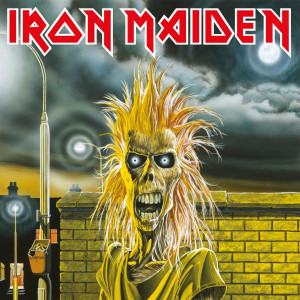
576. Iron Maiden / Iron Maiden. 1980. 5/5
The rise to prominence of Iron Maiden throughout 1978 and 1979 had been on the back of hard work, helpful promotion from Neal Kay and his venue and the acquisition of Rod Smallwood and Andy Taylor as managers of the band. The demo tape that the band had first recorded at Spaceward Studios on New Years Eve 1978 saw them gain fandom at Neal Kay’s Bandwagon, and further high-profile gigs on the back of the rise of the NWOBHM movement that was washing over the land. Then came the decision to release their demo as a self-release album, which became the legendary “The Soundhouse Tapes”. The band’s signing with EMI left them in a position where they could now go into the studio and record their debut album, something that both the band and their fans had been waiting what felt like a lifetime for.
Before that could happen, two personnel problems had to be taken care of. Up to this point in time of the band’s history there had been a consistent problem in finding permanent members to fill the second guitarist and rummer positions. In terms of the second guitarist to complement established member Dave Murray, the band was once again in a position that they needed to find one for the recording of the album.
In Mick Wall’s contemporaneous “Run to the Hills – The Authorised Biography of Iron Maiden” he wrote: “Maiden had recorded the Radio 1 session still as a four-piece. Now, with EMI in a hurry to get the band into the studio to begin recording their first album, the need to fill the vacancy for a second guitarist was more pressing than ever. "We could have easily done the album as a four-piece," says Steve, "but that was never the idea. We were always looking to be a band that had twin lead guitars, so we thought, 'Right, now we've got a deal we've just got to get this sorted.'" At first, they actually offered the job to Dave Murray's old Urchin sparring partner, Adrian Smith, but Urchin had just landed a deal themselves, and Adrian was loath to abandon his plans just as it seemed his band might be getting somewhere themselves. Instead, they placed an ad in Melody Maker, which read, in part, "Must be HMfreak. Twenty-two or under." Dennis Stratton, another long-haired East End musician who was, in truth, neither of these things, applied anyway and was "pleased, but rather surprised" to get offered the job”.
Stratton’s appointment may well have come through the desire of a musician with good standing and solid chops than anything else, especially when it was coming to record their first album. The problems that came with his rather swift demise from the band following the tour to support this album would be discovered from this point onwards.
The drumming problem was one of a different concern. Doug Sampson was a good drummer and was well established in the band. However, his health had been a concern, perhaps more so for Steve Harris and Rod Smallwood than Doug himself. There were concerns that he would not be able to survive the long and hard touring that was being planned to promote the album. It was with this in mind that Sampson was relieved of his duties. Though he was no doubt immensely disappointed at this decision, in interviews since he has admitted that it was probably the right move for all concerned. That would not have been much consolation as he watched the band explode over the next few years.
Now a new drummer had to come on board. Back to Mick Wall and his excellent biography. He wrote:
According to the received wisdom of the time, Clive Burr had been brought to Steve Harris' attention by the all-knowing Neal Kay, who had spotted the future Maiden drummer during his short tenure with their London NWOBHM rivals Samson. Steve, on the other hand, now claims that "we got Clive through auditions. We auditioned a few people. One bloke I'd seen who was really good was John Mylett, who had been in a band called Nutz, who were quite well known for a time in the '70s, before the punk thing came in and blew them away. Then later he joined another band who became quite well known as Rage. And it was between him and Clive, basically. In fact, John may even have been a better drummer, technically, than Clive, but in the end we gave it to Clive because he had this certain feel to his playing that felt right, and he was a nice bloke. Clive just had a certain something about him we liked, you know? And he was also from 'round our area as well, a West Ham supporter, so that sort of helped as well”.
For his part, Rod Smallwood confirmed later that Dennis Stratton had in fact tipped him off about Clive in the first place.
And so, the five members of Iron Maiden was now set – for this moment in time at least – and all that remained was to head into the studio and lay down the eight tracks that would become the legend that is the debut album from Iron Maiden, titled “Iron Maiden”.
In the years since, many of those both in the band and around the band have decried the production on this album, and suggested that it eventually harms the way that they view (metaphorically) this album. Legendary producer Martin Birch, who would eventually be the main man for the next decade of Iron Maiden albums, has said he was surprised that he wasn’t asked to do the job, though given he was at that time doing that same job on another little album called “Heaven and Hell” by another little known band called “Black Sabbath”, it seems he would have been unavailable anyway. Finding the right producer proved to be a problem. The first was dismissed because the band disliked the muddy quality produced. The second insisted that Steve Harris play with a pick, and soon found himself in the same dustbin outside the studio. The third, Will Malone, still seemed to be unable to get the sound that the band wanted. While everyone involved would have preferred a better sound, in many ways it is the production that allows it to retain its charm and greatness. Certainly, the album is tied to the era because of its sound, but that just makes the actual songs and music even more powerful, because it is so easy to hear how far ahead of their contemporaries they actually were by the riffs and rolls that they played. Better production may have increased that, but the reality is that everything here still holds up against everything in the past 45 years, and that this album is still unique as it is.
It was only natural that the band would open up their debut album with the song that was their first big hit and had drawn them the huge support they had initially received over the previous 18 months. “Prowler” was a hit in London pubs for a year before this album actually came out, having been a part of the original demo that had been pushed by people like Neal Kay, and had also appeared on the bands self-published “The Soundhouse Tapes”. It immediately puts forward Maiden’s main strengths – the twin guitars, one playing the rhythm and the other putting out a lead track, the underrated drum beat that holds them together, the bass line that dominates more than almost every other bass guitarist in history, and the vocals that were not classical hard rock, not punk, but a very complementary fusing of the two. In particular, Steve Harris’ bass line and Dave Murray’s lead guitaring are immediately at the forefront and shown to be the dominating influence of the band. The middle solo section of the track is still so fresh and bright and powerful, 45 years after this was recorded. That explosion of Dave’s guitar into the solo is still spine tingling stuff. Lyrically “Prowler” is suggestive in an unserious way, vocally descriptive rather than being lurid. This album has three songs of this ‘pub band’ narrative that tie this album to the era it was recorded in a lyrical aspect. Musically, it sets its bar far higher than that explanation.
There are a few songs on this album that reach the ‘outstanding’ level, especially for a band on their debut album, and because they break the mould of the music the band is expected to play. The first is one where the band’s versatility becomes obvious, the second song on the album, “Remember Tomorrow”. You come out of the opening track with its imagery and speed and driving guitars and drums... and then you hit the moody opening of the second track, of the bass line and moody guitar slowly and softly over the top. Then the entrance of the drum beat, but more importantly the vocals of Paul Di’Anno which prove he is not a one trick pony. He might have been belligerent on that opening song, but here he proves he can soar with the best of them, and then explode out of that when it becomes necessary. The same can be said of the whole band, they show here that they can combine the slower tempo melodic style and the fast tempo heavy timings, and within the same track. The explosion into the dual lead solo breaks through the middle of the track exemplify what everyone looks for in Iron Maiden, but the bookends of the track are what raises this to the highest levels of Iron Maiden songs. Lyrically and vocally it places itself in a different category from the majority of the songs here, a path that would be better worn over the future album releases. Musically it is in the higher echelon of what the band has produced. This is one of three songs here that lifts the album above the average and surely was what made people think “this Iron Maiden isn’t your average pub band”. Try and convince me Metallica didn’t have this song in mind when they wrote “Fade to Black”. This kind of change in song orientation was to become one of the hallmarks of Iron Maiden.
“Running Free” was already the pub anthem that became the stadium anthem by the time this album was recorded. In the same way that “Prowler” has lyrics that are very stylistic of the content that bands would base their songs around as they moved their way up through the club scene, “Running Free” has similar connotations of the protagonist having “all the boys are after me, and that’s the way it’s gonna be!”. The opening of that terrific head banging-type of bass line from Harris and drum beat from Clive, followed by the ‘boy on the town’ lyrics and catchy sing-along chorus makes it a natural for the pub environment, and eventually the stadium environment. All bands need an anthem, a song that they can get the crowd involved with, and this was Maiden’s from the get-go.
What comes next is the song that no one was doing, because it was just so far in advance of what heavy metal was at that point that Iron Maiden was still inventing it. It may have the progressive tendencies of bands such as Rush and even the band’s heroes in Deep Purple and Wishbone Ash, but this was another level. “Phantom of the Opera” is a quintessential classic, a song that had no right to have been written or recorded at that time. Steve Harris wrote a bass line that began matching twin guitar riffs, played it like a guitar, but with his fingers on a bass guitar. It is one of his most extraordinary efforts. Along with Clive Burr’s superb drumming that almost began matching the guitars in the same way, and with lyrics that began a tradition in the band, written about movies and books, this song is one of the most complete heavy metal songs ever written, and it was one of this band’s first released. Most would consider this to be one of the top ten Maiden songs. I certainly do. Can you Imagine seeing this song being performed at the Ruskin Arms or the Cart and Horses in 1979. How would you have been able to process that? That a pub band was playing a song that has this amazing complexity in the composition and performing of this track?! If anything gave heavy metal the kick in the backside it needed, it was this song. Put it up against any other song from any other band of the NWOBHM era, and there is no contest. This is what set Iron Maiden apart from every other band of that era, and why they were able to spring from the pack to become the band they are. Paul’s singing on this song is amazing, he almost acts as the Phantom himself. And the solo section again, not only the melodic harmony guitars and their individual solo’s, but Steve’s bassline underneath throughout is just the pinnacle of bass guitaring. Steve has often said since this album was released that he was so disappointed with the production and mixing, and I have always wondered if it is this song he is most referring to. Because when you hear it performed live on the “Live After Death” album, and you can actually hear fully what Harry is doing on his instrument during that song, it is quite incredible. The production here doesn’t quite allow it to shine like it does on that live version. But my word it is still an amazing song.
Flip the album over, and let’s start side two and see what we have. It opens up with the wonderfully fast tempoed instrumental “Transylvania” which is another perfect example of how excellent the musicians in this band are. Making instrumentals interesting and listenable is not an easy thing, but it is something that Iron Maiden made a habit of on their first few albums. It is played at the perfect pace, given side two the opening momentum it needs to continue how side one finished up. Going back to another Metallica reference, surely, they were driven to perform their own instrumental tracks on their albums by how good the ones that Iron Maiden produced on these early albums were. It is a ripping track, even into the conclusion when it dies slowly and quietly into the ether, only to segue perfectly and almost unnoticeably into “Strange World”. And what a song this is, the third of the three ‘outstanding’ level songs on this album, the ones that showcase the extremities of this band’s talent and ability to mix full fury heavy metal metallics with the melodic and softer-spoken pieces that retain all of the energy and power in a different habitat. Like “Remember Tomorrow” it showcases Paul’s ability as a vocalist to bring this kind of performance to his artform and retain his uniqueness in vocal quality. The structure of the song itself allows Paul’s vocals to emote the passion of the track, the guitars to be a punctuating point of difference when needed, and Steve Harris’s amazing wandering bass line that is probably the highlight of the song. Clive Burr's perfect toning on the drums is also so important in drawing it all together. Not many metal bands can pull off a song like this without compromising the principles of their music. “Strange World” is an absolute triumph in that respect.
Speed returns to the album with the first of the “Charlotte the Harlot” themed Iron Maiden tracks, and therefore not surprisingly entitled “Charlotte the Harlot”. It is the only song for which guitarist Dave Murray is solely credited for as a writer, and he is adamant that it is based n a real person and real events, though not him. Ok Dave. Here is the third song on the album that is written as a boy’s pub band anthem with lyrics that have been described in certain areas as childish and inappropriate. If you want to feel that way, then by all means do so. What you have missed is the story of the song, told in scintillating style with searing guitar riff and solo, hard core drums and bass thumping, and Di’anno’s vocals joyously bounding along with fist pumping and middle finger raised. It is still catchy as hell, a great singalong song, and after a few beers while listening to the album I defy you to try and not do the same. The album then concludes with the self-titled track, one that the band must have now played a billion times. Naming your band after a medieval torture device is one thing, writing a song about it is another. History, blood and heavy metal. Is it the perfect combnation to making a great song? Iron Maiden would use this basis for proving the theory for the next 45 years and counting. It still counts as a superb Iron Maiden song, the opening dual guitar riff into the bass and drums before Di’anno begins his vocals is still fantastic.
45 years is an amazing length of time, not only to find that an album can still stand up in the modern age, and to realise what the band has done since then, but to then realise what you as an individual have done in that time, and how long this album has been a part of your life. And that people are still drawing inspiration from this album even today. That longevity is not something that you can find in every debut album released. This however is one of them.
My story of the discovery of Iron Maiden has been well documented in several different epsiodes on a couple of different podcasts, so suffice to say that the concluding months of 1985 were an exciting time for me. Having acquired the three major releases of 1982, 1983 and 1985 and devoured them to the point of assimilation, it came time to find out what came next for the band that I had become slightly obsessed over. My heavy metal music dealer was happy to come to the party (or perhaps he wasn’t, I did ask a hell of a lot of him over those couple of years) and was able to fill the C60 cassette I offered him with the debut album from the band, along with the “Maiden Japan” live EP. It was at the same or similar time that he also taped me the “Killers” album, and so for me it was my introduction to Paul Di’anno as lead vocalist, coming after I had gorged out on the first three albums that had Bruce Dickinson in the same role.
Perhaps interestingly, as much as I still enjoyed this album, it wasn’t one I went to very often at that time. This was at the beginning of my incredible discovery fest of heavy metal, and I was really trying to grab everything that came in my vicinity and check it out. Having had a gorging of Iron Maiden for 3 months or so, I guess something had to eventually take a back seat, and it ended up with this album being one of them. Like I said, it wasn’t because I didn’t enjoy it. I really did. I just didn’t go to it as often as I was other albums. I actually began to listen to the album more when I finally got my vinyl copy of the album, later on in 1986.
Despite what has been said about the production of the album, it has never bothered me and my enjoyment of the album. As I mentioned earlier, it sounds like the albums from these NWOBHM bands that were coming through at this time of the era, and the songs on this album still jump off the vinyl compared to almost every other band of that era. The sheer energy and enthusiasm of the performance, and the glittering star quality of the writing, just burns like a supernova in comparison to the competition. The ability to combine the twin guitar harmonies into the heavy focused music and yet still perform tracks that show a melodic structure without losing focus of the band they are is truly remarkable. And to do all of that on their first album is an astounding feat. And every time you watch the movie “Bill & Ted’s Excellent Adventure”, and you hear the line “Put them in the Iron Maiden”, followed up by our heroes pronouncing “Iron Maiden! Excellent!”, you know that this album has succeeded on so many levels.
I’ve had this album back on the turntable now for two weeks – and how bloody good is it?! Honestly, it sounds better on vinyl and always has. I come home from work, talk to the wife, then retreat to the Metal Cavern, and put the needle to the vinyl and away we go. And it still sounds so amazing and so fresh. Everything about it is pure. The boys at the pub songs, the contemplative melodic songs, the bombastic songs, and then just “Phantom of the Opera” towering above them all. For me this album has never gotten old. It just continues to shine in all possible ways in all possible directions. Over the course of Iron Maiden’s 17 studio albums released over 45 years, I have most recently ranked this as my tenth favourite. This is not reflective of the quality of the album; indeed, it reflects just how strong the band’s material has been since they released this album.
As amazing as this album is and was, the strength of the band was about to increase. Martin Birch was about to come on board as the band’s producer, ensuring that every album for the next decade was perfectly presented to the listening public and had the best possible performances drawn from the band’s performers. And with Dennis Stratton moving aside because his musical preferences did not match that of the rest of the band, it left the door open for the man the band originally wanted for the position to come on board and provide his excellence into the music that was beginning to bloom. That of course is a story for another episode.
Wednesday, April 07, 2010
575. Scorpions / Sting in the Tail. 2010. 3/5
There has probably been more publicity surrounding the fact that this album apparently signals the final act for the Scorpions as a band than anything else, and perhaps it is this smoke screen that is being used to hide the fact that it has some failings.
The announcement that this would be the band’s final album, hoping to ‘retire’ while still at the top of their game, certainly drew some interest from me. However, I was more interested to see how they would follow up their finest album in almost 30 years, 2007’s Humanity: Hour 1.
Following on from the breaking of the Scorpions mould on their last album, this is a follow up that plays it straight down the line in order to try and keep all their fans of all genres happy, and in the process really not making anyone excited. The opening songs prove to be very much in the role of their typical nineties stuff, in a hard rock mode but without the great anthems that they flooded us with during the 1980's. "Raised on Rock", "Sting in the Tail", "No Limit" and "Rock Zone" leave you in no doubt that the band is trying to reinvest their past sound into their current music. There are also the typical Scorpions power ballads, which, I must say, don't quite hit the mark this time around.
In fact, the whole album is just off the track, and in trying to tie down what it is that just doesn't make it for me, I can come to a couple of conclusions - it is a very generic album, and it’s obvious that the band has played it very safe in the writing process. Being their final release, they have obviously gone out and tried to capture both lyrically and musically the best and most successful of their past, and recreate it here as a fitting finale for themselves and their fans. Though I hesitate to use the word, some of it is quite boring because of that, and in essence brings to the table the kind of emotion they were inevitably trying to prevent.
It's not a bad album, but it won't be memorable for the music, but only because (at this point) it will be their final release.
If they had announced that they were calling it a day after Humanity: Hour 1 I would have kicked up a stink, suggesting that they still had plenty left in the tank. Having now listened to Sting in the Tail a dozen times, I can honestly suggest that the band gets out and does a farewell World Tour – including coming to Australia, because we've only been waiting 30+ years – and then take a well earned rest, because maybe the bottom of the well is in sight.
Subscribe to:
Posts (Atom)