Overall, Van Halen had come away from the split with former lead vocalist David Lee Roth in a strong position. After the commercial success of the album “1984” with Roth on vocals, there was doubt over whether they could reproduce that success with Sammy Hagar coming in. That was laid to rest by the release of “5150”, which was full of chart busting singles and the same kind of hard rock guitar infused with the increasing keyboard and synth that “1984” had introduced, while Hagar’s vocals were a great match for what the band was producing.
Following the tour to support that album, the writing for the next album began soon after, with both Eddie and Sammy already inundated with ideas to progress with. Prior to the album being released, there was a lot of speculation as to how the band would progress musically on their second album with this line-up. DLR’s second solo album “Skyscraper” was released at the start of 1988, the episode of which you can find in this season of Music from a Lifetime, and it had shown a slight change in style from his first. And many wondered just where Van Halen would go with their new album, and whether Sammy Hagar would be an influence in its direction musically, or whether the musical direction that Eddie had taken over the previous two albums would continue to evolve in the same way. Long time fans of the band were looking for a return to a more guitar oriented theme much like their early work, where Eddie’s guitar dominated, rather than where the synths of the 1980’s did so. Prior to its release, this album was surrounded by theories and speculation, much of which perhaps ended up being problematic for the fans when the album finally saw the light of day.
“Mine All Mine” opens the album perfectly, a rocking Van Halen song at the right tempo, slotted with keyboards that dominate in a way they had for the band’s past two albums, and vocals that, at times, I often mistake for David Lee Roth at the beginning of the song, before it becomes obvious that it is still Sammy Hagar at the helm. Eddie’s solo here also revives the better attributes of the band as well.
In many ways, personally at least, I think “When It’s Love” is a poor choice as the follow up song. It’s the epitome of the Van Hagar rock ballad, and of course it did great business on the charts when released, but for me it stops the album in its tracks at the first hurdle. And, in many ways, it never really recovers. Of course, all of those millions of fans out there who love the song would disagree.
The middle trilogy of “AFU (Naturally Wired)”, “Cabo Wabo” and “Source of Infection” have a much sound about them, Eddie’s guitar and Sammy’s wailing with that great hard rock rhythm of Alex Van Halen and Michael Anthony. “Cabo Wabo” has a slower groove than the other two but fits in nicely. “Source of Infection” again could have been DLR singing such is the way the track is sung and creates the backing vocals the way the band used to.
Three songs released as singles follow this into the back half of the album, and as a result the real energy of the album gets misplaced. “Feels So Good” has almost church-organ keyboards throughout, only building with Eddie’s solo by the end of the song. “Finish What Ya Started” is a semi-acoustic tome that for many fans is a bonafide great song, but for me pretty much just stalls the album again, while “Black and Blue” is the more energetic of the three tracks.
“Sucker in a 3 Piece” is the concluding track on the album, unless you have the CD (which I guess would be the majority of album owners out there) which has a cover of the blues track “A Apolitical Blues” which, really, does nothing for me. It’s a strange one to have included to be honest, but along with some of the decision making on this album, perhaps it actually fits alongside that.
I never jumped out and bought this album. There was a lot of other albums at the time that were dominating my listening (and the severe lack of cash meant I couldn’t just buy every album I wanted in those uni days), and so for some time I only had the singles released from the album as my guide, which can sometimes be good and other times be average. It would be fair to say that in this case the singles coloured my feelings of the album. Once I started to listen to the album it was those songs that I heard the most, and for me it probably harmed the way I felt about the album.
Over the years, I wouldn’t say that my opinion of the album has changed much. And like I mentioned in the intro, for me this was a real line in the sand album. There is stuff I like enough here, and on the albums that followed, but none of them for me ever compared to those that came pre-1987. And that was never a nostalgia thing either, it was just that the band turned the dial away from the style of music they had always done to this point, and found the next station on the dial. None of it felt like a reaction to what was happening in music at the time, it honestly just felt that it was the direction this group of four was looking to diverge into. For me, I wasn’t completely invested in that direction.
I’ve spent the past two to three weeks listening to the album again in preparation for this episode, and my feelings on the album remain the same as they have for 35 years. I’ve put it on, and it almost immediately went into the background for me as I did whatever else I was doing at the time. At no time did it dominate, or demand that I sing along or stop what I was doing because it was awesome. An average album, without the hooks necessary to truly become a big hitter in my music collection.
One middle-aged headbanger goes where no man has gone before. This is an attempt to listen to and review every album I own, from A to Z. This could take a lifetime...
Podcast - Latest Episode
Saturday, May 20, 2023
Tuesday, May 16, 2023
1203. Iron Maiden / Piece of Mind. 1983. 5/5
Iron Maiden’s popularity had exploded worldwide with the release of their third studio album “The Number of the Beast”, and the success of the lead single from that album “Run to the Hills”. The story of that album can be found in an episode of this podcast back in Season 2 if you are interested in reliving the story that came with it.
Once the touring schedule for that album had been completed, the band could concentrate on the writing session for their follow up, something that was going to be a tough ask. The first part of that puzzle had already occurred by this point. Drummer Clive Burr, who had been a staple of the first three albums, had been let go by the band after he had taken a short leave of absence due to the death of his father. Filling in for him while he was away was drummer of the band Trust, Nicko McBrain. On Burr’s return, a meeting occurred where the band had decided that they needed to move in a different direction. What brought this on? There is no definitive answer to this. Several reports at the time suggested it was drugs and alcohol that had caused the separation, but more reliable quotes suggest that Clive and band leader Steve Harris had had too many disagreements and Steve’s patience had run out. Clive was quoted in “Classic Rock” magazine two years before his sad demise from multiple Sclerosis as saying - “Steve used to say I played the songs too fast, he was always telling me to slow down. My abiding memory of recording “The Number Of The Beast” album is Steve telling me to slow down.” There were odd spats, he says, but nothing major, nothing serious. Bruce Dickinson in his autobiography says he felt Clive’s dismissal came from personality conflicts with Steve, but that he had always wished he had been able to stay longer, as his drumming was his favourite of Maiden’s drummers. Without knowing anything for certain, it appears from the outside that when Nicko came in for Clive for those shows, something clicked for Steve Harris and he decided that it was this style of drumming the band needed, and he made that decision to fire Clive and hire Nicko full time. Nicko, of course, has been Iron Maiden’s drummer ever since.
The other major change for this album was that Bruce Dickinson was now officially able to contribute to the writing process. Because of contractual problems with his previous band Samson, Bruce was legally unable to be credited on any of that album’s songs, despite the fact that it was later revealed that he had made significant contributions to the songs "The Prisoner", "Children of the Damned" and "Run to the Hills". Now however he was free to be completely involved in the writing process and be credited for this. It gave the band an amazing set of songwriters in Steve Harris, Adrian Smith and Bruce Dickinson, who were able to write songs on their own but also with each other, something that began to create the amazing template for the Iron Maiden albums of the 1980’s. With Dave Murray also offering his one or two contributions per album, it truly made the band a full unit on the writing front.
When it came ot the writing and recording, the band left UK soil to do both. The writing for the album took place off the coast of France in Jersey in January of 1983, before they moved to the Bahamas to complete that job and then also record the album.
One of the interesting parts about this part of Iron Maiden’s career was the controversy that had come with their previous album and the branding of the band as satanists and devil worshippers as a result. Despite the ridiculousness of those claims, mostly from the conservative religious elements in the US, the band was somewhat branded in some places as a result. On this album, they decided to fight back. In an interlude directly preceding the track “Still Life”, there is an incomprehensible recording, which for all money sounds like it is backwards masking. As it turns out, that is exactly what it is. In order to put the wind up the kind of people who like to protest about ‘this kind of thing happening’ on albums, the band actually recorded Nicko saying "What ho said the t'ing with the three 'bonce', don't meddle with things you don't understand...", and then put it on the album backwards, no doubt driving those that like to protest about this kind of thing mad. And, let’s face it, could there ever be a better way to fight back against that kind of simple thinking than doing exactly this?
There are many elements that still make this a great album. First off, the writing and inspiration of the tracks. For me, I think it is a terrific thing to have so many songs here inspired by stories, either in the written form in the shape of books or poems or short stories, or by movies and the stories told in that art form. And that’s what helps make the songs interesting even 40 years later, because the stories are still there to be told and heard. And then you have the music itself, and the highly developed way it has progressed since their first album just three years previous. Yes, the drums are different because of the change of drummer, that is to be expected. And Nicko is spectacular on this album. But the guitars and the melodic trade off between Adrian and Dave throughout are immense. The switching of solos, the harmony guitars when used, and the amazing rhythm riffs are even more intense and perfectly constructed that they were even on “The Number of the Beast”. And that galloping bass guitar of Steve Harris that is completely unique in metal at the time. All of it combines here to make an unreal album.
And in some places it is just the small things that make it so amazing. The machine guns in the album opener “Where Eagles Dare” are actually just Nicko on his hi-hats. His amazing fills that flesh out the song so much but are often overlooked when it comes to the brilliance of the track itself. Even if you haven’t seen the film that the song is based on, you can almost see it occurring before you anyway as you listen to the song. And Bruce’s vocals lines, into that final high pitches scream at the end of the song is just shivers down the spine stuff. So much air guitaring goes on while this song is played. It is one of the great album openers of all time. This is followed by Bruce’s amazing “Revelations”, which swings between the faster and heavier to the moody and thoughtful, the power of the track being in his own incomparable vocals. His lyrics here, combined from several sources and focusing especially on the writings of Aleister Crowley, are mesmerising, and beautifully expressed.
Many people remained surprised that “Flight of Icarus” was released as the first single from the album, but given its length made it radio friendly, and the verse-chorus-verse-chorus-chorus composition also gave it that radio friendly appeal, perhaps in the long run it was not. Of course, it proved a hit in the US where it reached number 8, so the question is probably moot. Based around the Greek mythology story of Icarus it proved a hit to those who studied ancient history in high school. Side One of the album then concludes with the galloping joy of “Die With Your Boots On”, based on the story of Nostradamus and his visions that many believe foretold the future. Beyond that though, two great guitar solos and that superb bass guitar from Steve Harris drive the song along at the perfect clip and make it one of the best, most underrated Iron Maiden songs in their catalogue.
“The Trooper” is still regarded by most fans as the band’s greatest ever song. Everything about it seems iconic. The cover to the single, the second and final single released from the album, which of course then sold in the millions on T-shirts and posters. The sight of Eddie coming at you with the tattered Union Jack and the sword in his other hand is still one of the most decorated in music history. The amazing combination of the twin guitars on this song is unparalleled, with both Adrian and Dave producing an amazing performance. What makes the song so unique though is the fact that it tells the story of the Charge of the Light Brigade, one of the most famous battles of the Crimean War, and the galloping of Steve Harris’s bass guitar correlates perfectly to the sound of galloping horses, becoming the most iconic of songs as a result. And the sight of Bruce Dickinson standing astride on stage in both the music video for the song, and every night they play it live on stage, completes what is the perfect storm in heavy metal music. 40 years on, it has lost none of its power and standing in the metal world.
“Still Life”, preceded by Nicko’s reverse warning, is another of Maiden’s most underrated songs, and as Dave Murray’s sole co-written track again proves that less can be more. This is a beautifully moody yet melodically heavy track, that builds and wanes perfectly, lulling you into its spell before crashing into the main crunching riff and Bruce’s mood-changing vocals. It is an awesome song, one of my all time favourites with two perfectly played solos again through the middle of the song.
“Quest for Fire”, on the other hand, often gets short shrift when discussed by fans and critics alike. Unlike the other songs here, it seems a fairly simple one, with the only real outstanding feature being Steve basslines, especially through the chorus. Perhaps that is so, and it seems unlikely that anyone would ever put “Quest for Fire” on a pedestal. But to be honest, it never bothered me in the slightest growing up with the album, or now. It is part of the furniture, a song that is a part of Piece of Mind, and that is all that has ever mattered to me. But it is interesting that “Quest for Fire” is often paired up with “Sun and Steel” as being the weak links of the album, and I say interesting because I freaking LOVE “Sun and Steel”. Similar in what many call a ‘simple’ style, I love Bruce’s harmony vocals through the chorus, the melodic guitars especially in the solos, and Bruce’s climbing vocals at the end of the song. I still love it.
What is surely not in dispute is the awesomeness of the album’s closing track, “To Tame a Land”. Based on the novel “Dune” by Frank Herbert, "To Tame a Land" was meant to be called "Dune". They sought permission from Herbert’s agents to do so (much as they had done with Patrick McGoohan for “The Prisoner” on the previous album) but apparently the message they got back as quoted as such - "Frank Herbert doesn't like rock bands, particularly heavy rock bands, and especially bands like Iron Maiden". Thus this epic track is called “To Tame a Land” which to be honest is a much better sounding name for a song of this stature than “Dune”. It is one of Maiden’s most elaborately brilliant songs, amazingly sung by Bruce Dickinson, and then performed by the band itself. Nicko’s drumming is superb and also helps to dictate the mood of the track which is quite a feat for a drummer on this scale. Much like the opening track, even if you don’t know “Dune”, the song paints its own picture and allows you to see everything that the band wants you to see. And it also dictates to you once it has finished that you must turn the album over, and start it all over again.
You may have guessed by now that “Piece of Mind” is an album that I think pretty highly of. I didn’t actually hear the album until the final weeks of 1985, some two and a half years after it had been released. It was the very start of my journey into the love and obsession with the heavy metal genre of music. The previous week I had been handed a cassette with Iron Maiden’s next album, “Powerslave” recorded on it, and then my impatience for new material in this genre was curbed slightly by my heavy metal music dealer providing me with a copy of this album as well. And I began listening to both albums in the two weeks that led up to Xmas that year. Perhaps surprisingly, one song began to stick in my mind, and I began to play it over and over until I had all the lyrics right. That song was “Flight of Icarus”, and it became the song that truly got me into Iron Maiden. From there, the remainder of the album came along for the ride, first with “Die with Your Boots On” and of course “The Trooper”, which soon outstripped “Flight of Icarus” and became the anthem of my final two years of high school. I walked our school cross country the following year with my metal dealer, singing the whole album from start to finish to pass the time, playing each guitar solo on beautifully immaculate air guitars. I began bringing my portable cassette deck to school, so we could listen to this album and others like it during lunch and recess every day. My taped version had “The Trooper” where it jumped a couple of times – in fact, all of us in our group at high school did, because our same metal dealing mate was recording his album for everyone, and his vinyl jumped in the same spot every time. In fact, until we got “Live After Death”, we didn’t even have a copy of the song that was the full version without skipping. That was the joy and bane of the vinyl days of music. The band we were in during the early 1990’s played “The Trooper” in every setlist, and even began to play “Still Life” to rapturous applause during the concluding days of that band’s existence. I have “The Trooper” poster, framed and hanging on my wall in the Metal Cavern. And my 15 year old son Josh has one on his wall as well.
By the time I’d returned to school at the beginning of 1986, I was hooked, an addict. Iron Maiden was a drug, and this album was the affinity of it. It was the beginning of a journey for me, one that in 1986 included Iron Maiden, and the discovery of Metallica and Ronnie James Dio, the three artists that for me have defined a major portion of my teenage years, and my post-teens life. And for those last 30 years, if I was ever asked what my favourite albums of all time are, I can still confidently narrow down as my top three of all time. A Metallica one with crosses all over the front cover, an album that has a pyramid emblazoned on its front cover, and “Piece of Mind”. Come at me with suggestions that you think might be better. You’d be wrong.
Once the touring schedule for that album had been completed, the band could concentrate on the writing session for their follow up, something that was going to be a tough ask. The first part of that puzzle had already occurred by this point. Drummer Clive Burr, who had been a staple of the first three albums, had been let go by the band after he had taken a short leave of absence due to the death of his father. Filling in for him while he was away was drummer of the band Trust, Nicko McBrain. On Burr’s return, a meeting occurred where the band had decided that they needed to move in a different direction. What brought this on? There is no definitive answer to this. Several reports at the time suggested it was drugs and alcohol that had caused the separation, but more reliable quotes suggest that Clive and band leader Steve Harris had had too many disagreements and Steve’s patience had run out. Clive was quoted in “Classic Rock” magazine two years before his sad demise from multiple Sclerosis as saying - “Steve used to say I played the songs too fast, he was always telling me to slow down. My abiding memory of recording “The Number Of The Beast” album is Steve telling me to slow down.” There were odd spats, he says, but nothing major, nothing serious. Bruce Dickinson in his autobiography says he felt Clive’s dismissal came from personality conflicts with Steve, but that he had always wished he had been able to stay longer, as his drumming was his favourite of Maiden’s drummers. Without knowing anything for certain, it appears from the outside that when Nicko came in for Clive for those shows, something clicked for Steve Harris and he decided that it was this style of drumming the band needed, and he made that decision to fire Clive and hire Nicko full time. Nicko, of course, has been Iron Maiden’s drummer ever since.
The other major change for this album was that Bruce Dickinson was now officially able to contribute to the writing process. Because of contractual problems with his previous band Samson, Bruce was legally unable to be credited on any of that album’s songs, despite the fact that it was later revealed that he had made significant contributions to the songs "The Prisoner", "Children of the Damned" and "Run to the Hills". Now however he was free to be completely involved in the writing process and be credited for this. It gave the band an amazing set of songwriters in Steve Harris, Adrian Smith and Bruce Dickinson, who were able to write songs on their own but also with each other, something that began to create the amazing template for the Iron Maiden albums of the 1980’s. With Dave Murray also offering his one or two contributions per album, it truly made the band a full unit on the writing front.
When it came ot the writing and recording, the band left UK soil to do both. The writing for the album took place off the coast of France in Jersey in January of 1983, before they moved to the Bahamas to complete that job and then also record the album.
One of the interesting parts about this part of Iron Maiden’s career was the controversy that had come with their previous album and the branding of the band as satanists and devil worshippers as a result. Despite the ridiculousness of those claims, mostly from the conservative religious elements in the US, the band was somewhat branded in some places as a result. On this album, they decided to fight back. In an interlude directly preceding the track “Still Life”, there is an incomprehensible recording, which for all money sounds like it is backwards masking. As it turns out, that is exactly what it is. In order to put the wind up the kind of people who like to protest about ‘this kind of thing happening’ on albums, the band actually recorded Nicko saying "What ho said the t'ing with the three 'bonce', don't meddle with things you don't understand...", and then put it on the album backwards, no doubt driving those that like to protest about this kind of thing mad. And, let’s face it, could there ever be a better way to fight back against that kind of simple thinking than doing exactly this?
There are many elements that still make this a great album. First off, the writing and inspiration of the tracks. For me, I think it is a terrific thing to have so many songs here inspired by stories, either in the written form in the shape of books or poems or short stories, or by movies and the stories told in that art form. And that’s what helps make the songs interesting even 40 years later, because the stories are still there to be told and heard. And then you have the music itself, and the highly developed way it has progressed since their first album just three years previous. Yes, the drums are different because of the change of drummer, that is to be expected. And Nicko is spectacular on this album. But the guitars and the melodic trade off between Adrian and Dave throughout are immense. The switching of solos, the harmony guitars when used, and the amazing rhythm riffs are even more intense and perfectly constructed that they were even on “The Number of the Beast”. And that galloping bass guitar of Steve Harris that is completely unique in metal at the time. All of it combines here to make an unreal album.
And in some places it is just the small things that make it so amazing. The machine guns in the album opener “Where Eagles Dare” are actually just Nicko on his hi-hats. His amazing fills that flesh out the song so much but are often overlooked when it comes to the brilliance of the track itself. Even if you haven’t seen the film that the song is based on, you can almost see it occurring before you anyway as you listen to the song. And Bruce’s vocals lines, into that final high pitches scream at the end of the song is just shivers down the spine stuff. So much air guitaring goes on while this song is played. It is one of the great album openers of all time. This is followed by Bruce’s amazing “Revelations”, which swings between the faster and heavier to the moody and thoughtful, the power of the track being in his own incomparable vocals. His lyrics here, combined from several sources and focusing especially on the writings of Aleister Crowley, are mesmerising, and beautifully expressed.
Many people remained surprised that “Flight of Icarus” was released as the first single from the album, but given its length made it radio friendly, and the verse-chorus-verse-chorus-chorus composition also gave it that radio friendly appeal, perhaps in the long run it was not. Of course, it proved a hit in the US where it reached number 8, so the question is probably moot. Based around the Greek mythology story of Icarus it proved a hit to those who studied ancient history in high school. Side One of the album then concludes with the galloping joy of “Die With Your Boots On”, based on the story of Nostradamus and his visions that many believe foretold the future. Beyond that though, two great guitar solos and that superb bass guitar from Steve Harris drive the song along at the perfect clip and make it one of the best, most underrated Iron Maiden songs in their catalogue.
“The Trooper” is still regarded by most fans as the band’s greatest ever song. Everything about it seems iconic. The cover to the single, the second and final single released from the album, which of course then sold in the millions on T-shirts and posters. The sight of Eddie coming at you with the tattered Union Jack and the sword in his other hand is still one of the most decorated in music history. The amazing combination of the twin guitars on this song is unparalleled, with both Adrian and Dave producing an amazing performance. What makes the song so unique though is the fact that it tells the story of the Charge of the Light Brigade, one of the most famous battles of the Crimean War, and the galloping of Steve Harris’s bass guitar correlates perfectly to the sound of galloping horses, becoming the most iconic of songs as a result. And the sight of Bruce Dickinson standing astride on stage in both the music video for the song, and every night they play it live on stage, completes what is the perfect storm in heavy metal music. 40 years on, it has lost none of its power and standing in the metal world.
“Still Life”, preceded by Nicko’s reverse warning, is another of Maiden’s most underrated songs, and as Dave Murray’s sole co-written track again proves that less can be more. This is a beautifully moody yet melodically heavy track, that builds and wanes perfectly, lulling you into its spell before crashing into the main crunching riff and Bruce’s mood-changing vocals. It is an awesome song, one of my all time favourites with two perfectly played solos again through the middle of the song.
“Quest for Fire”, on the other hand, often gets short shrift when discussed by fans and critics alike. Unlike the other songs here, it seems a fairly simple one, with the only real outstanding feature being Steve basslines, especially through the chorus. Perhaps that is so, and it seems unlikely that anyone would ever put “Quest for Fire” on a pedestal. But to be honest, it never bothered me in the slightest growing up with the album, or now. It is part of the furniture, a song that is a part of Piece of Mind, and that is all that has ever mattered to me. But it is interesting that “Quest for Fire” is often paired up with “Sun and Steel” as being the weak links of the album, and I say interesting because I freaking LOVE “Sun and Steel”. Similar in what many call a ‘simple’ style, I love Bruce’s harmony vocals through the chorus, the melodic guitars especially in the solos, and Bruce’s climbing vocals at the end of the song. I still love it.
What is surely not in dispute is the awesomeness of the album’s closing track, “To Tame a Land”. Based on the novel “Dune” by Frank Herbert, "To Tame a Land" was meant to be called "Dune". They sought permission from Herbert’s agents to do so (much as they had done with Patrick McGoohan for “The Prisoner” on the previous album) but apparently the message they got back as quoted as such - "Frank Herbert doesn't like rock bands, particularly heavy rock bands, and especially bands like Iron Maiden". Thus this epic track is called “To Tame a Land” which to be honest is a much better sounding name for a song of this stature than “Dune”. It is one of Maiden’s most elaborately brilliant songs, amazingly sung by Bruce Dickinson, and then performed by the band itself. Nicko’s drumming is superb and also helps to dictate the mood of the track which is quite a feat for a drummer on this scale. Much like the opening track, even if you don’t know “Dune”, the song paints its own picture and allows you to see everything that the band wants you to see. And it also dictates to you once it has finished that you must turn the album over, and start it all over again.
You may have guessed by now that “Piece of Mind” is an album that I think pretty highly of. I didn’t actually hear the album until the final weeks of 1985, some two and a half years after it had been released. It was the very start of my journey into the love and obsession with the heavy metal genre of music. The previous week I had been handed a cassette with Iron Maiden’s next album, “Powerslave” recorded on it, and then my impatience for new material in this genre was curbed slightly by my heavy metal music dealer providing me with a copy of this album as well. And I began listening to both albums in the two weeks that led up to Xmas that year. Perhaps surprisingly, one song began to stick in my mind, and I began to play it over and over until I had all the lyrics right. That song was “Flight of Icarus”, and it became the song that truly got me into Iron Maiden. From there, the remainder of the album came along for the ride, first with “Die with Your Boots On” and of course “The Trooper”, which soon outstripped “Flight of Icarus” and became the anthem of my final two years of high school. I walked our school cross country the following year with my metal dealer, singing the whole album from start to finish to pass the time, playing each guitar solo on beautifully immaculate air guitars. I began bringing my portable cassette deck to school, so we could listen to this album and others like it during lunch and recess every day. My taped version had “The Trooper” where it jumped a couple of times – in fact, all of us in our group at high school did, because our same metal dealing mate was recording his album for everyone, and his vinyl jumped in the same spot every time. In fact, until we got “Live After Death”, we didn’t even have a copy of the song that was the full version without skipping. That was the joy and bane of the vinyl days of music. The band we were in during the early 1990’s played “The Trooper” in every setlist, and even began to play “Still Life” to rapturous applause during the concluding days of that band’s existence. I have “The Trooper” poster, framed and hanging on my wall in the Metal Cavern. And my 15 year old son Josh has one on his wall as well.
By the time I’d returned to school at the beginning of 1986, I was hooked, an addict. Iron Maiden was a drug, and this album was the affinity of it. It was the beginning of a journey for me, one that in 1986 included Iron Maiden, and the discovery of Metallica and Ronnie James Dio, the three artists that for me have defined a major portion of my teenage years, and my post-teens life. And for those last 30 years, if I was ever asked what my favourite albums of all time are, I can still confidently narrow down as my top three of all time. A Metallica one with crosses all over the front cover, an album that has a pyramid emblazoned on its front cover, and “Piece of Mind”. Come at me with suggestions that you think might be better. You’d be wrong.
Friday, May 05, 2023
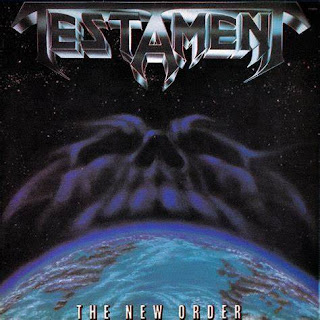
1202. Testament / The New Order. 1988. 4/5
With the release of their debut album “The Legacy” in 1987, an episode of which you can find in Season 2 of this podcast, Testament had stormed the US on coast-to-coast tours, blitzing through concerts and gigs and riding on the wave that was the thrash metal movement with their contemporaries Metallica, Megadeth, Slayer and Exodus. The success of the album and the subsequent touring meant that Testament was fast growing out of the support slot of touring and quickly becoming headliner material.
One thing the band hadn’t been aware of though was the terms of their contract with their recording company. They were still on tour promoting that debut album when they were informed that, in the terms of their agreement, they had to have a second album out, and pretty much within a year of that first album being released. As it was now January, that left them precious little time to write and record new material. The band had been doing some writing on tour, but now they found themselves under the pump and having to get what they had written up to speed, and then recorded as well.
Through January the band put down everything they had, and sent it off to their record company. However, the band still hadn’t completely read the terms under which they had been contracted, and an agreement stood that they had to have a minimum of 40 minutes of material on the album, and what they had submitted had come in under that, and somewhat significantly. With the album returned to the band in order to complete their dues, they decided to ‘fudge’ it a little. They added two instrumentals, they extended a few pieces in some of the songs to extend their length, and they recorded a cover version of the Aerosmith song “Nobody’s Fault”, all of which got the album to a length that was accepted by their bosses. It certainly wasn’t the best way of going about creating your sophomore album, but as always, the proof would be in the final product.
Without the pressures as described in the previous section in regards to the record companies demands, it is difficult to assess if this album would have been much different to what was eventually released. Obviously with more time the band may well have come up with better songs, or more songs of better material. I mean, I have no real problem with the version of “Nobody’s Fault” that they done here, and the instrumental features of “Hypnosis”, and “Musical Death (a Dirge)” which concludes the album is fine in their own way. But given some of the other absolute brilliant tracks that this album contains, I’ve often wondered what could have been achieved with more time and freedom than they had. Of course, perhaps this would also have inhibited the free rage and destruction that much of this album contains.
The way that the opening track “Eerie Inhabitants” kicks off has often made me wonder if it was influenced by the way songs like “Fight Fire with Fire” and “Battery” began those Metallica albums – with the quiet, unobtrusive, introspective start, that then kicks off into a blaze of guitar and crashing into the songs real beginning. Terrific. From here though we leap into the true awesomeness of this album. “The New Order” rips your head off, “Trial By Fire” again has an extended quieter guitar piece to start before launching into the song proper, and “Into the Pit” is exactly as you would imagine a song of this type to be like. These three songs show the amazing progress the band has made since their debut album, the heat and energy that comes with playing night after night on the road, and drawing in the joy and aggression of the crowds, and what THEY want from the band, which in this case is more heavier and faster guitars and powerful vocals and lyrics, along with guttural bass and driving drums. And all of that is showcased here, perfectly defining what Testament is all about at the start of their long journey.
With “Hypnosis” then acting as a break, the back half of the album creates more of the same, with “Disciples of the Watch” one of the best examples of Testament’s fury unleashed, before jumping into “The Preacher” and “A Day of Reckoning”. Like I said, the instrumental flurries that the band had to place on the album in order to get to their time constraints are fine, and they don’t' harm the album in any way, but there is little doubt that with a little more time, and the ability to add a couple more songs in instead of these breaks, it could have made this one of the all time classic thrash albums. Which, indeed, it actually is anyway.
As engrossed as I was with my burgeoning love of heavy metal at the time that this album was released, I didn’t actually get around to checking out Testament the band until the release of their album that followed this one, “Practice What You Preach”, before then grabbing “Souls of Black”, and off I went. To be honest, the exact timeline as to when I first heard and bought this album is a bit hazy, which my closest friends would have trouble believing. And yet it is true, the time I really heard this album is lost in the mists of time, which suggests it was probably either in the early 1990’s, or perhaps sometime in the late 1990’s. I don’t know. I’m sorry for everyone I’ve disappointed out there.
And much like with their debut album “The Legacy”, if only I’d had this at the time of its release, because I would have been screaming up the highway to uni, playing this at top volume and singing along, and it would have been awesome, because it is the perfect soundtrack for that part of life.
So beyond that, there isn’t much else to say. This period in thrash metal, with the kings of Metallica and Megadeth and Anthrax and Slayer, and the other bands like Exodus and Death Angel, was amazing times. And Testament stood head and shoulders with them, and this album is no different. Play it loud and play it proud, and just enjoy what screams out of the speakers at you.
One thing the band hadn’t been aware of though was the terms of their contract with their recording company. They were still on tour promoting that debut album when they were informed that, in the terms of their agreement, they had to have a second album out, and pretty much within a year of that first album being released. As it was now January, that left them precious little time to write and record new material. The band had been doing some writing on tour, but now they found themselves under the pump and having to get what they had written up to speed, and then recorded as well.
Through January the band put down everything they had, and sent it off to their record company. However, the band still hadn’t completely read the terms under which they had been contracted, and an agreement stood that they had to have a minimum of 40 minutes of material on the album, and what they had submitted had come in under that, and somewhat significantly. With the album returned to the band in order to complete their dues, they decided to ‘fudge’ it a little. They added two instrumentals, they extended a few pieces in some of the songs to extend their length, and they recorded a cover version of the Aerosmith song “Nobody’s Fault”, all of which got the album to a length that was accepted by their bosses. It certainly wasn’t the best way of going about creating your sophomore album, but as always, the proof would be in the final product.
Without the pressures as described in the previous section in regards to the record companies demands, it is difficult to assess if this album would have been much different to what was eventually released. Obviously with more time the band may well have come up with better songs, or more songs of better material. I mean, I have no real problem with the version of “Nobody’s Fault” that they done here, and the instrumental features of “Hypnosis”, and “Musical Death (a Dirge)” which concludes the album is fine in their own way. But given some of the other absolute brilliant tracks that this album contains, I’ve often wondered what could have been achieved with more time and freedom than they had. Of course, perhaps this would also have inhibited the free rage and destruction that much of this album contains.
The way that the opening track “Eerie Inhabitants” kicks off has often made me wonder if it was influenced by the way songs like “Fight Fire with Fire” and “Battery” began those Metallica albums – with the quiet, unobtrusive, introspective start, that then kicks off into a blaze of guitar and crashing into the songs real beginning. Terrific. From here though we leap into the true awesomeness of this album. “The New Order” rips your head off, “Trial By Fire” again has an extended quieter guitar piece to start before launching into the song proper, and “Into the Pit” is exactly as you would imagine a song of this type to be like. These three songs show the amazing progress the band has made since their debut album, the heat and energy that comes with playing night after night on the road, and drawing in the joy and aggression of the crowds, and what THEY want from the band, which in this case is more heavier and faster guitars and powerful vocals and lyrics, along with guttural bass and driving drums. And all of that is showcased here, perfectly defining what Testament is all about at the start of their long journey.
With “Hypnosis” then acting as a break, the back half of the album creates more of the same, with “Disciples of the Watch” one of the best examples of Testament’s fury unleashed, before jumping into “The Preacher” and “A Day of Reckoning”. Like I said, the instrumental flurries that the band had to place on the album in order to get to their time constraints are fine, and they don’t' harm the album in any way, but there is little doubt that with a little more time, and the ability to add a couple more songs in instead of these breaks, it could have made this one of the all time classic thrash albums. Which, indeed, it actually is anyway.
As engrossed as I was with my burgeoning love of heavy metal at the time that this album was released, I didn’t actually get around to checking out Testament the band until the release of their album that followed this one, “Practice What You Preach”, before then grabbing “Souls of Black”, and off I went. To be honest, the exact timeline as to when I first heard and bought this album is a bit hazy, which my closest friends would have trouble believing. And yet it is true, the time I really heard this album is lost in the mists of time, which suggests it was probably either in the early 1990’s, or perhaps sometime in the late 1990’s. I don’t know. I’m sorry for everyone I’ve disappointed out there.
And much like with their debut album “The Legacy”, if only I’d had this at the time of its release, because I would have been screaming up the highway to uni, playing this at top volume and singing along, and it would have been awesome, because it is the perfect soundtrack for that part of life.
So beyond that, there isn’t much else to say. This period in thrash metal, with the kings of Metallica and Megadeth and Anthrax and Slayer, and the other bands like Exodus and Death Angel, was amazing times. And Testament stood head and shoulders with them, and this album is no different. Play it loud and play it proud, and just enjoy what screams out of the speakers at you.
Wednesday, May 03, 2023
1201. Queensrÿche / Operation: Mindcrime. 1988. 5/5
Queensryche had made a steady progress from their earliest beginnings and then into their recording career over the five years that preceded this album being released. The initial success of their self-titled EP and the song “Queen of the Reich”, through to the progressive release “The Warning”, and the more complicated and thematic styles of “Rage for Order”, an album that was reviewed as the first ever episode of this podcast almost two years ago, some 257 episodes ago. Check it out, it’s still relevant!
There are some great interviews out there of the band in regards to the inspiration and collaboration that went into creating this album, and incorporating the story that it eventually portrays.
In essence, lead vocalist Geoff Tate formed the idea of the story, basing it on the ideas being formed by a group that he had been hanging around when he first moved to Canada, a militant movement that had been involved in bombings. From here he had begun forming the story of Nikki, a man who had been corrupted and drawn into a similar group to be used as a ‘one man death machine’. When he pitched the idea to the band, there was less than consensual agreement. However, guitarist Chris De Garmo liked the idea and began to collaborate with Tate on the storyline and begin composing songs as a result. Tate has said in interviews that he had to work on the other three members of the band – guitarist Michael Wilton, bassist Eddie Jackson and drummer Scott Rockenfield – in one-on-one conversations to bring them around to the idea. Eventually, the band warmed to the proposal, most likely after hearing the initial compositions that Tate and De Garmo had come up with.
The album was another step away from the band’s initial hair metal glam image, and into the more progressive metal that they had matured into on their previous album. Even though the album was not written or recorded in the same order as appears on the final album, it was important each piece showcased the mood of the story as it came, and that they were then able to sew all of the pieces together, not only in the order of the story from start to finish, but to do so without feeling clunky and without losing the flow of the album as a result. And the story had to be compelling, without letting the controversy of the topics covered throughout – an assassin, part of an organisation deliberately planning chaos, the political motivation behind it all, and the consequences (or not) suffered as a result - from taking over the focus of the album. Because the story had to be captivating, and the music was a massive part of that. Bringing all of that together in order to create a masterpiece or a dud was where the band was with this album. The end result could be the making of the band or the breaking of them.
“Operation: Mindcrime” can be considered a concept album, but also in its own way a rock opera. The story plays out in the songs, easily discerned even for the listener who isn’t interested in reading about it, but just as importantly, the album can be enjoyed even without wanting to know the story it is telling, because the song writing and musicianship throughout is next level. And that is very important to understand, because the flow of the album, with songs segueing from one to the next is particularly brilliant, with almost no interruption. And yet, each song is unique, it is not a copy of what comes before or after it. It is easy to discern the amazing amount of work that must have gone in to creating this album through the music, and making the story truly come to life.
The story of Nikki being coerced into becoming a hired killer comes through the opening tracks. The opening of “I Remember Now”, with Nikki at the end of his story, held in a hospital at the end of his rampage, then breaks into the power of the instrumental opening of “Anarchy X” which segues straight into “Revolution Calling”, setting the scene of the tale. From here the title track explains what is expected of Nikki from the nefarious Doctor X, and then into his job with “Speak”. The introduction of Mary through “Spreading the Disease”, “The Mission” and “Suite Sister Mary” explains her relationship with Nikki and how it ties into Dr X’s plans. The back half of the album then relates how Nikki wants to escape his life, but Dr X is having none of it, and how the story ends in tragedy and loss.
Beyond that of course the songs stand on their own. That opening salvo of “Anarchy X”, “Revolution Calling”, “Operation: Mindcrime”, “Speak” and “Spreading the Disease” is absolutely brilliant, led by the amazing drum work of Scott Rockenfield, who is precision perfect throughout the album. His drive on this album is magnificent to listen to. The twin guitar attack of Wilton and De Garmo fills each song with riffs aplenty, all held together with Eddie Jackson’s sublime bass work, and of course perfectly topped off by the amazing vocals of Geoff Tate.
Now, if I was to just be listening to songs for songs sake, I am happy to take or leave both “The Mission” and “Suite Sister Mary”. Both are an essential part of the story and the album, but because of their length and orchestration within, given the wonderful heaviness of the tracks that precede them, I can move on without them.
Beyond that the album heats up again, with the brilliant “The Needle Lies” which riffs up the pace and energy again. The three short joining tracks apart, the album concludes with the same energy if not speed of “Breaking the Silence”, “I Don’t Believe in Love” and “Eyes of a Stranger”, a brilliant way to bring the album to a close.
This album is probably the luckiest and most significant album purchase of my life. I happened to be in Kiama and walked into my local record store Kiama Sight and Sound, and started digging through the shelves, not really expecting to find anything outstanding to buy that I didn’t already own. Then I came across this album. At the time, my entire knowledge of Queensryche was their song “Queen of the Reich” and the film clip that accompanied it. I loved that song, and on the strength simply of that, I bought this album that day, took it home, immediately went to my parents' stereo and put it on. And was completely – blown – away. I listened to it three times, back to back. I pieced together the fact it was a concept album, and the story that was being told. It had me from the very beginning. But it isn’t just the story, because the music itself is what is the starring role here. Each song has its emotion and mood perfectly examined and performed by the music for each track. Both “The Mission” and “Suite Sister Mary”, being the epic track through the middle of the album, perform that task magnificently, while the anger in Nicky in tracks like “Revolution Calling”, “Speak”, “Spreading the Disease” and “The Needle Lies” is where Rockenfield, Wilton and De Garmo shine to their peak.
So I didn’t get this on its release, it was a number of months later before I came across it that fateful morning. But it didn’t take long to go to number one on my hit parade. I taped it to a blank cassette and put it in the car, and it was there... for years really. Wherever I was going, this album often got a hammering. At home, once I had purchased my own stereo system for my bedroom, this continued to get played over and over.
I have never gotten sick of this album. Never. Having it on again over the last month to consider for this review, it has been joyous to listen to it at least once every day. It never gets tired, the magnificence of its scope, and the grandeur of its sound. And perhaps, through this, it has become the rod of Queensryche’s back. Because as much as their following album “Empire” is, in its own way, just as amazing, and eventually sold more copies than “Operation: Mindcrime”, it is THIS album that every following Queensryche album has been judged on, and none can hold a candle to it.
“Operation: Mindcrime” remains as one of my favourite ten albums of all time. If you make a list, of ten albums, that are the only ones you can listen to for the remainder of your life, this for me would be one of them. As a concept album, nothing matches it. As a metal album, few can get close. As an experience, it is one everyone should take.
There are some great interviews out there of the band in regards to the inspiration and collaboration that went into creating this album, and incorporating the story that it eventually portrays.
In essence, lead vocalist Geoff Tate formed the idea of the story, basing it on the ideas being formed by a group that he had been hanging around when he first moved to Canada, a militant movement that had been involved in bombings. From here he had begun forming the story of Nikki, a man who had been corrupted and drawn into a similar group to be used as a ‘one man death machine’. When he pitched the idea to the band, there was less than consensual agreement. However, guitarist Chris De Garmo liked the idea and began to collaborate with Tate on the storyline and begin composing songs as a result. Tate has said in interviews that he had to work on the other three members of the band – guitarist Michael Wilton, bassist Eddie Jackson and drummer Scott Rockenfield – in one-on-one conversations to bring them around to the idea. Eventually, the band warmed to the proposal, most likely after hearing the initial compositions that Tate and De Garmo had come up with.
The album was another step away from the band’s initial hair metal glam image, and into the more progressive metal that they had matured into on their previous album. Even though the album was not written or recorded in the same order as appears on the final album, it was important each piece showcased the mood of the story as it came, and that they were then able to sew all of the pieces together, not only in the order of the story from start to finish, but to do so without feeling clunky and without losing the flow of the album as a result. And the story had to be compelling, without letting the controversy of the topics covered throughout – an assassin, part of an organisation deliberately planning chaos, the political motivation behind it all, and the consequences (or not) suffered as a result - from taking over the focus of the album. Because the story had to be captivating, and the music was a massive part of that. Bringing all of that together in order to create a masterpiece or a dud was where the band was with this album. The end result could be the making of the band or the breaking of them.
“Operation: Mindcrime” can be considered a concept album, but also in its own way a rock opera. The story plays out in the songs, easily discerned even for the listener who isn’t interested in reading about it, but just as importantly, the album can be enjoyed even without wanting to know the story it is telling, because the song writing and musicianship throughout is next level. And that is very important to understand, because the flow of the album, with songs segueing from one to the next is particularly brilliant, with almost no interruption. And yet, each song is unique, it is not a copy of what comes before or after it. It is easy to discern the amazing amount of work that must have gone in to creating this album through the music, and making the story truly come to life.
The story of Nikki being coerced into becoming a hired killer comes through the opening tracks. The opening of “I Remember Now”, with Nikki at the end of his story, held in a hospital at the end of his rampage, then breaks into the power of the instrumental opening of “Anarchy X” which segues straight into “Revolution Calling”, setting the scene of the tale. From here the title track explains what is expected of Nikki from the nefarious Doctor X, and then into his job with “Speak”. The introduction of Mary through “Spreading the Disease”, “The Mission” and “Suite Sister Mary” explains her relationship with Nikki and how it ties into Dr X’s plans. The back half of the album then relates how Nikki wants to escape his life, but Dr X is having none of it, and how the story ends in tragedy and loss.
Beyond that of course the songs stand on their own. That opening salvo of “Anarchy X”, “Revolution Calling”, “Operation: Mindcrime”, “Speak” and “Spreading the Disease” is absolutely brilliant, led by the amazing drum work of Scott Rockenfield, who is precision perfect throughout the album. His drive on this album is magnificent to listen to. The twin guitar attack of Wilton and De Garmo fills each song with riffs aplenty, all held together with Eddie Jackson’s sublime bass work, and of course perfectly topped off by the amazing vocals of Geoff Tate.
Now, if I was to just be listening to songs for songs sake, I am happy to take or leave both “The Mission” and “Suite Sister Mary”. Both are an essential part of the story and the album, but because of their length and orchestration within, given the wonderful heaviness of the tracks that precede them, I can move on without them.
Beyond that the album heats up again, with the brilliant “The Needle Lies” which riffs up the pace and energy again. The three short joining tracks apart, the album concludes with the same energy if not speed of “Breaking the Silence”, “I Don’t Believe in Love” and “Eyes of a Stranger”, a brilliant way to bring the album to a close.
This album is probably the luckiest and most significant album purchase of my life. I happened to be in Kiama and walked into my local record store Kiama Sight and Sound, and started digging through the shelves, not really expecting to find anything outstanding to buy that I didn’t already own. Then I came across this album. At the time, my entire knowledge of Queensryche was their song “Queen of the Reich” and the film clip that accompanied it. I loved that song, and on the strength simply of that, I bought this album that day, took it home, immediately went to my parents' stereo and put it on. And was completely – blown – away. I listened to it three times, back to back. I pieced together the fact it was a concept album, and the story that was being told. It had me from the very beginning. But it isn’t just the story, because the music itself is what is the starring role here. Each song has its emotion and mood perfectly examined and performed by the music for each track. Both “The Mission” and “Suite Sister Mary”, being the epic track through the middle of the album, perform that task magnificently, while the anger in Nicky in tracks like “Revolution Calling”, “Speak”, “Spreading the Disease” and “The Needle Lies” is where Rockenfield, Wilton and De Garmo shine to their peak.
So I didn’t get this on its release, it was a number of months later before I came across it that fateful morning. But it didn’t take long to go to number one on my hit parade. I taped it to a blank cassette and put it in the car, and it was there... for years really. Wherever I was going, this album often got a hammering. At home, once I had purchased my own stereo system for my bedroom, this continued to get played over and over.
I have never gotten sick of this album. Never. Having it on again over the last month to consider for this review, it has been joyous to listen to it at least once every day. It never gets tired, the magnificence of its scope, and the grandeur of its sound. And perhaps, through this, it has become the rod of Queensryche’s back. Because as much as their following album “Empire” is, in its own way, just as amazing, and eventually sold more copies than “Operation: Mindcrime”, it is THIS album that every following Queensryche album has been judged on, and none can hold a candle to it.
“Operation: Mindcrime” remains as one of my favourite ten albums of all time. If you make a list, of ten albums, that are the only ones you can listen to for the remainder of your life, this for me would be one of them. As a concept album, nothing matches it. As a metal album, few can get close. As an experience, it is one everyone should take.
Tuesday, May 02, 2023
1200. Poison / Open Up and Say... Ahh! 1988. 3.5/5
The hair and glam metal scene on the West Coast of the US had been a consistent benefactor of the genre through most of the 1980’s, with bands such as Motley Crue, W.A.S.P, Ratt, Bon Jovi and others having success in the live scene as well as being able to penetrate the charts at the same time. Poison had climbed aboard that gravy train with the release of their debut album “Look What the Cat Dragged In” in 1986, with the make up and teased hair and spandex all being the bright and colourful standout of the band promoting the light and fun music and songs they produced. Utilising the success of the bands that came before them, Poison managed to find their own style that complemented what had opened the doors, and made a breezy entrance as a result.
Followed a tour that brought about good review for their live show, it came time to come up with the follow up to that album. And, though I’m not sure what the band would have discussed when it came to this new album, it seems likely that not only did they want to build on the platform the songs of their first album had provided, but also find a way to continue to be their own band, and not just go with a formula that other glam metal bands had used over the years. That didn’t mean that they would abandon what had been successful, but it feels as though they have made an effort to keep the energy up throughout the whole album, making it something that is impossible to turn away from when it is playing.
Everything that Poison throw at you on this album has a perfect vibe for what the band is trying to achieve. So yes, the songs are the high partying, love as a metaphor type songs that you generally expect from the hair and glam metal bands of the era. And they are the songs that, for the most part but not exclusively, are centred on attracting the female sex to their music. But that doesn’t mean they aren’t attractive to teenage and 20-something guys too. Because the mix of what the lyrics are saying and the way the music is played are two entirely different things, and therefore are expelling two different types of attractants to the listener.
Most of the album moves along at the rock kind of pace, one that allows for head bobbing and foot tapping, even air guitaring and drumming in places. Songs that you can put on in the car and blasts out at volume as you drive down the strip, or the Australian equivalent of that, the avenue. The opening six tracks on the album all have a certain set of credentials in that they are based on the terrific rhythm of Rikki Rockett’s classy drumming and the sensational bass lines of Bobby Dall, both of which drive the album wonderfully well. They are the undersold gems of Poison and especially on this album. Because usually when you speak of the band, it is the vocals of Bret Michaels and the lead guitar of CC De Ville that gets the plaudits. And, once again, both are great here. Poison does live off of Michaels’ awesome vocal chords and the way he is able to sell the songs, and CC’s lead breaks and squeals are also what draws in many listeners. But that solid spectacular drumming and terrific bass underneath, combined with both of their excellent supporting vocals, are as much as the success story of this album as the two who get the front and centre gig.
And they are great hard rock tracks, like I said. “Love on the Rocks”, “Nothin’ But a Good Time”, “Back to the Rocking Horse” are all uptempo and upvibing songs, perfect party songs once the beer has kicked in. Then you have “Good Love”, “Tearin Down the Walls” and “Look But You Can’t Touch” that continue that energy through the middle of the album.
The one song here of course that doesn’t fit that mould is “Every Rose Has Its Thorn”, which many people viewed as a cynical attempt to get radio airplay when this album was released. I was one of them. But to be honest the true nature of the track is that Bret Michaels wrote it for a reason, and then found the perfect place on the album to put it so that it didn’t mess up the flow of the album, and create any road blocks. Placed between the high voltage of “Fallen Angel” and the terrific rocked-up version of the Loggins & Messina cover version of “Your Mama Don’t Dance”, “Every Rose Has Its Thorn” has its acoustic based power anthem well surrounded, such that it blends in as well as this kind of song can when it is so different from what comes before and after. And of course, the radio DID eat it up. And the album sales soared because of it.
So perhaps you have already gathered from the way this review has gone, that when this album was released, I pretty much turned my nose up at it. And like other albums and artists before and since, it was more from a case that acquaintances of mine who didn’t like the music I was into suddenly saying “Yeah! Poison! How awesome are they?!” and me turning away from them on that basis. And yes that was petty, because I loved the other bands I mentioned at the top of the program that were from the same area and of the same genre, so I really should have been right behind them! But no, I let them and this album pass, with only the singles to go off. And it wasn’t until a full 14 months later, when I actually saw Poison live touring on this album (and yes, we had only gone to see them because it was a few weeks after we saw Metallica on the “Damaged Justice” world tour, and we were so amped and desperate to see more live bands that we decided to go to this tour) that I had any thoughts about catching up on the album. Which, for the most part, I still didn’t do.
FINALLY, about 20 years ago, I saw an MTV live set that the band did, with songs off the first two albums, and I thought “Wow, they sound great! I should go back and check out those albums!” Which I did. And have now spent the last 20 years kicking myself as to why it took me so long to actually indulge myself in this album in particular. Because it’s great! It has touches of Motley Crue and Ratt about it, but mostly it is just energetic, passionate hair metal that doesn’t muck around, doesn’t have ebbs and flows like other albums, it just comes at you and keeps going. The musicianship is brilliant, and the songs are fun and rocking. Is it just me reminiscing about this era of my life that has me enjoying this so much now? I don’t doubt that that is a part of it, but mostly, I just think this is a great album of the genre. And having had it on rotation for the last three weeks once again, I think my enjoyment of this album has only grown as a result.
Followed a tour that brought about good review for their live show, it came time to come up with the follow up to that album. And, though I’m not sure what the band would have discussed when it came to this new album, it seems likely that not only did they want to build on the platform the songs of their first album had provided, but also find a way to continue to be their own band, and not just go with a formula that other glam metal bands had used over the years. That didn’t mean that they would abandon what had been successful, but it feels as though they have made an effort to keep the energy up throughout the whole album, making it something that is impossible to turn away from when it is playing.
Everything that Poison throw at you on this album has a perfect vibe for what the band is trying to achieve. So yes, the songs are the high partying, love as a metaphor type songs that you generally expect from the hair and glam metal bands of the era. And they are the songs that, for the most part but not exclusively, are centred on attracting the female sex to their music. But that doesn’t mean they aren’t attractive to teenage and 20-something guys too. Because the mix of what the lyrics are saying and the way the music is played are two entirely different things, and therefore are expelling two different types of attractants to the listener.
Most of the album moves along at the rock kind of pace, one that allows for head bobbing and foot tapping, even air guitaring and drumming in places. Songs that you can put on in the car and blasts out at volume as you drive down the strip, or the Australian equivalent of that, the avenue. The opening six tracks on the album all have a certain set of credentials in that they are based on the terrific rhythm of Rikki Rockett’s classy drumming and the sensational bass lines of Bobby Dall, both of which drive the album wonderfully well. They are the undersold gems of Poison and especially on this album. Because usually when you speak of the band, it is the vocals of Bret Michaels and the lead guitar of CC De Ville that gets the plaudits. And, once again, both are great here. Poison does live off of Michaels’ awesome vocal chords and the way he is able to sell the songs, and CC’s lead breaks and squeals are also what draws in many listeners. But that solid spectacular drumming and terrific bass underneath, combined with both of their excellent supporting vocals, are as much as the success story of this album as the two who get the front and centre gig.
And they are great hard rock tracks, like I said. “Love on the Rocks”, “Nothin’ But a Good Time”, “Back to the Rocking Horse” are all uptempo and upvibing songs, perfect party songs once the beer has kicked in. Then you have “Good Love”, “Tearin Down the Walls” and “Look But You Can’t Touch” that continue that energy through the middle of the album.
The one song here of course that doesn’t fit that mould is “Every Rose Has Its Thorn”, which many people viewed as a cynical attempt to get radio airplay when this album was released. I was one of them. But to be honest the true nature of the track is that Bret Michaels wrote it for a reason, and then found the perfect place on the album to put it so that it didn’t mess up the flow of the album, and create any road blocks. Placed between the high voltage of “Fallen Angel” and the terrific rocked-up version of the Loggins & Messina cover version of “Your Mama Don’t Dance”, “Every Rose Has Its Thorn” has its acoustic based power anthem well surrounded, such that it blends in as well as this kind of song can when it is so different from what comes before and after. And of course, the radio DID eat it up. And the album sales soared because of it.
So perhaps you have already gathered from the way this review has gone, that when this album was released, I pretty much turned my nose up at it. And like other albums and artists before and since, it was more from a case that acquaintances of mine who didn’t like the music I was into suddenly saying “Yeah! Poison! How awesome are they?!” and me turning away from them on that basis. And yes that was petty, because I loved the other bands I mentioned at the top of the program that were from the same area and of the same genre, so I really should have been right behind them! But no, I let them and this album pass, with only the singles to go off. And it wasn’t until a full 14 months later, when I actually saw Poison live touring on this album (and yes, we had only gone to see them because it was a few weeks after we saw Metallica on the “Damaged Justice” world tour, and we were so amped and desperate to see more live bands that we decided to go to this tour) that I had any thoughts about catching up on the album. Which, for the most part, I still didn’t do.
FINALLY, about 20 years ago, I saw an MTV live set that the band did, with songs off the first two albums, and I thought “Wow, they sound great! I should go back and check out those albums!” Which I did. And have now spent the last 20 years kicking myself as to why it took me so long to actually indulge myself in this album in particular. Because it’s great! It has touches of Motley Crue and Ratt about it, but mostly it is just energetic, passionate hair metal that doesn’t muck around, doesn’t have ebbs and flows like other albums, it just comes at you and keeps going. The musicianship is brilliant, and the songs are fun and rocking. Is it just me reminiscing about this era of my life that has me enjoying this so much now? I don’t doubt that that is a part of it, but mostly, I just think this is a great album of the genre. And having had it on rotation for the last three weeks once again, I think my enjoyment of this album has only grown as a result.
Sunday, April 30, 2023
1199. Men at Work / Cargo. 1983. 2.5/5
No one, surely not even the band themselves, would have imagined the plaudits that came their way after the release of that debut album “Business as Usual” back in 1981. That album, one where you can hear an episode reviewing it back in Season 1 of this podcast, had two cracks at both the Australian and US markets, essentially through the song “Down Under”. The bleeding of that song into international markets allowed the band the exposure that most other local bands could only dream of with their first album, and meant that the expectation of what to expect on the follow up would lead to two things – the pressure for the band to follow up its success by writing more songs that would again capture the imagination of the listening public, but also a ready-made leap in album sales when the new album was actually released.
The success of the debut album actually led to the release date for “Cargo” being put back somewhat significantly. As “Business as Usual” was still making solid sales, their record company felt that releasing this album too soon would be detrimental to that money-making machine. “Cargo” had been written and recorded throughout the first half of 1982, and was ready for release by mid that year, so it was pretty much another nine months on before it actually saw the light of day. The first single from the album was released in Australia in October of that year, a full six months before the album eventually made the record shelves. That release date, 40 years ago this week, had been preceded by the second single a few weeks earlier, and the success of both of those songs on the singles chart gave the album a huge push when it finally came to light.
This album continues with the interesting mix of song styles and musical direction that the first album started, though the direction here is perhaps in a more commercial bent. It majors in the age of new wave mixed with the pop sensibilities that were around in that era of music, eschewing any pretence of incorporating rock into the mix. Once again, there are songs especially such as “Settle Down My Boy”, “Blue for You” and “I Like To” that all have that reggae blended new wave style that, while I can listen to it when it comes from bands such as Men at Work and others like The Police, I don’t especially love it. The mix of Greg Ham’s saxophone does tend to soften the reggae part and bring to the surface more of the new wave part when it is used in the songs here.
While the album flows together nicely from start to finish, it is an acquired taste. Anyone coming in looking for a combination of the energy that comes from the band’s best known singles will possibly feel disappointed. Those singles are catchy, and were released as singles because of that. But the other songs on the album are a mixture. We have those three I’ve just mentioned that have their own style, and then you have a song such as “Upstairs in My House” which mixes the sax and new wave keyboards with Colin Hay’s beautifully pitched vocals soaring through the song, which makes it one of the highlights. In other tracks the instrumental pieces that proliferate sometime feels as though they have freeform experimentalising on them, where the music continues on just for the sake of filling some space. On numerous listens, sometimes those songs just seem to track longer than they should.
So beyond the bulk of the album, the singles do poke their heads above the waterline to make themselves heard. The opening two songs are “Dr Heckyll and Mr Jive” and “Overkill” which get the album off to an excellent. “High Wire” sits in the middle of the album and lifts it profile there as well, while “It’s a Mistake” still provides the riposte that energises whenever it appears.
Like I mentioned during the review part of this album, the band’s first album was still around the charts at the time this was eventually released, and it became more prominent again six months later when Australia II won the America’s Cup, when “Down Under” had become the unofficial anthem of the campaign. So in many ways, despite the late release and the particular way they released the singles from THIS album, “Cargo” was still being overshadowed by its predecessor all along the way – at least, that’s how it felt to me at the time.
While this was released at a time before I had begun to seek out and buy albums of my own accord, I did know the singles of it off the radio. Eventually “Business as Usual” became one of the first albums that I did ever purchase. “Cargo” was an album I heard sporadically at friends’ of my parents, and not many places otherwise. Eventually down the track, a few years after Men At Work had ceased to exist, I did get a taped copy of this album on cassette and listened to it for awhile. For several reasons – I was listening to much heavier material at the time, and the age of new wave was well and truly passed – I didn’t get as much out of it as I had with the debut album, and it slipped from my mind.
So I’ve listened to it again over the past couple of weeks, and I have the same feelings about it now as I did then. I’ve been quite happy to have it on and listen to it, knowing it isn’t my preferred genre in this day and age. The comparison with The Police is still there, less than there was on the first album, but there nonetheless. And my main joy of an early episode of the comedy series “Scrubs” is when Colin Hay came on and played an acoustic version of this album’s superior song.
The success of the debut album actually led to the release date for “Cargo” being put back somewhat significantly. As “Business as Usual” was still making solid sales, their record company felt that releasing this album too soon would be detrimental to that money-making machine. “Cargo” had been written and recorded throughout the first half of 1982, and was ready for release by mid that year, so it was pretty much another nine months on before it actually saw the light of day. The first single from the album was released in Australia in October of that year, a full six months before the album eventually made the record shelves. That release date, 40 years ago this week, had been preceded by the second single a few weeks earlier, and the success of both of those songs on the singles chart gave the album a huge push when it finally came to light.
This album continues with the interesting mix of song styles and musical direction that the first album started, though the direction here is perhaps in a more commercial bent. It majors in the age of new wave mixed with the pop sensibilities that were around in that era of music, eschewing any pretence of incorporating rock into the mix. Once again, there are songs especially such as “Settle Down My Boy”, “Blue for You” and “I Like To” that all have that reggae blended new wave style that, while I can listen to it when it comes from bands such as Men at Work and others like The Police, I don’t especially love it. The mix of Greg Ham’s saxophone does tend to soften the reggae part and bring to the surface more of the new wave part when it is used in the songs here.
While the album flows together nicely from start to finish, it is an acquired taste. Anyone coming in looking for a combination of the energy that comes from the band’s best known singles will possibly feel disappointed. Those singles are catchy, and were released as singles because of that. But the other songs on the album are a mixture. We have those three I’ve just mentioned that have their own style, and then you have a song such as “Upstairs in My House” which mixes the sax and new wave keyboards with Colin Hay’s beautifully pitched vocals soaring through the song, which makes it one of the highlights. In other tracks the instrumental pieces that proliferate sometime feels as though they have freeform experimentalising on them, where the music continues on just for the sake of filling some space. On numerous listens, sometimes those songs just seem to track longer than they should.
So beyond the bulk of the album, the singles do poke their heads above the waterline to make themselves heard. The opening two songs are “Dr Heckyll and Mr Jive” and “Overkill” which get the album off to an excellent. “High Wire” sits in the middle of the album and lifts it profile there as well, while “It’s a Mistake” still provides the riposte that energises whenever it appears.
Like I mentioned during the review part of this album, the band’s first album was still around the charts at the time this was eventually released, and it became more prominent again six months later when Australia II won the America’s Cup, when “Down Under” had become the unofficial anthem of the campaign. So in many ways, despite the late release and the particular way they released the singles from THIS album, “Cargo” was still being overshadowed by its predecessor all along the way – at least, that’s how it felt to me at the time.
While this was released at a time before I had begun to seek out and buy albums of my own accord, I did know the singles of it off the radio. Eventually “Business as Usual” became one of the first albums that I did ever purchase. “Cargo” was an album I heard sporadically at friends’ of my parents, and not many places otherwise. Eventually down the track, a few years after Men At Work had ceased to exist, I did get a taped copy of this album on cassette and listened to it for awhile. For several reasons – I was listening to much heavier material at the time, and the age of new wave was well and truly passed – I didn’t get as much out of it as I had with the debut album, and it slipped from my mind.
So I’ve listened to it again over the past couple of weeks, and I have the same feelings about it now as I did then. I’ve been quite happy to have it on and listen to it, knowing it isn’t my preferred genre in this day and age. The comparison with The Police is still there, less than there was on the first album, but there nonetheless. And my main joy of an early episode of the comedy series “Scrubs” is when Colin Hay came on and played an acoustic version of this album’s superior song.
Saturday, April 29, 2023
1198. AC/DC / Powerage. 1978. 4/5
By the time 1978 had come around, AC/DC had built their reputation on the back of hard blazing live shows based on their amazing rhythm section holding together at the seams, while lead guitarist Angus Young and lead vocalist Bon Scott did their thing to create the powerhouse that the band had become.
One change had occurred in the group, with bass guitarist Mark Evans having been moved on, and Cliff Williams coming in to take his place. What hadn’t changed was the volatile way the band was received by fans over the globe. Having been adored by their home fans in Australia initially, their popularity had waned slightly as the band had relocated to the UK and built their reputation on the continent. This had led to better sales in the Uk and Europe. In the US however, they were still being held at bay by their record company who were continually unhappy with what the band had been producing. They had canned the release of “Dirty Deeds Done Dirt Cheap”, and had been almost fooled into releasing the previous album “Let There Be Rock”, an episode you can find in Season 2 of this podcast. But that album had been one where the band had decided on a strategy of riffs on riffs in order to collate their new songs, and it was a strategy that they brought forward into the writing for their new album “Powerage”. Recorded back in Sydney in Albert Studios, the band worked at what they did best, the blues based hard rock that powered through the speakers and powered up the room.
When it comes to listening to albums by AC/DC in the Bon Scott era, I’ve found that in general there is a wider slew of song variations than became the case in the Brian Johnson era. More simply put, once we got to “Back in Black” and beyond, there is a certain style that the vast majority of songs sit in that gives them a certain sameness. Leading up to that album, and certainly pre-”Powerage”, there was a mixture of the high octane and the cooler blues based tracks on those albums, where the pace of the songs sometimes ebbed and flowed throughout. Overall though, “Powerage” may be the exception to that thought process, as what we have here are nine songs that sit much closer together in style and substance than those other releases. The rhythm section barely pauses for breath throughout. Angus slices through each song with his trademark solo lead, and Bon sings everything in his trademark energetic style. It’s a great fit all the way through, opening with the anthemic “Rock ‘N’ Roll Damnation”, a song that was basically written for the American market when their arm of the record company complained that there were no singles on the album. Following this is the wonderful “Down Payment Blues” with a great rock base carrying the song, and followed by “Gimme a Bullet” that picks up that beat from the leading song and carries it on perfectly.
The close of side one and the opening of side two centre on the AC/DC classics “Riff Raff” and “Sin City”. “Riff Raff” comes at you hard and fast with that driving drums and guitar fuelling Bon’s vocal masterclass, while “Sin City” is the obvious exception to the ‘rage-all-the-way-through' songs, but the energy seeps out throughout, and it retains its title of classic to this day. “What’s Next to the Moon” picks things up again following the slight change in mood, and is complemented by “Gone Shootin’” that follows it. “Up to My Neck in You” is top shelf classic Bon Scott era AC/DC, blown away with that charging rhythm section driving the song while Bon tells his story, and then the album concludes with the bombastic “Kicked in the Teeth”. And is interesting to this day that for many enjoyers of AC/DC the band that the songs that proliferate “Powerage” may not be considered classics from the AC/DC catalogue, but they all do their job in keeping the album moving and driving it (within the speed limit) to its destination.
And that is the beauty of “Powerage”. It doesn’t have the power-punch hit songs or singles of other albums, or the massive gap between high energy hard rock and slower bluesy ballad type songs. What it does have is a perfectly balanced selection of songs that doesn’t deviate in style and substance. Bon’s vocals are superb, Angus’s lead is wonderful, and the backing beat of Malcolm, Phil and Cliff is perfect. The foot tapping and air drums don’t quit for the entire span of the album, and makes it a joyful experience every time you put it on to listen to.
No doubt I’ve mentioned this already on this podcast when it comes to the AC/DC catalogue, but I didn’t start listening to the whole of the AC/DC album collection until I was beyond my high school years. I heard other people playing their albums on bus trips and in the school yard, most especially “TNT” and “Back in Black”, but discovering the goodness of the other albums came to me in trickles.
I distinctly remember first listening to “Powerage”, and not being overly ecstatic about it. At the time I guess I was looking for more like those two albums I just mentioned, and “Powerage” doesn’t fit that mould, so I didn’t seek it out often over a number of years. Eventually of course I went through a preiod of making an effort to go through a band’s complete discography, and I discovered that I had, of course, made a huge error in judgement. Because this album actually pulls itself into a category of its own, because it is so different from other releases. And while there will be those of you out there who proclaim ‘surely every AC/DC album sounds the same as the next one?’, that is patently not true. “Powerage” for me has a uniqueness that might be subtle but is still there. Following on from the quite brilliant “Let There Be Rock”, this album pushed forward with similar characteristics, ones that led to what became their initial masterpiece in their next studio album “Highway to Hell”. It draws together the strengths that the band had in its ranks, and focused more tightly on them to produce a bunch of songs that, while most are relatively unknown outside of the true AC/DC fans base, still sounds as fresh and marketable today as they did 45 years ago. And not every band or album can claim to be that.
One change had occurred in the group, with bass guitarist Mark Evans having been moved on, and Cliff Williams coming in to take his place. What hadn’t changed was the volatile way the band was received by fans over the globe. Having been adored by their home fans in Australia initially, their popularity had waned slightly as the band had relocated to the UK and built their reputation on the continent. This had led to better sales in the Uk and Europe. In the US however, they were still being held at bay by their record company who were continually unhappy with what the band had been producing. They had canned the release of “Dirty Deeds Done Dirt Cheap”, and had been almost fooled into releasing the previous album “Let There Be Rock”, an episode you can find in Season 2 of this podcast. But that album had been one where the band had decided on a strategy of riffs on riffs in order to collate their new songs, and it was a strategy that they brought forward into the writing for their new album “Powerage”. Recorded back in Sydney in Albert Studios, the band worked at what they did best, the blues based hard rock that powered through the speakers and powered up the room.
When it comes to listening to albums by AC/DC in the Bon Scott era, I’ve found that in general there is a wider slew of song variations than became the case in the Brian Johnson era. More simply put, once we got to “Back in Black” and beyond, there is a certain style that the vast majority of songs sit in that gives them a certain sameness. Leading up to that album, and certainly pre-”Powerage”, there was a mixture of the high octane and the cooler blues based tracks on those albums, where the pace of the songs sometimes ebbed and flowed throughout. Overall though, “Powerage” may be the exception to that thought process, as what we have here are nine songs that sit much closer together in style and substance than those other releases. The rhythm section barely pauses for breath throughout. Angus slices through each song with his trademark solo lead, and Bon sings everything in his trademark energetic style. It’s a great fit all the way through, opening with the anthemic “Rock ‘N’ Roll Damnation”, a song that was basically written for the American market when their arm of the record company complained that there were no singles on the album. Following this is the wonderful “Down Payment Blues” with a great rock base carrying the song, and followed by “Gimme a Bullet” that picks up that beat from the leading song and carries it on perfectly.
The close of side one and the opening of side two centre on the AC/DC classics “Riff Raff” and “Sin City”. “Riff Raff” comes at you hard and fast with that driving drums and guitar fuelling Bon’s vocal masterclass, while “Sin City” is the obvious exception to the ‘rage-all-the-way-through' songs, but the energy seeps out throughout, and it retains its title of classic to this day. “What’s Next to the Moon” picks things up again following the slight change in mood, and is complemented by “Gone Shootin’” that follows it. “Up to My Neck in You” is top shelf classic Bon Scott era AC/DC, blown away with that charging rhythm section driving the song while Bon tells his story, and then the album concludes with the bombastic “Kicked in the Teeth”. And is interesting to this day that for many enjoyers of AC/DC the band that the songs that proliferate “Powerage” may not be considered classics from the AC/DC catalogue, but they all do their job in keeping the album moving and driving it (within the speed limit) to its destination.
And that is the beauty of “Powerage”. It doesn’t have the power-punch hit songs or singles of other albums, or the massive gap between high energy hard rock and slower bluesy ballad type songs. What it does have is a perfectly balanced selection of songs that doesn’t deviate in style and substance. Bon’s vocals are superb, Angus’s lead is wonderful, and the backing beat of Malcolm, Phil and Cliff is perfect. The foot tapping and air drums don’t quit for the entire span of the album, and makes it a joyful experience every time you put it on to listen to.
No doubt I’ve mentioned this already on this podcast when it comes to the AC/DC catalogue, but I didn’t start listening to the whole of the AC/DC album collection until I was beyond my high school years. I heard other people playing their albums on bus trips and in the school yard, most especially “TNT” and “Back in Black”, but discovering the goodness of the other albums came to me in trickles.
I distinctly remember first listening to “Powerage”, and not being overly ecstatic about it. At the time I guess I was looking for more like those two albums I just mentioned, and “Powerage” doesn’t fit that mould, so I didn’t seek it out often over a number of years. Eventually of course I went through a preiod of making an effort to go through a band’s complete discography, and I discovered that I had, of course, made a huge error in judgement. Because this album actually pulls itself into a category of its own, because it is so different from other releases. And while there will be those of you out there who proclaim ‘surely every AC/DC album sounds the same as the next one?’, that is patently not true. “Powerage” for me has a uniqueness that might be subtle but is still there. Following on from the quite brilliant “Let There Be Rock”, this album pushed forward with similar characteristics, ones that led to what became their initial masterpiece in their next studio album “Highway to Hell”. It draws together the strengths that the band had in its ranks, and focused more tightly on them to produce a bunch of songs that, while most are relatively unknown outside of the true AC/DC fans base, still sounds as fresh and marketable today as they did 45 years ago. And not every band or album can claim to be that.
Friday, April 28, 2023
1197. Blind Guardian / Night-Fall in Middle Earth. 1998. 4.5/5
Blind Guardian’s profile as a band had been steadily building over the years, and along that path was also a redefining of their sound and the way they were writing and recording their albums. Their early albums were definitely heralded by a speed metal sound that came from their love of the band Helloween, and in many ways were certainly inspired by them. Over the course of their previous three albums, the band had begun to incorporate a lot more changes in their output, beginning to forgo the out and out speed and writing more complicated pieces, also injecting other instruments and styles within their basic framework. In particular, they had begun to sew in influences such as a folk rock sound into pieces of both the “Somewhere Far Beyond” album (which has an episode dedicated to it back in Season 3 of this podcast) and “Imaginations from the Other Side” album, bringing acoustic instruments and clear voiced vocals to include in songs that were of a ballad variety, but without the lyrical content that would normally signify such a connotation. Indeed, Hansi Kursch, lead singer and lyric writer, continued to delve deeply into mysticism and novels for his inspiration, which allowed Blind Guardian to avoid any comparisons with ballad-seeking bands for the sake of commercialisation.
For the new album, the band pushed things to a new limit. What they decided on was a concept album, based on the J.R.R Tolkien novel “The Silmarillion”, which was posthumously put together by his son Christopher. Piecing together the story through both song and short spoken words interludes between the tracks, it is a labour of love that once again stretched the way the band composed their music. There is a defined and conscious effort to have the music on the album try to have you feeling as though the events are set in that Middle-Earth setting, with the use of folk instruments including flutes and violin, along with heavily chorused vocals, mixed with the band’s usual hard riffing and fast paced playing, creating the atmosphere that gives the impression that you have been transported to this age, but without losing the integrity that Blind Guardian had built up over a decade in the business.
Now the thing to take into consideration from the very start is that this album is telling a story, but the album can work with or without that when you are listening to it. Indeed I don’t take that into account whenever I listen to this album. There are many people out there who are annoyed about the spoken word pieces that come between most of the tracks that help to gel the story together. And that is fine. Most probably, if it had been in the age of cassettes when this was released (and yes scarily that appears to be returning in some form) I would probably have gone through when recording it for the car and cut out all of those interludes and just left the main tracks. Skipping them when listening to this on CD does make a difference but not in all places. It is just easier to accept it as it is – a performance piece.
So as an album itself, it has many rises and falls, peaks and troughs, depending on where the story is going at that point of the album. And the album has songs that are standouts, ones that lift the album each time they come around. And as already mentioned, the morphing of the band’s sound from its original roots to a more orchestral style involving layered vocals and more interesting instruments filling out the songs makes this an album that is the fulcrum of the maturing of Blind Guardian.
In regards to what would be regarded as the ‘songs’ of the album, it opens in style with “Into the Storm” in a classic Blind Guardian fury of riff and vocals. This is followed by “Nightfall”, one of the more recent age styled song, showing a different side to the band than they had previously done a lot of. "The Curse of Fëanor" again channels the roots of the band, showcasing in the main the amazing ability Hansi Kursh has of going for the high range and pitch in his singing to the calm and melodic as well, helped along with great riffing from André Olbrich and Marcus Siepen and the incomparable drumming of Thomas Stauch. “Blood Tears” is a more reflective and powerful song, which is followed by one of the band’s masterpieces, “Mirror, Mirror”, which 25 years later is still as awesome as it was on its release.
"Noldor (Dead Winter Reigns)" is of the then modern age of Blind Guardian, with lots of choral vocals mixing with an atmospheric background. It is followed by the return of the old with a scintillating performance in “Time Stands Still (at the Iron Hill)”, with Hansi’s vocal range tested throughout and some great guitar riffs flying in throughout. This still finds its way into live set lists and is a crowd favourite. “Thorn”s stirring vocal soaring from Hansi is its starring role, his vocals here are incredible. “When Sorrow Sang” is another beauty, rampaging through the back half of the storyline like the Blind Guardian of old, while “A Dark Passage” brings the album and the story to a close in a pleasing fashion, being both anthemic and reflective in the same breath.
I don’t mind admitting that my favourite era of Blind Guardian is the early albums, where they barely had time to draw breath given the pace they played the songs. But I do enjoy almost all of their albums throughout their career... probably just three where I have a real problem with the content. And this isn’t one of those.
I didn’t come across Blind Guardian until their next album, “A Night at the Opera”, one that, for me at least, went a bit too far in the direction they had been striving for. And so it was not until a couple of years later when I began to really discover the European power metal bands such as Stratovarius, Sonata Arctica, Primal Fear and the like, that I gave Blind Guardian a second chance. And this album was one of the two I discovered, along with “Tales from the Twilight World”. And once I was invested in Hansi’s amazing vocals, and the wonderful guitaring and drums through the track list, I was hooked.
Like I have already mentioned when it comes to “Nightfall in Middle-Earth", I have never invested myself in the story, and I too was often annoyed by the interludes between songs. While I know they served their purpose of the concept album, to me it felt as though they were blocking the flow of the album, managing to make it stall along the way. Over the years that has become less of a problem for me, but I understand when others suggest it to still be the case.
There are some great songs here, some of the band’s best. When they toured Australia for the first time and played in Sydney, they were forced to start late because of sound problems, which meant the show ran late, and because of the venue’s noise restrictions, they couldn’t perform the encore. That encore, as it has been for 20+ years, was “Mirror, Mirror”, a song that everyone in attendance of course had been gunning to hear live for 20 years. The scene was one of massive disappointment. Hansi apologised profusely, and promised that when they NEXT toured and played Sydney, they would play “Mirror, Mirror” twice. Four years later... it didn’t happen... but to hear it once live was still reward enough.
For the new album, the band pushed things to a new limit. What they decided on was a concept album, based on the J.R.R Tolkien novel “The Silmarillion”, which was posthumously put together by his son Christopher. Piecing together the story through both song and short spoken words interludes between the tracks, it is a labour of love that once again stretched the way the band composed their music. There is a defined and conscious effort to have the music on the album try to have you feeling as though the events are set in that Middle-Earth setting, with the use of folk instruments including flutes and violin, along with heavily chorused vocals, mixed with the band’s usual hard riffing and fast paced playing, creating the atmosphere that gives the impression that you have been transported to this age, but without losing the integrity that Blind Guardian had built up over a decade in the business.
Now the thing to take into consideration from the very start is that this album is telling a story, but the album can work with or without that when you are listening to it. Indeed I don’t take that into account whenever I listen to this album. There are many people out there who are annoyed about the spoken word pieces that come between most of the tracks that help to gel the story together. And that is fine. Most probably, if it had been in the age of cassettes when this was released (and yes scarily that appears to be returning in some form) I would probably have gone through when recording it for the car and cut out all of those interludes and just left the main tracks. Skipping them when listening to this on CD does make a difference but not in all places. It is just easier to accept it as it is – a performance piece.
So as an album itself, it has many rises and falls, peaks and troughs, depending on where the story is going at that point of the album. And the album has songs that are standouts, ones that lift the album each time they come around. And as already mentioned, the morphing of the band’s sound from its original roots to a more orchestral style involving layered vocals and more interesting instruments filling out the songs makes this an album that is the fulcrum of the maturing of Blind Guardian.
In regards to what would be regarded as the ‘songs’ of the album, it opens in style with “Into the Storm” in a classic Blind Guardian fury of riff and vocals. This is followed by “Nightfall”, one of the more recent age styled song, showing a different side to the band than they had previously done a lot of. "The Curse of Fëanor" again channels the roots of the band, showcasing in the main the amazing ability Hansi Kursh has of going for the high range and pitch in his singing to the calm and melodic as well, helped along with great riffing from André Olbrich and Marcus Siepen and the incomparable drumming of Thomas Stauch. “Blood Tears” is a more reflective and powerful song, which is followed by one of the band’s masterpieces, “Mirror, Mirror”, which 25 years later is still as awesome as it was on its release.
"Noldor (Dead Winter Reigns)" is of the then modern age of Blind Guardian, with lots of choral vocals mixing with an atmospheric background. It is followed by the return of the old with a scintillating performance in “Time Stands Still (at the Iron Hill)”, with Hansi’s vocal range tested throughout and some great guitar riffs flying in throughout. This still finds its way into live set lists and is a crowd favourite. “Thorn”s stirring vocal soaring from Hansi is its starring role, his vocals here are incredible. “When Sorrow Sang” is another beauty, rampaging through the back half of the storyline like the Blind Guardian of old, while “A Dark Passage” brings the album and the story to a close in a pleasing fashion, being both anthemic and reflective in the same breath.
I don’t mind admitting that my favourite era of Blind Guardian is the early albums, where they barely had time to draw breath given the pace they played the songs. But I do enjoy almost all of their albums throughout their career... probably just three where I have a real problem with the content. And this isn’t one of those.
I didn’t come across Blind Guardian until their next album, “A Night at the Opera”, one that, for me at least, went a bit too far in the direction they had been striving for. And so it was not until a couple of years later when I began to really discover the European power metal bands such as Stratovarius, Sonata Arctica, Primal Fear and the like, that I gave Blind Guardian a second chance. And this album was one of the two I discovered, along with “Tales from the Twilight World”. And once I was invested in Hansi’s amazing vocals, and the wonderful guitaring and drums through the track list, I was hooked.
Like I have already mentioned when it comes to “Nightfall in Middle-Earth", I have never invested myself in the story, and I too was often annoyed by the interludes between songs. While I know they served their purpose of the concept album, to me it felt as though they were blocking the flow of the album, managing to make it stall along the way. Over the years that has become less of a problem for me, but I understand when others suggest it to still be the case.
There are some great songs here, some of the band’s best. When they toured Australia for the first time and played in Sydney, they were forced to start late because of sound problems, which meant the show ran late, and because of the venue’s noise restrictions, they couldn’t perform the encore. That encore, as it has been for 20+ years, was “Mirror, Mirror”, a song that everyone in attendance of course had been gunning to hear live for 20 years. The scene was one of massive disappointment. Hansi apologised profusely, and promised that when they NEXT toured and played Sydney, they would play “Mirror, Mirror” twice. Four years later... it didn’t happen... but to hear it once live was still reward enough.
Tuesday, April 18, 2023
1196. Scorpions / Savage Amusement. 1988. 3.5/5
The years leading up to the production of this album were arguably the most successful of the Scorpions career. On the back of albums such as “Lovedrive”, “Animal Magnetism”, “Blackout” and “Love at First Sting”, the band had found the perfect mix of hard-rock-to-heavy-metal tracks that could get the fans fist pumping and air guitaring, with power rock ballads that could find their way onto commercial radio and attract those fans that enjoyed this side of their personality. On the back of Klaus Meine’s amazing vocals and the twin guitars of Rudolph Schenker and Matthias Jabs, Scorpions had managed to crack the US market with songs like “Blackout”, “Rock You Like a Hurricane” and “Still Loving You”. The band went on a world tour that stretched beyond two years, in the process recording the hit live album “World Wide Live”, and the music world through that period of the mid-1980's was at their feet. Backed by MTV and other music video shows having their hits on regular rotation, their success was at critical mass.
On the back of this, the band returned to write and record their follow up to “Love at First Sting” through 1987. In a move that suggested “when it ain’t broke, don’t fix it”, Schenker and Meine did the bulk of the writing, with Schenker writing the music and Meine the lyrics. They also retained the services of Dieter Dierks as producer, and the trio who had been behind the band’s success came together to create an album that could stand alongside the success of their recent releases.
From the outset, this is a different album than what had come before it. While the basics on the surface appear the same, there is a definite mellowing or cleansing in effect. It’s interesting in retrospect that this album has been compared to the way Def Leppard’s “Hysteria” seemed to have been smoothed out and commercialised, that the production made it a much more streamlined and sauna-ed album. That might be an over simplification for the way this album turned out, but it has its truths involved.
The true heavy songs on this album are few and far between, the ones where the band really extends themselves, and allows Klaus to get right into the vocals on the song and Matthias is allowed to let rip on the lead guitar. “We Let it Rock, You Let it Roll” and “Love on the Run” could in fact be the only songs on this album that go in that direction. The majority of the songs are mid-range, mid-tempo tracks that are enjoyable enough because they are Scorpions songs, but they lack that energy and push that had been present before this. And with the success of albums such as “Hysteria” and Whitesnake’s “1987” album, perhaps this was what the band felt was their logical step in regards to their music.
The opening of “Don’t Stop at the Top”, “Rhythm of Love” and “Passion Rules the Game” - the last two of which were released as singles from the album – are all very formula-written, almost songs-by-numbers with vocals and guitars that are inoffensive and meant to appease all fans. They feel like they were the purpose-written songs here to promote the album to the MTV generation, and not turn them off. The songs through the middle of the album, such as “Media Overkill”, “Walking on the Edge” and “Every Minute Every Day” are good solid Scorpions tracks that the band has always been good at.
“Believe in Love”, the other single released from the album, and the song that closes out the album, with a music video that shows lots of shots of the band playing live on stage and the crowd holding lighters in the air, and snatches of people gathered in large city squares, always felt like it was trying to make a statement without getting into too much controversy. A couple of years later it all made sense, as this was an obvious precursor to “Wind of Change” that came on the next album. Play them back to back, you’ll see and hear what I mean. Just change the lyrics from being about love to being about peace, and you have the same basis in both.
It would not be unfair to suggest that, having loaded up on “Lovedrive” and “Blackout” and “Love at First Sting” over the previous three years in my opening years of heavy metal obsession, I expected a lot of this album when it was released. I absolutely believed it was going to be one of the albums of 1988, that it would continue down the route those albums had taken, and would blow me away with its awesomeness. It would be more accurate to say that this confused me somewhat with its averageness. And, again to be fair, it was released in the same two week period as Yngwie Malmsteen’s “Odyssey” and the majesty that was Iron Maiden’s “Seventh Son of a Seventh Son”, so it had a lot of competition just with those two albums to compete against for my listening time and my love. But if it had retained that excellence of those earlier Scorpions albums I mentioned, it would have competed just fine.
And that’s the bare bones of the facts. This album isn’t as good as those albums. It certainly sounds like a Scorpions album, it has all of the required usual aspects of a Scorpions album. It’s just that the songs here are just not up to the level of those previous albums. They aren’t bad, in fact many are quite good, but for SCORPIONS songs, they are for the most part just average on their scale. They lack the intensity and fire power that would lift them and the album itself to a higher level.
I’ve still enjoyed catching up with this album over the last couple of weeks. It definitely wasn’t an unpleasant experience. But it did confirm to me that what I thought of it at the time, and at other periods over the past 35 years when I’ve put it on, hasn’t changed that much. There’s nothing wrong with “Savage Amusement”, it’s just that if you were choosing a Scorpions album to listen to for some great music for an hour, there are others in their discography that you would choose before this one.
On the back of this, the band returned to write and record their follow up to “Love at First Sting” through 1987. In a move that suggested “when it ain’t broke, don’t fix it”, Schenker and Meine did the bulk of the writing, with Schenker writing the music and Meine the lyrics. They also retained the services of Dieter Dierks as producer, and the trio who had been behind the band’s success came together to create an album that could stand alongside the success of their recent releases.
From the outset, this is a different album than what had come before it. While the basics on the surface appear the same, there is a definite mellowing or cleansing in effect. It’s interesting in retrospect that this album has been compared to the way Def Leppard’s “Hysteria” seemed to have been smoothed out and commercialised, that the production made it a much more streamlined and sauna-ed album. That might be an over simplification for the way this album turned out, but it has its truths involved.
The true heavy songs on this album are few and far between, the ones where the band really extends themselves, and allows Klaus to get right into the vocals on the song and Matthias is allowed to let rip on the lead guitar. “We Let it Rock, You Let it Roll” and “Love on the Run” could in fact be the only songs on this album that go in that direction. The majority of the songs are mid-range, mid-tempo tracks that are enjoyable enough because they are Scorpions songs, but they lack that energy and push that had been present before this. And with the success of albums such as “Hysteria” and Whitesnake’s “1987” album, perhaps this was what the band felt was their logical step in regards to their music.
The opening of “Don’t Stop at the Top”, “Rhythm of Love” and “Passion Rules the Game” - the last two of which were released as singles from the album – are all very formula-written, almost songs-by-numbers with vocals and guitars that are inoffensive and meant to appease all fans. They feel like they were the purpose-written songs here to promote the album to the MTV generation, and not turn them off. The songs through the middle of the album, such as “Media Overkill”, “Walking on the Edge” and “Every Minute Every Day” are good solid Scorpions tracks that the band has always been good at.
“Believe in Love”, the other single released from the album, and the song that closes out the album, with a music video that shows lots of shots of the band playing live on stage and the crowd holding lighters in the air, and snatches of people gathered in large city squares, always felt like it was trying to make a statement without getting into too much controversy. A couple of years later it all made sense, as this was an obvious precursor to “Wind of Change” that came on the next album. Play them back to back, you’ll see and hear what I mean. Just change the lyrics from being about love to being about peace, and you have the same basis in both.
It would not be unfair to suggest that, having loaded up on “Lovedrive” and “Blackout” and “Love at First Sting” over the previous three years in my opening years of heavy metal obsession, I expected a lot of this album when it was released. I absolutely believed it was going to be one of the albums of 1988, that it would continue down the route those albums had taken, and would blow me away with its awesomeness. It would be more accurate to say that this confused me somewhat with its averageness. And, again to be fair, it was released in the same two week period as Yngwie Malmsteen’s “Odyssey” and the majesty that was Iron Maiden’s “Seventh Son of a Seventh Son”, so it had a lot of competition just with those two albums to compete against for my listening time and my love. But if it had retained that excellence of those earlier Scorpions albums I mentioned, it would have competed just fine.
And that’s the bare bones of the facts. This album isn’t as good as those albums. It certainly sounds like a Scorpions album, it has all of the required usual aspects of a Scorpions album. It’s just that the songs here are just not up to the level of those previous albums. They aren’t bad, in fact many are quite good, but for SCORPIONS songs, they are for the most part just average on their scale. They lack the intensity and fire power that would lift them and the album itself to a higher level.
I’ve still enjoyed catching up with this album over the last couple of weeks. It definitely wasn’t an unpleasant experience. But it did confirm to me that what I thought of it at the time, and at other periods over the past 35 years when I’ve put it on, hasn’t changed that much. There’s nothing wrong with “Savage Amusement”, it’s just that if you were choosing a Scorpions album to listen to for some great music for an hour, there are others in their discography that you would choose before this one.
Friday, April 14, 2023
1195. David Bowie / Let's Dance. 1983. 3/5
Having released so many albums in his career up to the point where the 1980’s decade began, it may come as somewhat of a surprise when it is revealed that Bowie himself went into this new album with a desire to have a commercial hit, with both album and singles. His first album of the decade, “Scary Monsters (and Super Creeps)”, had in fact done rather better than his so-called “Berlin Trilogy”, which had received widespread acclaim from music critics without being as successful as their reviews made them out to be. On “Scary Monsters (and Super Creeps)”, Bowie had managed to have quite a great deal of success. That album had reached number 1 in the UK and Australia, and #12 in the US, while the single “Ashes to Ashes” had made top 10 in the UK and Australia, though not in the US.
Following this album, Bowie had made changes in his management and record company, and had also collaborated with Queen to release the single “Under Pressure”, which again went to #1 in the UK. The growing commercial success appeared to have taken a hold of him, and he hired producer Nile Rodgers in an effort make a change to what had occurred on his recent albums. Rodgers had written and produced a number of R&B hits in recent times, both for his own band Chic and other artists, songs such as “Le Freak” and “We Are Family” and “Upside Down”. And it was this that Bowie was hoping to tap into, the have popular songs driving the force of the album. He also decided to work with a whole different band of musicians, believing it was time for him to work outside of his comfort zone and find a new medium to work with. A number of these ended up being Rodgers’ frequent collaborators from Chic. One who Bowie requested personally was the then-unknown guitarist Stevie Ray Vaughan, whom he has seen play at Montreux. Though he was seen by many as a strange choice, there is little doubt that Bowie knew what he had seen, and knew what he wanted, and Vaughan’s contribution on lead guitar to the album is an important part of its eventual success.
In looking at the album as a whole, it perhaps makes sense to look at it in its two halves – the singles, and the non-singles, that make up the bulk of the album to which they have served. Of course, the singles have utilised these other tracks as B-sides, so that almost every song from the album gains a place on a single as either an A-side or a B-side.
The second side of the album is where all of the non-A-side singles resided, which I know made it difficult or easy for some people I knew who had the album back in my high school years, because they would generally just play the first half of the album over and over again as a result. But that would be to the detriment of those songs on the back side of the album.
“Ricochet” starts that second side of the album, and for the most part doesn’t really stick with the style of the rest of the album. Rather than flowing, it feels as though it stops and starts. “Criminal World” is a cover of the song done by a band called Metro a few years earlier, and this is more like the new wave and romantic era that the album fell in with, also inducing some reggae themes along the way. This is followed by “Cat People (Putting Out Fire)”, an updated version of the song that Bowie wrote and recorded with Georgio Moroder for the movie Cat People a couple of years earlier. It has a better energy about it than the songs around it, and Vaughan’s guitar solo indices most of that. And the final track “Shake It” closes out the album with a funky style that is reminiscent of that late 1970’s sound that producer Nile Rodgers had been involved with more than David Bowie had.
On the other hand, the first half of the album has the most recognisable tracks, the ones that anyone growing up in the 1980’s would recognise. The album opens with “Modern Girl”, the upbeat singalong dance track that seems to be more likely as the direction Bowie was looking for when he began this album. It is followed by the other two big time singles, “China Girl”, which Bowie had actually co-written with Iggy Pop for his first solo album, and was redesigned and re-recorded for Bowie’s purposes here, and the title track “Let’s Dance” which became one of his biggest selling singles. The final song of the side is “Without You”, which often divides fans and critics alike as to its place in the bowie song history.
It is interesting to note that this album is in fact David Bowie’s highest selling album of all time, selling almost 11 million copies worldwide since its release. It also achieved its purpose in gaining popularity and commerciality, topping charts around the world. And yet, despite this, there is often conflict when it comes to discussion on its merits compared to the remainder of his discography. Albums such as “Hunky Dory”, “The Rise and Fall of Ziggy Stardust and the Spiders from Mars” and “Heroes” in particular are the albums that are considered ground-breaking, the ones where the artistic vision of the artist in question is praised above all. And yet, this album has noses pointe upwards and flaring in contempt, indeed, even from Bowie himself. He often said that the success of this album hindered his creativity for the remainder of the 80’s decade, because he felt he had to follow up the style of this album as this is what had proven to be popular, the commercial popularity that he had apparently sought out. And when that success was not replicated by the following two albums, he walked away, and sought out the critical acclaim that had once been his once again. All very strange.
My journey with David Bowie was for the most part not commenced until after the 80’s were in the rear vision mirror. I enjoyed the singles off this album, and bits and pieces of albums earlier and later. I almost convinced myself to go see him with friends when he toured at the end of 1987, and in recent years have regretted my eventual decision not to. By the time I realised how amazing David Bowie was it was well beyond the glory years, but this album was one that I sought out following viewing the perfect 1980’s retro film “The Wedding Singer”, which drew on the nostalgia that that era was beginning to draw upon of those of my age group. And so I discovered this album for the first time, with the singles I knew and the others I did not. And I can only agree that it isn’t as important or arty as those other three albums. But you know what it is? It’s fun, and that is what the best 80’s albums are with their new wave and new romantic leanings. And my favourite Bowie song from the era might be looked down upon in certain circles, but for me still typifies that era of music, and showcases just why David Bowie was so brilliant, because he could transcend the era and be just as relevant in it, even when he tried to diss it later on.
Following this album, Bowie had made changes in his management and record company, and had also collaborated with Queen to release the single “Under Pressure”, which again went to #1 in the UK. The growing commercial success appeared to have taken a hold of him, and he hired producer Nile Rodgers in an effort make a change to what had occurred on his recent albums. Rodgers had written and produced a number of R&B hits in recent times, both for his own band Chic and other artists, songs such as “Le Freak” and “We Are Family” and “Upside Down”. And it was this that Bowie was hoping to tap into, the have popular songs driving the force of the album. He also decided to work with a whole different band of musicians, believing it was time for him to work outside of his comfort zone and find a new medium to work with. A number of these ended up being Rodgers’ frequent collaborators from Chic. One who Bowie requested personally was the then-unknown guitarist Stevie Ray Vaughan, whom he has seen play at Montreux. Though he was seen by many as a strange choice, there is little doubt that Bowie knew what he had seen, and knew what he wanted, and Vaughan’s contribution on lead guitar to the album is an important part of its eventual success.
In looking at the album as a whole, it perhaps makes sense to look at it in its two halves – the singles, and the non-singles, that make up the bulk of the album to which they have served. Of course, the singles have utilised these other tracks as B-sides, so that almost every song from the album gains a place on a single as either an A-side or a B-side.
The second side of the album is where all of the non-A-side singles resided, which I know made it difficult or easy for some people I knew who had the album back in my high school years, because they would generally just play the first half of the album over and over again as a result. But that would be to the detriment of those songs on the back side of the album.
“Ricochet” starts that second side of the album, and for the most part doesn’t really stick with the style of the rest of the album. Rather than flowing, it feels as though it stops and starts. “Criminal World” is a cover of the song done by a band called Metro a few years earlier, and this is more like the new wave and romantic era that the album fell in with, also inducing some reggae themes along the way. This is followed by “Cat People (Putting Out Fire)”, an updated version of the song that Bowie wrote and recorded with Georgio Moroder for the movie Cat People a couple of years earlier. It has a better energy about it than the songs around it, and Vaughan’s guitar solo indices most of that. And the final track “Shake It” closes out the album with a funky style that is reminiscent of that late 1970’s sound that producer Nile Rodgers had been involved with more than David Bowie had.
On the other hand, the first half of the album has the most recognisable tracks, the ones that anyone growing up in the 1980’s would recognise. The album opens with “Modern Girl”, the upbeat singalong dance track that seems to be more likely as the direction Bowie was looking for when he began this album. It is followed by the other two big time singles, “China Girl”, which Bowie had actually co-written with Iggy Pop for his first solo album, and was redesigned and re-recorded for Bowie’s purposes here, and the title track “Let’s Dance” which became one of his biggest selling singles. The final song of the side is “Without You”, which often divides fans and critics alike as to its place in the bowie song history.
It is interesting to note that this album is in fact David Bowie’s highest selling album of all time, selling almost 11 million copies worldwide since its release. It also achieved its purpose in gaining popularity and commerciality, topping charts around the world. And yet, despite this, there is often conflict when it comes to discussion on its merits compared to the remainder of his discography. Albums such as “Hunky Dory”, “The Rise and Fall of Ziggy Stardust and the Spiders from Mars” and “Heroes” in particular are the albums that are considered ground-breaking, the ones where the artistic vision of the artist in question is praised above all. And yet, this album has noses pointe upwards and flaring in contempt, indeed, even from Bowie himself. He often said that the success of this album hindered his creativity for the remainder of the 80’s decade, because he felt he had to follow up the style of this album as this is what had proven to be popular, the commercial popularity that he had apparently sought out. And when that success was not replicated by the following two albums, he walked away, and sought out the critical acclaim that had once been his once again. All very strange.
My journey with David Bowie was for the most part not commenced until after the 80’s were in the rear vision mirror. I enjoyed the singles off this album, and bits and pieces of albums earlier and later. I almost convinced myself to go see him with friends when he toured at the end of 1987, and in recent years have regretted my eventual decision not to. By the time I realised how amazing David Bowie was it was well beyond the glory years, but this album was one that I sought out following viewing the perfect 1980’s retro film “The Wedding Singer”, which drew on the nostalgia that that era was beginning to draw upon of those of my age group. And so I discovered this album for the first time, with the singles I knew and the others I did not. And I can only agree that it isn’t as important or arty as those other three albums. But you know what it is? It’s fun, and that is what the best 80’s albums are with their new wave and new romantic leanings. And my favourite Bowie song from the era might be looked down upon in certain circles, but for me still typifies that era of music, and showcases just why David Bowie was so brilliant, because he could transcend the era and be just as relevant in it, even when he tried to diss it later on.
Subscribe to:
Posts (Atom)