The songs on this single/EP/whatever you want to call it, were recorded back in 1980, when Sweet Savage had their core group together of Haller, Campbell, Fleming and Bates. Though rumours abound that it was released, or was supposed to be released, as a single back in 1984 or 1985, it had never been confirmed. this "EP" as it is called was released in 2005 with the original songs. Both of these songs, "The Raid" and "The Ripper" are the original 1980 versions, while a demo version of "The Raid" is tacked on as the third song to make it look like value (I guess). Before listening to this, I had visions of "The Ripper" being a cover version of the classic Judas Priest song, but it is in fact its own enjoyable version of the age old story.
Both songs here are as enjoyable as most of the smallish repertoire the band had prior to 1983, and if you enjoy those songs then you will certainly enjoy these as well. Perhaps you will also reflect as I often do as to how they were unable to make it with the talent they had in this band.
One middle-aged headbanger goes where no man has gone before. This is an attempt to listen to and review every album I own, from A to Z. This could take a lifetime...
Podcast - Latest Episode
Thursday, July 04, 2013
673. Sweet Savage / Caught in the Middle - Teaser [Single]. 1983. 4/5
Such is the scarcity of being able to drag up original material from Sweet Savage, given that the original incantation of the band was unable to break into the recording market, it has only been in very recent times that I have been able to track down a copy of this, their second single. More is the pity, because not only is it terrific, it brought with it some very enjoyable surprises.
Take "Straight Through the Heart". It starts off with a sensational riff, a riff that really gets you going straight away. The thing I knew instantly was that the riff had been written by lead guitarist Vivian Campbell. How did I know this? Well, if you listen to Dio's first album Holy Diver, released not too long after this single by Sweet Savage, and play a song called "Caught in the Middle", then you will be amazed that, yes... it is the same riff. Far from being disappointed, I think it's great. The song itself is completely different apart from that opening riff, and it kicks along terrifically. New lead singer Robert Casserly lends his lead vocals to both these tracks, and he shines, showing off a more pure vocal than Ray Haller, who did vocals on the first single. The B side to this single is "Teaser", and perhaps lends itself closer to a Def Leppard-type sound than earlier songs had, but it too is a good rocking song.
Campbell left the band apparently only a couple of weeks after recording this has been completed, and the band soon folded without him. Although they were revived in the 1990's, it is a shame that they were unable to make it work it this time period, given the strength of the material they had, which this single showcases nicely.
672. Sweet Savage / Take No Prisoners - Killing Time [Single]. 1981. 4/5
This is the first single release from Northern Ireland's Sweet Savage, which to all intents and purposes should have been the springboard to further success. For whatever reason may have eventuated, that success was never forthcoming, which I find remarkable.
"Take No Prisoners" is a smart song, led by the vocals of bass guitarist Ray Haller, and driven by the twin guitars of teenager Vivian Campbell and Trevor Fleming. This is backed by the B side "Killing Time", which also showcases the best of the band, with a speedy pace rocketing along with both guitars and drums. Both songs here are good, solid songs from the NWOBHM era, and perhaps this was drowned out by all of those bands who were clambering over each other at the time to try and 'make it big'.
Sweet Savage was never able to make it unfortunately, although this single did manage to influence others. Campbell eventually left to join Dio and later on Whitesnake and Def Leppard. Meanwhile, a young band called Metallica had discovered this band, and played "Killing Time" in their early rehearsal days, and some years and millions of record sales later, they recorded a cover version of the song for the B side of their "The Unforgiven" single in 1991. Recognition just a few years too late perhaps.
671. Sweet Savage / Demo 81 [EP]. 1981. 4/5
It can be a tough gig trying to nail down a recording contract as a band. No doubt there is a lot of luck, and of being in the right place at the right time, when it comes to actually making it in the music business. With this being the case, it is still an amazing thought that Sweet Savage was unable to crack it during their formative years between 1979-1984. There were a couple of singles, and this multi-track titled simply Demo 81 in which to enjoy their craft. There is conjecture over whether or not this actually ever existed, and that perhaps it is just a name under which someone threw together these songs when they themselves collected them. Whatever the case, this is the collection I have discovered and have collated it as such.
"Killing Time" has become the band's most famous song, simply through it being covered by Metallica as a B-side to their "The Unforgiven" single. Sweet Savage's original version more than holds up. The great thing to me is that, though this is a terrific song, it does not overshadow the others on this album. "Eye of the Storm" has always been another big favourite of mine, driven along by the fast pace of the song and Vivian Campbell's excellent licks. The other three songs here follow a similar vein. In fact, "Sweet Surrender" follows the song structure of "Killing Time" extremely closely, with different words and a slightly changed riff progression fitting in to all the same crevices. It slightly amusing to check out the first time, though eventually you get used to it actually being a different song. "Into the Night" and "Queens Vengeance" are also upbeat songs, all with what is that signature Sweet Savage guitar sound that Campbell and Trevor Fleming have cropped together.
I like all of the songs here, and it again makes me wonder why the band was unable to take that one further step into 'music career'. Despite that, this is still as enjoyable today as it would have been when it was first written and recorded over thirty years ago, which speaks volumes for its freshness and writing background.
670. Metallica / Soundwave Festival Sydney 24-2-2013 [LiveMetallica]. 2013. 5/5
This is another of the ever-popular releases by Metallica from their LiveMetallica conglomerate, where you can purchase every live show they do.
This one was from their headlining set at this year's Soundwave Festival in Sydney, which I attended. As it turned out however, I did not actually see Metallica that night. Apart from the ridiculous crush to get into the stadium, and the impossibility of finding a seat or even a standing room position in which to see them, I had decided that I should head out to the outer stages and check out some bands that I had not seen before. The only songs I actually heard that night were "Orion" (which sounded awesome) and "One", as I walked around the outside of ANZ Stadium on my way to my next 'gig'.
I got this anyway, as I like to collect gigs that bands have done in Sydney. And the setlist here is a virtual who's who of Metallica's best, with songs that Australian's haven't heard live from the band for a long time, such as "Hit the Lights", "Holier Than Thou", "Ride the Lightning", the aforementioned "Orion" and "Fight Fire With Fire". Terrific stuff. Throw in classics like "Master of Puppets", "Creeping Death", "Blackened" and "Fade to Black" and you have a great gig list. OK, so James mightn't be able to sing those songs like he used to, and Lars doesn't even pretend that he can play the drums on those songs like he used to, but it is still great to hear them live.
Am I disappointed I didn't actually get to see this set live? Yes and no. I'm glad I saw the bands I did at the time, and the fact I can listen to this now whenever I want makes up for that in my mind.
Wednesday, July 03, 2013
669. Queensrÿche / Queensrÿche. 2013. 3.5/5
12 months after the acrimonious split between band and lead singer, and twenty years after what appears to have become their theoretical peak, this album, the eponymous Queensrÿche can settle most of the arguments that have floated around for most of that time. There will still be two sides to the arguments, but no doubt one side will be more heavily populated with this release.
Led by new lead vocalist Todd Le Torre, a man whose own voice lends itself almost remarkably to his predecessor, this is the first album released by the Queensrÿche band in their new era. The lead break on the opening song makes it clear immediately that this is the real deal. This is just a part of what has been missing for so many years, and here on "Where Dreams Go to Die" you immediately open your eyes and say to yourself "There it is... THAT'S Queensrÿche!". There is more urgency in all of the songs, each one different from the next, but none allows the album to drift into an ineffective sleep, which has been a real bugbear of mine over recent releases. The strength comes from guitaring that exudes more energy, a drumkit that appears to have rejuvenated itself and begun to emit the kind of power drumming that it was once renown for, and a vocal capacity that is at the forefront of every song, be it slower and melodic or faster and powerful, and not reedy or seeping into the background.
In comparison to the album released by Geoff Tate under the Queensrÿche moniker, Frequency Unknown, it really is no contest. Put more succinctly, that album headed in the same direction as the previous three or four full Queensrÿche albums, albums that were written by Geoff and others outside the band, and are almost universally shunned by the majority of Queensrÿche fans. This album, written entirely by the band members including Le Torre, is much closer to what most Queensrÿche fans would relate to as a Queensrÿche album. The band SOUNDS like Queensrÿche again, and Le Torre's vocals are driving the songs, not halting them in their tracks. Want to really notice the difference? Play this back-to-back with Frequency Unknown or Dedicated to Chaos or American Soldier. The music doesn't lie. This album has energy bursting throughout, and compared to the dull and lifeless example of the other three albums mentioned there is no contest.
But here's the bottom line. This is a major recovery of sorts, and it is enjoyable to listen to and to realise that this band still has more to offer than the past decade or so has shown. But even having said that, there are no songs here that really make you sit forward in your chair when you hear them begin, ones that snap you to attention in anticipation of what is to come. From a personal point of view, this album is faithful to the progressive style of music that the band played on their early albums, but I think the opportunity for some more firepower in some of the songs was missed. That may well have been what the band was looking for. A song like "Vindication" is probably the fastest song on the album, but to me could have had a bit more grunt in it. Still, this is a small, personal taste conclusion. The song is still great, and is one of the pointers towards the two halves of the Queensrÿche play that has been going on. Another is "A World Without", one of the slower songs on the album, but executed with the real Queensrÿche presence so that it doesn't become a dreary ballad-type.
The more you listen to the album, the better it gets. I don't want to sound like a broken record (no pun intended) but this is the first time in a generation when I can honestly say I love listening to a Queensrÿche album. I didn't have to try hard to love it, and then failed. If anything, I was as hard on this during my first listens as any new album release in recent years, because to me the band had to prove that they really could produce something to show that the past twelve months, the past five years, the past fifteen years, was really worth it. And they HAVE done it. They have produced an album that not only shows they can still be a force in the music world, but that the future may even be brighter.
Tuesday, July 02, 2013
668. Megadeth / Super Collider. 2013. 2.5/5
With Dave Mustaine being the fairly opinionated guy that he is, one wonders what his response might have been if, back in 1983, before Megadeth had formed, he had been offered a copy of 2013's Super Collider and asked what his opinion of it was. I'm guessing that his response would have been in the negative, perhaps even a violent negative. I just can't see that the man who was about to write such classics as "Wake Up Dead" and "Hook in Mouth" would think that there was very much of virtue in the album that he had been asked to listen to.
Given this, I can really only agree with that opinion. I'm not sure what I expected from this album, given what I felt was the unevenness of the last few Megadeth albums. What I didn't expect was the almost total lack of grunt and power. I mean, Megadeth was at the forefront of thrash metal, wasn't it? You'd have a hard time convincing anyone of that if they had heard nothing of Megadeth except this album. Honestly, this would be like putting on what you thought was the new Foo Fighters album, but finding out it is actually the new Nickelback album. That is the difference between what I would consider Megadeth to be and what I found on Super Collider.
Is it bad? Well, no I guess not. But wow it is different. The opening song "Kingmaker" is OK, a decent riff and it moves along at a reasonable pace. "Super Collider" is a drifter, in that it never really kicks into gear, and Dave's vocal just wanders through the song with out ever gaining any momentum. "Burn!" almost sounds like a reject song from Countdown to Extinction or Youthanasia, one that didn't have enough to be considered for those albums... but it makes it here. The same could be said for "Built for War". Having made it this far into the album, you really begin to wonder what the motivation was for the band this time around. Sure, there are some reasonable licks and solos in the mix, but where is the energy and emotive moments, the ones that get up out of your chair and start pumping your fist in the air, or playing that air guitar or drum kit? They can't be found here. I mean, "Off the Edge" is a boring, repetitive hard rock song that goes nowhere musically or vocally. It is lifted by the solo break, but then it is back to monotony.
"Dance in the Rain" is OK, it too reminds you of those previously mentioned albums with Dave's monologue replacing singing for much of the song. "Forget to Remember" is my favourite song on the album, but I'm not really sure what attracts me to it. My next favourite would be "Cold Sweat", the Thin Lizzy cover that concludes the album. It really cements the whole experience as a very un-Megadeth release. There is basically no metal on here at all, it is a very hard-rock oriented album, albeit with that Megadeth sounding twist. And seriously, what the fuck is with the fiddle and other assorted instruments in the song "The Blackest Crow"?! That song really makes me question where this band is headed. I don't have anything against artists trying some innovation in their material, but I do question the setting. B-sides of singles, or one-off EP's between albums, would be the perfect place. Megadeth has already had its Risk and I'm not sure they need to go down that path again.
Whatever Dave was looking to achieve with this, I guess only he knows. It is Megadeth's highest charting album since Youthanasia which only goes to prove that good marketing can get people to buy almost anything. As for its musical direction, as a lifelong fan of the band almost since their inception, this album is the one that has caused me the most concern. Perhaps it is a one off, where some new things were attempted that will not be the case the next time around. Or perhaps this is the beginning of Megadeth's journey to commercial hard rock, and the attempt to pander to hard rock fans. Whatever the answer is, all I can suggest is that while this is not a complete dead loss, it has drifted into what I would term as "easy listening hard rock". It is up to the individual as to what they like, but for me, this isn't it.
667. Masterplan / Novum Initium. 2013. 3.5/5
Following on from what turned out to be the rather lukewarm previous album Time To Be King, Masterplan has again parted ways with lead vocalist Jorn Lande, which may well turn out to be a blessing in disguise, given that the band probably needs to find its own identity away from that of their oft-quoted and adored former singer. This brought on a real reformatting of the band, with Martin “Marthus” Skaroupka (drums), Rick Altzi (vocals) and Jari Kainulainen (bass) coming in for this album to join original members and writers Roland Grapow (guitar) and Axel Mackenrott (keyboards).
From the very beginning of the album, it is obvious that Masterplan has regained their mojo. It is immediately obvious in both the music and the singing. Rick Altzi sounds much like Jorn Lande without being a clone or copycat, and as such his vocals fit very snugly into the Masterplan edict. Songs such as "The Game", "Black Night of Magic" and "Return from Avalon" are top shelf songs, up with the best this band has produced.
So, if I stick to my usual power metal album checklist, I think you'll find that all the boxes are ticked.
- Fantastic drumming throughout, punctuated by some at times superb double kick that really drives the songs along (kudos " Marthus")
- Awesome European power metal vocals, reaching the heights and stretching my own singing beyond its limits as I try to sing along. I have not heard of anything else that Rick Altzi has done in his career, but he is the absolute perfect fit for Masterplan, and his work here is incredible. Take a bow.
- The power ballad, laden with keyboards which dominate. Yep, we've got a couple, and yes for me they just slow the momentum of the album at the wrong times. Look, for power metal ballads the ones on this album aren't so bad and they are well done so I can forgive them a little.
- Lots of guitar driven songs. Roland Grapow's magnificent guitaring and great soloing here continues to produce the goods.
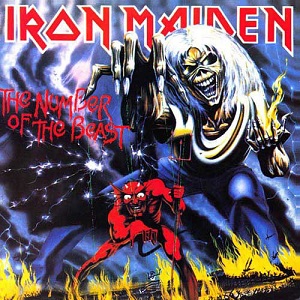
666. Iron Maiden / The Number of the Beast. 1982. 5/5
It may well be a little presumptuous to try and rate and review an album that is without doubt one of the most influential heavy metal albums of all time, and also a stand out as one of the finest albums ever released of any genre of music. However, given that I have reached the magical number of 665 album reviews, then it is only fitting that my 666th album review should indeed be Iron Maiden's The Number of the Beast.
A number of things fell into place for this album to become such a wonderful item. The introduction of Bruce Dickinson to replace Paul Di'Anno for one. Despite the great work that Di'Anno had done with the band on their first two albums, Bruce brought another dimension of possibilities to Iron Maiden, not only with his dynamic vocal range but his song writing capabilities. Also, with all of the band's previously written material having been exhausted in the recording of the first two albums, it now forced them to write all new material for this release, something that allowed them to stretch themselves with all they had learned in recent years.
"Invaders" is similar in structure to both "Prowler" and "Wrathchild", which were the opening songs on Iron Maiden and Killers respectively. It's a short sharp introduction, punctuated by the rifling Steve Harris bassline and those duelling guitars and machine gun drumming, along with Bruce's first strike on vocals, hitting those notes straight up to make this album immediately stand out from the first two releases. I've never really been sure why this song has been so maligned, even by members of the band itself. I think it is a great introduction into the album, showcasing in a historic way what the band could do well in the same way as the aforementioned two songs. It may not be an epic, as future album openers "Where Eagles Dare" and "Aces High" are, but I still think this is a great song, and more is the pity we haven't heard it in a live setting.
"Invaders" is followed by the amazing "Children of the Damned", a truly moody and magnificent song that is still one of the best this band has produced. This was certainly not a song they could have done with Di'Anno on vocals, it would never have worked. Bruce is truly magnificent here, crooning away at the start under the brooding and melodic guitars. The music almost perfectly reflects and remembers the story it is based on, and the following movie of the same name. The moody feel flows into the lead solo break where the song breaks ranks and returns to the fierce Maiden guitar/drum break that they are renown for, while Bruce returns in full force to conclude the song on an upswing. In recent times Bruce was quoted as saying that Black Sabbath's marvellous "Children of the Sea" also inspired this song, and it can actually be seen and heard in the song and its layout.
"The Prisoner" is an inspired song, derived from the classic British TV series, which begins with a monologue taken from that show, which leads straight into a terrific opening where Clive Burr's drums are featured over the short riffs of the guitars. Great start to the song, which then moves into a running guitar bridge which suits the songs lyrics down to the ground, making you fell as though you are "on the run", before launching into "not a Prisoner, I'm a free man!" The lead break again is just classic Maiden, underpinned by Burr's machine-like drumming. Great song.
Following on from two of my all-time favourite Iron Maiden songs comes a third, the brilliant "22 Acacia Avenue". The single guitar riff to start, with Bruce speaking over the top is just great, before busting into the song itself. An old Adrian Smith song from his Urchin days that was reformatted to become the 'next chapter' in the "Charlotte the Harlot" story, this is again highlighted (I believe) by Clive's brilliant drumming throughout the whole song - listen again and be amazed at its precision and power. The lead break cleverly remind you of the middle of the original "Charlotte the Harlot" before breaking ranks and finishing off the song in style.
The second half of the album (for those who are old enough to have owned this on vinyl of course) contains three of Maiden's best known and most beloved songs.
"The Number of the Beast" is the song that much of bible belt America decided was proof that the band was just a bunch of devil worshipping freaks. In reality of course, it was written by Steve Harris after he had watched that fine film, "Damien: Omen II", which tells the STORY of the devil's child. Anyway, pre-empted by a reading from the Book of Revelation from the New Testament, another of Maiden's memorable guitar intros launches the song, leading up to the anthemic calling of "Six! Six six! The number of the beast!". It is still a great song after all these years. This is followed by the song that almost everyone knows whether they are a metal fan or not. "Run to the Hills" spans the generations and the genres, and broke into mainstream radio back when it was released. This is another song that starts with Clive's rhythmic and precision drumming, a drum beat that drummers all over the world have learned at one stage or another, much in the same way all guitarists learn the riff of "Smoke on the Water". Along with the renown guitar riff, and Bruce's superb leading vocals throughout, but especially in the chorus, this has become the song everyone knows Maiden for, and everyone has had a go at hitting Bruce's heights with "Run to the hills, run FOR your LIFE!".
"Gangland" is the second maligned song on the album, and again I think that is unfortunate. The story goes that, when "Run to the Hills" was being prepared for release as the single before the album, a choice had to be made between "Gangland" and "Total Eclipse" as to which would be the B side of the single, with the other song going onto the album The Number of the Beast. It came to pass that "Total Eclipse" became the B side, though Steve Harris has said since that he thinks the wrong decision was made, and that the songs should have been reversed. I can't say I agree, though maybe because the fact is that "Gangland" IS on the album. I like "Total Eclipse", but I've always though of it as have 'B side qualities'. "Gangland" may well reside in the same laneways as "Quest For Fire" as 'forgotten' Maiden songs, but I still like it and think it holds its own here.
The album concludes with the song most of the band consider one of their best, "Hallowed Be Thy Name". It is an epic, in song structure, lyrically and in performance. It once again, as with so many songs just on this album alone, has a distinctive and unique opening to the song, a natural flow from the subtle to the heavy guitar, a brilliant range in the vocals that only Bruce could bring and an anthemic quality, this time into the conclusion of the song. It has been an enduring classic and one that has rarely been out of the band's live set since this album was released.
It is a difficult task to convey how truly magnificent this album is. Only by listening to it can you hear everything that one tries to explain in words, and fails to do to anyone's satisfaction. There are albums that I would place higher on a list of my all-time favourite albums, but that doesn't take away or detract from the fact that this is one of the best ever produced, and its legacy is heightened by the number of bands that have become huge in the past thirty years that this inspired.
665. Alice in Chains / The Devil Put Dinosaurs Here. 2013. 2/5
It was great news for all that Alice in Chains was producing another album. After the excellent comeback of Black Gives Way to Blue there was plenty of cause to be excited at the prospect. There was also a whisper that the band was looking to produce a heavier album this time around. Now, it's all fine to come out and do a heavy album and really push that aspect. With my love of heavy metal, I encourage it from most bands. But heavy is not just tuning that guitar down to a guttural peak and play slow chunking riffs, it needs to have direction and variety, and a hook to grab you and drag you in. The Devil Put Dinosaurs Here really lacks that hook.
There is not the same emotion in the songs or the strength in the vocals. Not the same inspiration, nor the same drive. They seem to be dawdling along to their destination, not taking you along for the ride. The lyrical aspect here is almost nauseating, like reciting poetry in a monotone, uninflected voice. Everything seems to be playing in the same key, at exact the same tempo.
And I think that this is the main problem here. While it SOUNDS like an Alice in Chains album, it just doesn't have the energy and heart of an Alice in Chains album. It really just plods along, almost like an approaching migraine, grinding its way along at the same sort of pace and constant nagging, until you can really take no more. Yep, this is grunge, but almost to an excess, as if they were saying "These are our roots, rediscover them - to the MAX!"
"Voices" is the first song that really tugs at the memory strings. I can almost hear Layne's spirit coming in to harmonise along in the chorus. But even this song just misses a chance to show some power and reach out and grab you through your chest. Instead, it warbles along, like a stagnant stream searching for a surge of water behind it to push it along. That surge never seems to arrive.
Unlike it's predecessor, Black Gives Way to Blue, which had some great songs, the vocals here are pretty much just tracking together. There is no great duelling of voices between Jerry and Will, nor any great harmonising between them.
In the end this has come to a disappointing climax. There just isn't anything here that can lift this album above the average.
It's not that I hate this album, it's just that, overall, I don't like it either. It missed the mark, and it is missing some of the vital ingredients that made Alice in Chains a force to be reckoned with. Perhaps in a live environment these songs would come to life, but from my stereo speakers it sounds like a funeral, and the bell may be tolling for thee.
Subscribe to:
Posts (Atom)