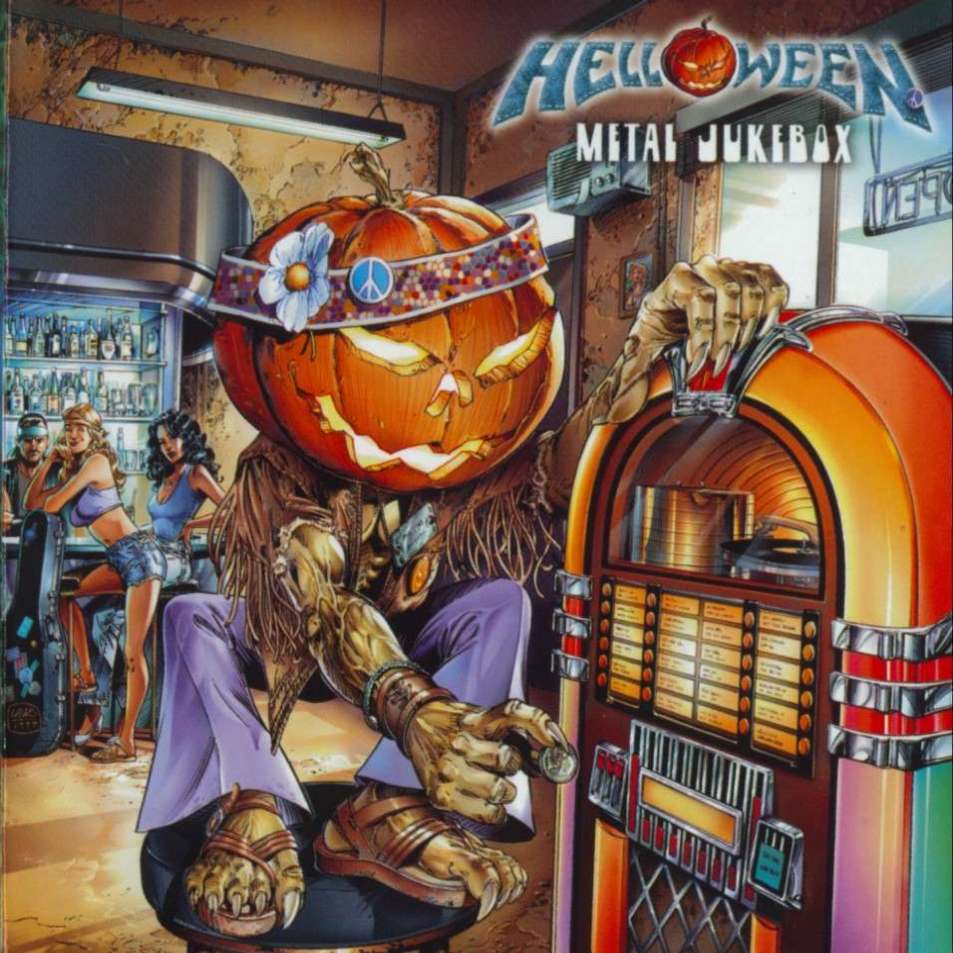
At what point of your career do you think you would have to get to before you decided that recording and releasing an album fully devoted to cover songs is the right thing to do? Although this is basically a rhetorical question, it is perhaps one worth considering. Is it a point where you are so comfortable in your band’s success that you are sure that this decision could either be an excellent upselling move to create further record sales, such as the way Metallica’s “Garage Days Re-revisited" EP had done in 1987, and then “Garage Inc” had been the year prior to this album’s release. Or is it a point that it was the perfect time to rekindle a dwindling interest in the band as a whole, to draw back fans lost due to underperforming albums in recent times, such as perhaps Queensryche’s “Take Cover” compilation in 2007. Or is it a point where you’ve got nothing better to do and you just feel like doing some songs, more or less like Ozzy Osbourne’s “Under Cover” album in 2005. And there are many other examples, for which the reasons why they were done can only be asked of the artists themselves.
In the case of Helloween, their trajectory had been on a steady rise once again having bottomed out in the early 1990’s. On the back of some changes in the band and on two excellent albums in “Master of the Rings” and “The Time of the Oath”, Helloween had gotten back on their feet and were making headway again in the difficult musical times they found themselves in.
One of the interesting things about the recording of the album is that all of the music was recorded by each member separate from the others, in different studios around the world. I would think that was interesting because if it is a covers album, it must have been very difficult to organise how the band wanted each cover version to sound. I mean, you couldn’t just ask each member to go in and decide how they wanted to play each song, and then try and piece it all together! That would have been an impossible task. So there had to have been some conversation on the songs and the way they were going to do their ‘Helloween’ versions, in order to make it sound like they weren’t just playing a note for note version of each of the tracks, before they all went to their different locations and physically recorded each bit by themselves. I’d have thought that recording a covers album would have been a fun thing to do AS A BAND rather than singularly and apart.
The song selection by the band for this album covers the gamut of great hard rock and pop bands of the 1970’s, along with a couple of surprises along the way. And the great part about these versions of these songs is that they are faithful to the originals, in the way that if you know the song it is instantly recognisable, but they have also put a bit of Helloween into them to create a bigger adaption, either through instrumentation or tempo or vocal.
Covering a Beatles song is always fraught with danger, so I’m always of the belief that you should accept them with a grain of salt. And their version here of “All My Loving” with double kick and a faster speed does credit to bringing a different light to the song. On the other hand, the cover of Cream’s “White Room” draws out the heavier tones of the track while retaining the original beautiful groove and feeling of the song. Andi sings this particularly well and the band play it superbly. Another song they do excellently is “Hocus Pocus”, the Focus song that many people would know when they heard even if they didn’t know the title or the original band that played it. The original has been used in commercials and films for decades, and this version more than does it justice.
There were several songs here that I was unfamiliar with when I bought the album, and have since gone back to check out those versions to sit alongside these, and Helloween’s versions are comparable. The Sensational Alex Harvey Band’s “Faith Healer” is a faithful version here (no pun intended), and “Mexican” by Babe Ruth also is an interesting song. The other song I didn’t know was “Juggernaut” by Frank Marino, and this version is a beauty, played at a great clip that mirrors the title of the track.
That leaves the first five songs on the album, by recognisable artists that would seem to have been highly influential on the band’s sound. “Locomotive Breath” by Jethro Tull is a classic favourite of many metal bands of this era, and Helloween’s version is excellent. One of the interesting versions is their take on Faith No More's “From Out of Nowhere”, given the modern age of the band, which suggests this was chosen because it was a favourite of the band rather than an influence. Their aggressive take on Scorpions “He’s a Woman She’s a Man” is fantastic, as is their over-the-top cover of ABBA’s “Lay All Your Love on Me”, one that sears the veneer off the table. And the last track is David Bowie’s “Space Oddity”, a real fan’s closely held interpretation of Bowie’s classic.
Much like I have a saying for live albums – that you should really know by now if you have been listening to this podcast for a while – I have a saying about cover albums. And it is this – albums with cover songs have a shelf life. You will listen to them for a certain time, but eventually you are going to want to go back and listen to the original versions, because in most cases they will still be better or more interesting than the cover versions. And that is true here as well.
What I like about this collection is that there is a variety of artists, many of whom you will not have expected the band to choose, and that they weren’t afraid to go after some iconic classics to perform. The Beatles, ABBA, David Bowie... those three songs could have fallen completely flat if they hadn’t done a good job on them. Fortunately for all, they did.
I bought this on its release, more on a promise I made to myself after missing the original release dates of both “Master of the Rings” and “The Time of the Oath” because of the disappointment I had of “Chameleon”. And while I enjoyed it at the time, it wasn’t what I really wanted, which was a new album by Helloween. This was fine, and fun to listen to, but once it had served its purpose at the time it then went back on the CD shelves. Pretty much until the last couple of weeks. I’m sure I’ve listened t it since, but not in a memorable way.
What I discovered over this short time period since I have been reviewing it for this podcast, I have to say that I’ve found it more enjoyable than I remember. It may well be because I haven’t listened to it for some time, or that it is a novelty again, but it has been fun. The shorter time period availed to me at the moment, with so many episodes to produce, may also help in this matter. It IS a well compiled album, with great cover songs of terrific artists, and you can’t ask for more than that. But it won’t be like an album written by the band. You probably won’t listen to it multiple times, and you probably won’t take it out very often to listen to because of its content. But don’t confuse that with it being an average album. It certainly isn’t that. And for the marketplace in these kinds of albums being produced by bands, it ranks at the higher end of the scale.
One middle-aged headbanger goes where no man has gone before. This is an attempt to listen to and review every album I own, from A to Z. This could take a lifetime...
Podcast - Latest Episode
Thursday, August 06, 2015
Wednesday, August 05, 2015
838. Quiet Riot / Metal Health. 1983. 3/5
If ever the power of MTV in the early to
mid-1980's could be proven, it would have to be in the success garnered
by Quiet Riot's breakout album Metal Health.
Having released two albums, both of which were only initially released
in Japan, and then lost members to other projects and in essence having
broken up, surely no one could have foreseen the amazing success this
album had in the American charts, subsequently becoming the first album
of heavy metal origin to get to Number One. And surely all from a couple
of music videos.
My initiation of this phenomenon didn't come until a couple of years after the album's release. I knew the single, the Slade cover "Cum on Feel the Noize" because it had been plastered over Australian radio for a short burst back in the last year, but I wasn't overly aware of the music videos for both it and "Metal Health" until the mid-1980's when music video shows began to become more popularised in Australia. But once you saw them you had them ingrained in you. They featured the over-the-top music of the band playing on stage and gallivanting around, mixed in with the story happening throughout, all in vibrant colours, music and action. You can see why it dragged people in - hell, it helped to drag me in! Both of those videos became popular viewing, and thus translated to buying the album and playing it ad nauseum as well.
The question to be posed, both now and retrospectively back to 1983 is this - is this album really very good? I mean, being popular at the time is fine, and drawing in fans through the use of clever music videos is also something that is excellent for the bottom line. But in the long run, whether it be six months down the track or 30+ years in the future, can you really say that this is an album full of good songs, or just an album built on the promise of a couple of tracks?
Let's go with the nostalgia factor first, because that would appear to be the most redeeming feature at this point in time. Now, I may still listen to this album, and I may well sing "METAL HEALTH WILL DRIVE YOU MAD!!!" and "WE'LL GET WILD, WILD WILD!!!" at the top of my voice whenever I hear it and I'm in the mood for that kind of thing. Well, those angles still work, because my pre-teenage kids will sing along with these songs now too, so the residual effect is still there in those tracks. But for me it's the feeling of nostalgia I get from these songs that makes me still like them rather than from any true brilliance of the tracks themselves. Similarly with "Slick Black Cadillac", a re-recording of the same track from Quiet Riot II. I now it and sing along with it, but I'm never really sure if I like it, or whether it is just because I know it so well. So kudos on those three songs.
But what about the rest? "Don't Wanna Let You Go" is a barren track with the clear guitar sound throughout the song and the stark, dead-sounding drum beat all combining to make it feel as though it was recorded in a big empty room. After the energy and bounce that is present in the opening two songs, this is a very strange inclusion. "Love's a Bitch", "Breathless" and "Run For Cover" are all run-of-the-mill, average hard rock tunes done in a Quiet Riot flavour. "Battle Axe" is an guitar instrumental that gives Carlos Cavazo the chance to showcase his wares. "Let's Get Crazy" is a slightly less raucous twin brother of "Metal Health", with a similar riff rock tune and vocal structure in place. "Thunderbird" was written and posthumously dedicated to former Quiet Riot guitarist Randy Rhoads, who had died in the tragic plane crash the previous year. It could have used a bit more grunt or even speed as a fair tribute to him, as it tends to just wail out the end of the album in an ineffective and somewhat less appealing manner.
In attempting to answer the question I posed myself earlier, I have been unable to come up with a definitive response. I find that much of the album to me appears less than stellar, that it is made up of songs that are of a simple hard rock method without enormous redeeming features that would combine to make a great album. And yet, despite this, I can't help but enjoy the album each and every time I put it on to listen to. It's a ridiculous notion, but the pull of great memories seems to outweigh the swing of average pandering. And as it turns out, just like in that famous single, "I don't know why... I don't know why..."
Rating: "Got no brains, I'm insane". 3/5
My initiation of this phenomenon didn't come until a couple of years after the album's release. I knew the single, the Slade cover "Cum on Feel the Noize" because it had been plastered over Australian radio for a short burst back in the last year, but I wasn't overly aware of the music videos for both it and "Metal Health" until the mid-1980's when music video shows began to become more popularised in Australia. But once you saw them you had them ingrained in you. They featured the over-the-top music of the band playing on stage and gallivanting around, mixed in with the story happening throughout, all in vibrant colours, music and action. You can see why it dragged people in - hell, it helped to drag me in! Both of those videos became popular viewing, and thus translated to buying the album and playing it ad nauseum as well.
The question to be posed, both now and retrospectively back to 1983 is this - is this album really very good? I mean, being popular at the time is fine, and drawing in fans through the use of clever music videos is also something that is excellent for the bottom line. But in the long run, whether it be six months down the track or 30+ years in the future, can you really say that this is an album full of good songs, or just an album built on the promise of a couple of tracks?
Let's go with the nostalgia factor first, because that would appear to be the most redeeming feature at this point in time. Now, I may still listen to this album, and I may well sing "METAL HEALTH WILL DRIVE YOU MAD!!!" and "WE'LL GET WILD, WILD WILD!!!" at the top of my voice whenever I hear it and I'm in the mood for that kind of thing. Well, those angles still work, because my pre-teenage kids will sing along with these songs now too, so the residual effect is still there in those tracks. But for me it's the feeling of nostalgia I get from these songs that makes me still like them rather than from any true brilliance of the tracks themselves. Similarly with "Slick Black Cadillac", a re-recording of the same track from Quiet Riot II. I now it and sing along with it, but I'm never really sure if I like it, or whether it is just because I know it so well. So kudos on those three songs.
But what about the rest? "Don't Wanna Let You Go" is a barren track with the clear guitar sound throughout the song and the stark, dead-sounding drum beat all combining to make it feel as though it was recorded in a big empty room. After the energy and bounce that is present in the opening two songs, this is a very strange inclusion. "Love's a Bitch", "Breathless" and "Run For Cover" are all run-of-the-mill, average hard rock tunes done in a Quiet Riot flavour. "Battle Axe" is an guitar instrumental that gives Carlos Cavazo the chance to showcase his wares. "Let's Get Crazy" is a slightly less raucous twin brother of "Metal Health", with a similar riff rock tune and vocal structure in place. "Thunderbird" was written and posthumously dedicated to former Quiet Riot guitarist Randy Rhoads, who had died in the tragic plane crash the previous year. It could have used a bit more grunt or even speed as a fair tribute to him, as it tends to just wail out the end of the album in an ineffective and somewhat less appealing manner.
In attempting to answer the question I posed myself earlier, I have been unable to come up with a definitive response. I find that much of the album to me appears less than stellar, that it is made up of songs that are of a simple hard rock method without enormous redeeming features that would combine to make a great album. And yet, despite this, I can't help but enjoy the album each and every time I put it on to listen to. It's a ridiculous notion, but the pull of great memories seems to outweigh the swing of average pandering. And as it turns out, just like in that famous single, "I don't know why... I don't know why..."
Rating: "Got no brains, I'm insane". 3/5
Tuesday, August 04, 2015
837. Blind Guardian / Memories of a Time to Come. 2012. 4/5
What do you do when you decide it is time
to take a long and well deserved break from touring and writing, in
order to keep your fans remembering that you are still out there, but
just on a sabbatical? Well, you release a box set containing the
majority of your back catalogue firstly, and then you release a double
album packed full of some of your greatest hits, with some remixing on
some tracks and some remastering on some tracks, and put it out into the
public sphere to feast upon.
As always, greatest hits packages are a subjective argument. There will always be songs included and songs that are left out that will be debated by fans as to whether it was warranted. This is no exception. Depending upon whether you rate one era of Blind Guardian over another, this could be seen to be somewhat of a furphy. I think the toughest part of picking out songs for a best of for Blind Guardian is the fact that all of the songs intertwine with the others on their album, making them a part of the fabric of that album, thus meaning to hear them individually sometimes doesn't work because you are expecting to hear them with their other songs around them. In time they work fine in that respect, as is obvious through the songs that make the live set list each tour, but initially that can be a bit more difficult that you would expect.
Certainly this double album is packed full of great songs, with many of my favourites here, such as "Nightfall", "Traveller in Time", "Follow the Blind", "Sacred Worlds", "Valhalla" and "Mirror Mirror". None of the entries can be questioned, and as a soundtrack to the career of Blind Guardian it serves its purpose if being used as an introduction point for the uninitiated.
So let's just say that I enjoy this collection, and it has some terrific songs on it. If I had been in charge of the track list it would have been quite different from this one - I mean really, where the hell is "Welcome to Dying" for a start?!? And the fact that these songs have had a makeover also improves the release.
Rating: Best-of in competition. 4/5
As always, greatest hits packages are a subjective argument. There will always be songs included and songs that are left out that will be debated by fans as to whether it was warranted. This is no exception. Depending upon whether you rate one era of Blind Guardian over another, this could be seen to be somewhat of a furphy. I think the toughest part of picking out songs for a best of for Blind Guardian is the fact that all of the songs intertwine with the others on their album, making them a part of the fabric of that album, thus meaning to hear them individually sometimes doesn't work because you are expecting to hear them with their other songs around them. In time they work fine in that respect, as is obvious through the songs that make the live set list each tour, but initially that can be a bit more difficult that you would expect.
Certainly this double album is packed full of great songs, with many of my favourites here, such as "Nightfall", "Traveller in Time", "Follow the Blind", "Sacred Worlds", "Valhalla" and "Mirror Mirror". None of the entries can be questioned, and as a soundtrack to the career of Blind Guardian it serves its purpose if being used as an introduction point for the uninitiated.
So let's just say that I enjoy this collection, and it has some terrific songs on it. If I had been in charge of the track list it would have been quite different from this one - I mean really, where the hell is "Welcome to Dying" for a start?!? And the fact that these songs have had a makeover also improves the release.
Rating: Best-of in competition. 4/5
Monday, August 03, 2015
836. Mercyful Fate / Melissa. 1983. 4.5/5
Growing up during my formative teenage
heavy metal years, I had always been aware of the band Mercyful Fate,
when searching furtively through the record racks at places like Utopia
Records in Sydney. However, despite the knowledge of their existence, I
had never heard any of their material, and knew no one who had either,
and so they were always one of those bands that were on my 'maybe' list
that was never actioned. More is the pity it took me so long to
eventually buy and listen to this album.
It eventually took Metallica to make me walk down the path, with the release of their Garage Inc. album, and their tribute to their friends with the song "Mercyful Fate", a medley of tracks all meshed into one quite brilliant song. this cover finally pushed me to go out an buy some Mercyful Fate albums, which (by fate?) had just been remastered and re-released on CD when I went searching. Good timing all round.
You can hear immediately what drew people to this band in those early days. Great guitar riffs set against some melodramatic and atmospheric instrumentalisation, and the unusual but effective vocals of King Diamond himself. That to me was the most difficult thing to get past in order to gain an appreciation for this band, and this album in particular. The vocal style of King Diamond can be a huge barrier for some who listen to this album with me. In essence, they can't get past the enormous change in range of the vocals as they are sung. Initially for me as well, when I first bought this album. However, it really didn't take long to be able to move past that, such that I only notice it now when I am trying to sing along to the songs, and realising I just can't reach those kind of pitches.
The album starts off with the brilliant "Evil", which drags you in immediately with its brilliant guitar riff and rolling drum beat. From the very beginning you are banging your head along in time with the music. This is a super song, set off by the brilliant music but also King's brilliant vocals, the surge between normal register and then the almost-comical over exerted high pitched melody. Not to forget those guitar solo sections, that just blaze along with real spirit and passion. Just a brilliant opening to the album. This is followed by "Curse of the Pharaohs" which again has a very distinctive introduction and a great riff underlying King's vocals. Once again though its the solo guitar section that not only provides a highlight for the song, but indicates the quality of the band and its members. The solos here again are terrific, ones that make you want to pick up a guitar (generally an air one) and play along. "Into the Coven" starts off with a melodic guitar piece courtesy of Hank Shermann before breaking into the song proper, with King's high soaring vocals over the mandatory low growl heavy metal riff, with an atmospheric break in the middle of the song that sounds terrific before charging off again into the guitar solos. It is bombastic and bloody, and lyrically the kind of stuff that draws in teenage boys because it will more than likely offend their adult parents, and musically the stuff that draws them in because it is guitar and drums and loud and fast.
"At the Sound of the Demon Bell" continues down the same track, with a solid guitar riff anchoring the song throughout and following a similar theme as those songs that have gone before. "Black Funeral" rumbles along in triplet time, and ends abruptly almost mid-song without warning. Did they not have a way to end the song, and just thought 'bugger it, we'll just stop and see how it turns out'? It still amuses me.
"Satan's Fall" stretched for an interesting eleven minutes, which isn't so surprising when you take in to count that it sounds like there are about ten different short songs all meshed together to become one long song. The riffs change, the tempo and mood changes, and the next part of the song takes place, until it all seems to start again. Sometimes it is that the song almost stops, and allows you to have a direct correlation between each 'act' of the song, but sometimes it just flows into the next 'act' without pause. It must have been quite something to record, and then learn in order to play live. No matter how many times you listen to this song, you can pick up new things along the way. I don't thin it ever becomes boring, in fact I think it is a triumph. later progressive bands such as Dream Theater have written songs in 'acts', and the songs draw on for up to 25 minutes in this way. Mercyful Fate here became a pioneer of that kind of recording, and though the acts aren't individually titled, you can pick them out yourself as you listen to the song. Awesome.
The album concludes with the eponymous title track, which for me probably slightly halts the momentum of the album given its radical change in the tempo and style, but that doesn't make it any less impressive in the fact that the band continues to show diversity and the ability to surprise.
I still think, even today, anyone picking up this album and giving it a fair hearing will find a lot to like about it. It's influence is out there in the metal world, and has been showcased by some of the biggest bands of the 80's and 90's. The songs are great, but dig deeper, and listen to the fabulous drumming of Kim Ruzz, the rumbling bass work of Timi Hansen, and the amazing dual guitaring of Hank Shermann and Michael Denner. The musicianship here is superb, and is what keeps drawing me back to this album in particular. And, of course, the vocals of King Diamond. Combined, this makes Melissa an album that is worthy of your attention and of your undying obedience.
Rating: I was born in the cemetery, under the sign of the moon, raised from my grave, by the dead. 4.5/5
It eventually took Metallica to make me walk down the path, with the release of their Garage Inc. album, and their tribute to their friends with the song "Mercyful Fate", a medley of tracks all meshed into one quite brilliant song. this cover finally pushed me to go out an buy some Mercyful Fate albums, which (by fate?) had just been remastered and re-released on CD when I went searching. Good timing all round.
You can hear immediately what drew people to this band in those early days. Great guitar riffs set against some melodramatic and atmospheric instrumentalisation, and the unusual but effective vocals of King Diamond himself. That to me was the most difficult thing to get past in order to gain an appreciation for this band, and this album in particular. The vocal style of King Diamond can be a huge barrier for some who listen to this album with me. In essence, they can't get past the enormous change in range of the vocals as they are sung. Initially for me as well, when I first bought this album. However, it really didn't take long to be able to move past that, such that I only notice it now when I am trying to sing along to the songs, and realising I just can't reach those kind of pitches.
The album starts off with the brilliant "Evil", which drags you in immediately with its brilliant guitar riff and rolling drum beat. From the very beginning you are banging your head along in time with the music. This is a super song, set off by the brilliant music but also King's brilliant vocals, the surge between normal register and then the almost-comical over exerted high pitched melody. Not to forget those guitar solo sections, that just blaze along with real spirit and passion. Just a brilliant opening to the album. This is followed by "Curse of the Pharaohs" which again has a very distinctive introduction and a great riff underlying King's vocals. Once again though its the solo guitar section that not only provides a highlight for the song, but indicates the quality of the band and its members. The solos here again are terrific, ones that make you want to pick up a guitar (generally an air one) and play along. "Into the Coven" starts off with a melodic guitar piece courtesy of Hank Shermann before breaking into the song proper, with King's high soaring vocals over the mandatory low growl heavy metal riff, with an atmospheric break in the middle of the song that sounds terrific before charging off again into the guitar solos. It is bombastic and bloody, and lyrically the kind of stuff that draws in teenage boys because it will more than likely offend their adult parents, and musically the stuff that draws them in because it is guitar and drums and loud and fast.
"At the Sound of the Demon Bell" continues down the same track, with a solid guitar riff anchoring the song throughout and following a similar theme as those songs that have gone before. "Black Funeral" rumbles along in triplet time, and ends abruptly almost mid-song without warning. Did they not have a way to end the song, and just thought 'bugger it, we'll just stop and see how it turns out'? It still amuses me.
"Satan's Fall" stretched for an interesting eleven minutes, which isn't so surprising when you take in to count that it sounds like there are about ten different short songs all meshed together to become one long song. The riffs change, the tempo and mood changes, and the next part of the song takes place, until it all seems to start again. Sometimes it is that the song almost stops, and allows you to have a direct correlation between each 'act' of the song, but sometimes it just flows into the next 'act' without pause. It must have been quite something to record, and then learn in order to play live. No matter how many times you listen to this song, you can pick up new things along the way. I don't thin it ever becomes boring, in fact I think it is a triumph. later progressive bands such as Dream Theater have written songs in 'acts', and the songs draw on for up to 25 minutes in this way. Mercyful Fate here became a pioneer of that kind of recording, and though the acts aren't individually titled, you can pick them out yourself as you listen to the song. Awesome.
The album concludes with the eponymous title track, which for me probably slightly halts the momentum of the album given its radical change in the tempo and style, but that doesn't make it any less impressive in the fact that the band continues to show diversity and the ability to surprise.
I still think, even today, anyone picking up this album and giving it a fair hearing will find a lot to like about it. It's influence is out there in the metal world, and has been showcased by some of the biggest bands of the 80's and 90's. The songs are great, but dig deeper, and listen to the fabulous drumming of Kim Ruzz, the rumbling bass work of Timi Hansen, and the amazing dual guitaring of Hank Shermann and Michael Denner. The musicianship here is superb, and is what keeps drawing me back to this album in particular. And, of course, the vocals of King Diamond. Combined, this makes Melissa an album that is worthy of your attention and of your undying obedience.
Rating: I was born in the cemetery, under the sign of the moon, raised from my grave, by the dead. 4.5/5
Friday, July 31, 2015
835. Iced Earth / The Melancholy E.P. 2001. 3.5/5
This EP was initially only meant to be
handed out to radio stations as a promotion. Then at one stage there was
a limited number pressed for fans to purchase. Two years later in 2001,
it was eventually reissued with two further tracks for the general
masses to get their hands on, and it is this version which I possess
Listen to "Melancholy (Holy Martyr)", "Watching Over Me" and "I Died For You" and can you hear the similarities in the tracks? I swear if you switched the lyric sheets on these two songs that you could pretty much make them fit within the framework of each song. That's not having a dig at the songs in question, it just never fails to surprise me as to how similar these songs are, and that I never really noticed it before I got this EP and started listening to it. I have always been a little disappointed in these tracks, as when they reach the parts of the songs where the riffs really cut in they sound great, but there is too much soft and slower parts of them to make them really great songs. A small footnote that I still enjoy the songs, but that slower starts feel unnecessary.
There are three cover songs here on this extended EP. The cover of Bad Company's "Shooting Star" is difficult for me to judge, because I really don't have any feelings for Bad Company's music at all. Thusly, this song may or may not be a great cover of the original, but it sounds boring and uninteresting compared to Iced Earth's normal output, which probably doesn't say much for the material they had to work with. The cover of Black Sabbath's "Electric Funeral" is an interesting take, certainly given the different direction Matt Barlow takes with the vocals from the original which was sung by Ozzy Osbourne. not a bad cover given they gave it a real Iced earth sound rather than the Black Sabbath sound. This the band has done again with their cover of Judas Priest's "The Ripper", which originally appeared on the tribute album A Tribute to Judas Priest: Legends of Metal Vol. II. Barlow again gives it his own interpretation and doesn't try to mimic Rob Halford's vocals, a very sensible option.
The EP concludes with a live version of "Colours" that was recorded during the session for Alive in Athens but didn't make the final cut for the album. It's a cracking version of this song, and is worthy of its position here rather than being lost in the mists.
EP's are generally hit and miss, depending on what content they have. They can be superfluous or they can be essential. The Melancholy E.P. is an essential item for Iced Earth fans, given the rarity of many parts of this album, and the enjoyment you will get from it when you put it on your CD player.
Rating: I feel it once again, it's overwhelming me. 3.5/5
Listen to "Melancholy (Holy Martyr)", "Watching Over Me" and "I Died For You" and can you hear the similarities in the tracks? I swear if you switched the lyric sheets on these two songs that you could pretty much make them fit within the framework of each song. That's not having a dig at the songs in question, it just never fails to surprise me as to how similar these songs are, and that I never really noticed it before I got this EP and started listening to it. I have always been a little disappointed in these tracks, as when they reach the parts of the songs where the riffs really cut in they sound great, but there is too much soft and slower parts of them to make them really great songs. A small footnote that I still enjoy the songs, but that slower starts feel unnecessary.
There are three cover songs here on this extended EP. The cover of Bad Company's "Shooting Star" is difficult for me to judge, because I really don't have any feelings for Bad Company's music at all. Thusly, this song may or may not be a great cover of the original, but it sounds boring and uninteresting compared to Iced Earth's normal output, which probably doesn't say much for the material they had to work with. The cover of Black Sabbath's "Electric Funeral" is an interesting take, certainly given the different direction Matt Barlow takes with the vocals from the original which was sung by Ozzy Osbourne. not a bad cover given they gave it a real Iced earth sound rather than the Black Sabbath sound. This the band has done again with their cover of Judas Priest's "The Ripper", which originally appeared on the tribute album A Tribute to Judas Priest: Legends of Metal Vol. II. Barlow again gives it his own interpretation and doesn't try to mimic Rob Halford's vocals, a very sensible option.
The EP concludes with a live version of "Colours" that was recorded during the session for Alive in Athens but didn't make the final cut for the album. It's a cracking version of this song, and is worthy of its position here rather than being lost in the mists.
EP's are generally hit and miss, depending on what content they have. They can be superfluous or they can be essential. The Melancholy E.P. is an essential item for Iced Earth fans, given the rarity of many parts of this album, and the enjoyment you will get from it when you put it on your CD player.
Rating: I feel it once again, it's overwhelming me. 3.5/5
Thursday, July 30, 2015
834. Iron Savior / Megatropolis. 2007. 3.5/5
Iron Savior have been somewhat of a
measuring stick in regards to power metal in the European union over the
past 15 to 20 years. While other bands of the genre seem to have their
highs and lows in regards to output and the quality of the material they
release, Iron Savior has been remarkably consistent throughout. It
would probably be a step too far to suggest that they have released some
timeless, unforgettable albums, but in almost every regard each album
they have released has been of a high quality and wonderfully enjoyable.
On Megatropolis perhaps that has slipped just a little, but that doesn't mean it also is not a very good album.
What I like about Iron Savior's music is that it is always upbeat, and rarely gets bogged down in slower numbers that can really kill the momentum of an album. Once again it starts off in a typically pacey manner, fuelled by Piet Sielck's vocal chords and typical guitar riff, along with the rumbling bass guitar on the bottom end and double kick keeping everything together and constrained. "Running Riot" has all of those qualities which mark an atypical Iron Savior start. This is followed by "The Omega Man" which has always been one of my favourites off the album. It has a great riff, a great feel, and Piet moves his way up the vocal scale during the song which increases and enhances the mood of the song as it is required. "Flesh" actually comes across as a very unusual song for this band, but it is surprisingly effective. It is of a slower, heavier tempo with a very un-power metal riff. It is much closer to traditional metal song than that. "Megatropolis" returns us back to the fast paced riffing and drumming that the band is renown for, with great harmony guitars through the middle of the song as well as resplendent with individual solos.
The middle four songs are good solid songs without being outstanding in any respect. "Cybernetic Queen" and "Cyber Hero" both play along with a pleasing beat and nice harmony vocals from Piet. "A Tale From Down Below" and "I Still Believe" both offer mid-tempo ranges throughout. The album finishes with a flourish, and the show closing number "Farewell and Good Bye" feels like the last number of a musical, ending the show on an upward inflection of the final act closes and the curtain falls. I think it is a great song to close out the album, full of lament and emotion from the central character of the song. Excellent stuff.
Megatropolis probably doesn't ring my bells as much as previous albums did, but having said that there are some terrific songs on here, highlighted by the two opening tracks and the final song. Newcomers to this band would probably listen to this album and suggest that it is really all very straight forward without being spectacular. I don't think that opinion is very far off the mark, but it is what fans of the band can squeeze from behind these first observations that make it rank above the average in those respects.
Rating: 'Cause after all I'm just a man, with a broken dream, not man and not machine. 3.5/5
What I like about Iron Savior's music is that it is always upbeat, and rarely gets bogged down in slower numbers that can really kill the momentum of an album. Once again it starts off in a typically pacey manner, fuelled by Piet Sielck's vocal chords and typical guitar riff, along with the rumbling bass guitar on the bottom end and double kick keeping everything together and constrained. "Running Riot" has all of those qualities which mark an atypical Iron Savior start. This is followed by "The Omega Man" which has always been one of my favourites off the album. It has a great riff, a great feel, and Piet moves his way up the vocal scale during the song which increases and enhances the mood of the song as it is required. "Flesh" actually comes across as a very unusual song for this band, but it is surprisingly effective. It is of a slower, heavier tempo with a very un-power metal riff. It is much closer to traditional metal song than that. "Megatropolis" returns us back to the fast paced riffing and drumming that the band is renown for, with great harmony guitars through the middle of the song as well as resplendent with individual solos.
The middle four songs are good solid songs without being outstanding in any respect. "Cybernetic Queen" and "Cyber Hero" both play along with a pleasing beat and nice harmony vocals from Piet. "A Tale From Down Below" and "I Still Believe" both offer mid-tempo ranges throughout. The album finishes with a flourish, and the show closing number "Farewell and Good Bye" feels like the last number of a musical, ending the show on an upward inflection of the final act closes and the curtain falls. I think it is a great song to close out the album, full of lament and emotion from the central character of the song. Excellent stuff.
Megatropolis probably doesn't ring my bells as much as previous albums did, but having said that there are some terrific songs on here, highlighted by the two opening tracks and the final song. Newcomers to this band would probably listen to this album and suggest that it is really all very straight forward without being spectacular. I don't think that opinion is very far off the mark, but it is what fans of the band can squeeze from behind these first observations that make it rank above the average in those respects.
Rating: 'Cause after all I'm just a man, with a broken dream, not man and not machine. 3.5/5
Wednesday, July 29, 2015
833. Y&T / Mean Streak. 1983. 4/5
It had been a long journey for Y&T through the first ten years of the band’s existence after forming in 1972. The quartet of Dave Meniketti on lead guitar and lead vocals, Joey Alves on rhythm guitar, Phil Kennemore on bass and Leonard Haze on drums had recorded two initial albums as Yesterday & Today, before shortening the band name to Y&T. Having changed record companies, these initial albums were followed by two much more focused albums in the early 1980’s with “Earthshaker” and “Black Tiger”, where the band brought to the studio the sound and attitude they had cultivated on the road. This resulted in the band receiving critical acclaim for their work through Europe, but little commercial success in their native US, despite a plethora of tracks that were worthy of attention. On the tour to promote “Black Tiger” the band supported some of the biggest bands in the world such as Ozzy Osbourne, Motley Crue, Alice Cooper, Iron Maiden and Dio, and were playing in bigger stadiums and garnering more attention as a result.
What was needed to continue their ambitious push was a breakthrough on the American commercial radio stations. Fellow long-term American battlers Twisted Sister and Night Ranger were beginning to attract this kind of attention, and for Y&T to reach the next level they felt that they needed to find a way to crack that market. Their problem was how to do it without being accused of selling out, while pushing forward in their hard rock artform rather than folding back into the less raucous sound of their first two albums in the 1970’s. The basis of what they were chasing appeared to be in the songs of “Black Tiger”, but could they push further forward in that direction on their follow up to that album?
The band couldn’t have done too much better in their quest to gain higher approval of the commercial rock gods than with the opening track to the album, the title track "Mean Streak". This is still the star of this show, with its mercurial guitar riff, hard hitting drums and spitting lyrics. This song goes hard from the outset, delivering great vocals, super drums from Haze and Meniketti blazing away on guitar and vocals. It’s a beauty and a great opening to the album itself. In some ways, the opening is so good that the rest of the album has a hard time trying to keep up, but there is still plenty here to enjoy. The following track tries for the same biting lyrics as the album opener. “Straight Through the Heart” doesn’t flow as pleasingly as the opening track but it has a hard pitch to it that works on most levels with another solid solo driving this through the back half of the song. For the most part though, the rest of the album is an either 'take it or leave it' proposition. Some will find that it probably tends to repeat itself most of the way through, with lyrically similar themes cropping up and not a huge amount of variety in the song writing and taking the album just on the surface that could be seen to be a fair enough comment.
However, I can forgive the majority of that for two main reasons. The upbeat style of the songs keeps the album moving without getting too bogged down in complicated timings and technicalities. The musicianship is good, and Meniketti's vocals always smooth over anything that might be remotely out of the ordinary. "Lonely Side of Town" and "Hang 'Em High" are two great examples here. A number of the songs are very middle of the road, almost 'easy listening' kind of material, in the way that some hard rock albums just get into a groove and never seem to leave it. Songs like "Take You to the Limit" and "Sentimental Fool" fall into this section, which doesn't make them unlikeable, it just makes them come across as though they have been written a bit too close together and as a result have some similar facets to their composition. “Midnight in Tokyo” probably falls into this section of the album as well, but given that it acted as one of the songs that began to get the band noticed, there seems to have been a necessity for it to appear here. Then there is “Down and Dirty” which closes out the album in a similar fashion to “Straight Thru the Heart”. These are good songs that build the solid core of the album. And that does bring around the second reason for forgiving any noticeable traces of triviality. And that is that, despite the fact that the band craved a commercial breakthrough, they have not allowed that to infiltrate the quality of the overall tracks and album as a result. What comes here on “Mean Streak” is a solid hard rock album that utilises the best skills that this quartet has, and puts it out there for you to listen to. They have not gone down the glam metal route, they have not bowed to a soft rock ballad in order to gain acceptance. They have stuck to their guns and brought out the kind of album their fans would have wanted, and that is what is the best part of this album.
Back in 1986 when the fabled weekend of the "Music Video Hits" program on Channel 10 on Australian TV was dedicated to heavy metal music videos, one of those that became a favourite for me was the video for Y&T's "Mean Streak". The song and video both caught my attention immediately, and from that point the song became a hit for me. However, it wasn't until a little under two years later, as I rummaged around in one of my favourite haunts, Illawarra Books & Records, that I came across a copy of the album of the same name, and my hand couldn't get to my wallet fast enough to pay for it.
To be honest it was as much a surprise to me that I loved this album as much as I did at that time, when my main focus was the giants and heavier bands such as Iron Maiden, Metallica and Megadeth. But it was my first year of university, and my wide-ranging search for new music and new bands was incorporating subtle differences in genres. Y&T, and "Mean Streak” in particular, fitted very nicely into this bracket, the kind of album I could put on and just let flow across whatever mood I was in at the time. It wasn't straight out aggression. It had those wonderful Meniketti vocals layered over the terrific rhythm section of Kennemore and Hazes and the great guitars of Alves and Meniketti himself. This blended their 1970's roots as found on their eponymous debut album with the harder sound specified in the drums and guitar that had been building over each album.
Y&T is one of those bands that, like Night Ranger, could and should have been bigger than they have ever become. Both have albums that should be considered classics, but perhaps just lack those last vital ingredients that could make them timeless. “Mean Streak” is like that for me, an album I still love to this day, and enjoy anytime I put it on, but taking away my biased joy of the album, perhaps it just needed something else in the mix which may have propelled it to a higher plane. Despite that, it is still a great favourite for me. It got a hammering when I first bought it, and was on heavy rotation for at least a two year period, so all of these songs are ingrained in me to a level where I don't really hear anything that I don't like. It's an historic relic for me, and one I love as much for the nostalgia it brings whenever I listen to it now, as to the actual music itself.
What was needed to continue their ambitious push was a breakthrough on the American commercial radio stations. Fellow long-term American battlers Twisted Sister and Night Ranger were beginning to attract this kind of attention, and for Y&T to reach the next level they felt that they needed to find a way to crack that market. Their problem was how to do it without being accused of selling out, while pushing forward in their hard rock artform rather than folding back into the less raucous sound of their first two albums in the 1970’s. The basis of what they were chasing appeared to be in the songs of “Black Tiger”, but could they push further forward in that direction on their follow up to that album?
The band couldn’t have done too much better in their quest to gain higher approval of the commercial rock gods than with the opening track to the album, the title track "Mean Streak". This is still the star of this show, with its mercurial guitar riff, hard hitting drums and spitting lyrics. This song goes hard from the outset, delivering great vocals, super drums from Haze and Meniketti blazing away on guitar and vocals. It’s a beauty and a great opening to the album itself. In some ways, the opening is so good that the rest of the album has a hard time trying to keep up, but there is still plenty here to enjoy. The following track tries for the same biting lyrics as the album opener. “Straight Through the Heart” doesn’t flow as pleasingly as the opening track but it has a hard pitch to it that works on most levels with another solid solo driving this through the back half of the song. For the most part though, the rest of the album is an either 'take it or leave it' proposition. Some will find that it probably tends to repeat itself most of the way through, with lyrically similar themes cropping up and not a huge amount of variety in the song writing and taking the album just on the surface that could be seen to be a fair enough comment.
However, I can forgive the majority of that for two main reasons. The upbeat style of the songs keeps the album moving without getting too bogged down in complicated timings and technicalities. The musicianship is good, and Meniketti's vocals always smooth over anything that might be remotely out of the ordinary. "Lonely Side of Town" and "Hang 'Em High" are two great examples here. A number of the songs are very middle of the road, almost 'easy listening' kind of material, in the way that some hard rock albums just get into a groove and never seem to leave it. Songs like "Take You to the Limit" and "Sentimental Fool" fall into this section, which doesn't make them unlikeable, it just makes them come across as though they have been written a bit too close together and as a result have some similar facets to their composition. “Midnight in Tokyo” probably falls into this section of the album as well, but given that it acted as one of the songs that began to get the band noticed, there seems to have been a necessity for it to appear here. Then there is “Down and Dirty” which closes out the album in a similar fashion to “Straight Thru the Heart”. These are good songs that build the solid core of the album. And that does bring around the second reason for forgiving any noticeable traces of triviality. And that is that, despite the fact that the band craved a commercial breakthrough, they have not allowed that to infiltrate the quality of the overall tracks and album as a result. What comes here on “Mean Streak” is a solid hard rock album that utilises the best skills that this quartet has, and puts it out there for you to listen to. They have not gone down the glam metal route, they have not bowed to a soft rock ballad in order to gain acceptance. They have stuck to their guns and brought out the kind of album their fans would have wanted, and that is what is the best part of this album.
Back in 1986 when the fabled weekend of the "Music Video Hits" program on Channel 10 on Australian TV was dedicated to heavy metal music videos, one of those that became a favourite for me was the video for Y&T's "Mean Streak". The song and video both caught my attention immediately, and from that point the song became a hit for me. However, it wasn't until a little under two years later, as I rummaged around in one of my favourite haunts, Illawarra Books & Records, that I came across a copy of the album of the same name, and my hand couldn't get to my wallet fast enough to pay for it.
To be honest it was as much a surprise to me that I loved this album as much as I did at that time, when my main focus was the giants and heavier bands such as Iron Maiden, Metallica and Megadeth. But it was my first year of university, and my wide-ranging search for new music and new bands was incorporating subtle differences in genres. Y&T, and "Mean Streak” in particular, fitted very nicely into this bracket, the kind of album I could put on and just let flow across whatever mood I was in at the time. It wasn't straight out aggression. It had those wonderful Meniketti vocals layered over the terrific rhythm section of Kennemore and Hazes and the great guitars of Alves and Meniketti himself. This blended their 1970's roots as found on their eponymous debut album with the harder sound specified in the drums and guitar that had been building over each album.
Y&T is one of those bands that, like Night Ranger, could and should have been bigger than they have ever become. Both have albums that should be considered classics, but perhaps just lack those last vital ingredients that could make them timeless. “Mean Streak” is like that for me, an album I still love to this day, and enjoy anytime I put it on, but taking away my biased joy of the album, perhaps it just needed something else in the mix which may have propelled it to a higher plane. Despite that, it is still a great favourite for me. It got a hammering when I first bought it, and was on heavy rotation for at least a two year period, so all of these songs are ingrained in me to a level where I don't really hear anything that I don't like. It's an historic relic for me, and one I love as much for the nostalgia it brings whenever I listen to it now, as to the actual music itself.
Tuesday, July 28, 2015
832. Mortal Sin / Mayhemic Destruction. 1987. 4.5/5
When Metallica first toured Australia in
May 1989, they announced that local metal act Mortal Sin would be their
support. Before that gig I bought their new album Face of Despair,
played it to death and loved every second of it. I even bought their
tour shirt ("Voyage of the Disturbed!") which finally died from overuse.
After the gig, I went searching for their debut album, Mayhemic Destruction,
from which the band had played a couple of tracks, most noticeably the
brilliant "Lebanon". There was just one problem. Back in the day, this
album was as rare as hens teeth, and just as difficult to track down.
Believe me, I tried for a very long time before I found it, and that was
even through Utopia Records, who can get just about anything! Today of
course it would be practically impossible to find a physical copy of
this album, but at least with iTunes you can still find and buy this
album, which is a great thing (yes, it is up there now if you are
interested). What I eventually had to be happy with was a second hand
cassette I found in a Newtown second hand record store a few years later
- I would love to have had the vinyl, I really would. However, beggars
can't be choosers, and at least I had a copy of the album.
This is a brilliant slice of metal history, certainly from an Australian perspective. At a time when thrash metal was being heralded by bands such as Metallica, Slayer, Anthrax, Exodus and Testament, this album loses nothing in comparison to those early albums by these bands. The opening track is an instrumental, "The Curse", which serves as an introduction to the band and its wares. This is followed by "Women in Leather", where Mat Maurer's recognisable vocals make their first appearance. The mighty "Lebanon" has been a legendary classic amongst the Australian metal community for 30 years, and is still a shining light all these years later. "Liar" and "Blood Death Hatred" blitz along with a cacophony of double kick and blazing guitar. "Mortal Slaughter" and "Into the Fire" continue the metal fest, before "Mayhemic Destruction" finishes off the album in style, speeding along while Maurer tries a different vocal technique here to create a full collection of thrash metal stereotype songs.
The band itself is on fire throughout the whole album, and for something that was really only meant to be a demo tape, this is quite amazing. The quality of the musicianship is just brilliant. The guitaring of Keith Krstin and Paul Carwana sounds great - raw in places certainly, but impressive all the same. Andy Eftichoiu's bass work is terrific, really giving the songs the bottom end that they need and deserve, and making its presence felt throughout. So too is Wayne Campbell's drumming, hard and tough and loud and the driving force through the album, able to dictate the tempo of every song to perfection. Mat Maurer's vocals top off the set, and while they are not as cultured here as they would be on the following album, he mixes things up, singing with great poise on "Women in Leather" and descending to a growl and scream on "Mayhemic Destruction".
It might seem like tame stuff now, almost thirty years on from its initial release, but at the time it was huge - monstrous even. I only saw the band a few times live, in their different guises depending on who had been recruited at the time, but at their peak they were a worthy contender for best Australian metal band. How they didn't go on to bigger and better things is still a mystery - band disharmony has often stopped bands in their tracks. Despite all of that, this album still holds its own in the annals of metaldom, and is an album I can put on at any time and still love.
Rating: Send out the kamikazes on a suicide attack. 4.5/5
This is a brilliant slice of metal history, certainly from an Australian perspective. At a time when thrash metal was being heralded by bands such as Metallica, Slayer, Anthrax, Exodus and Testament, this album loses nothing in comparison to those early albums by these bands. The opening track is an instrumental, "The Curse", which serves as an introduction to the band and its wares. This is followed by "Women in Leather", where Mat Maurer's recognisable vocals make their first appearance. The mighty "Lebanon" has been a legendary classic amongst the Australian metal community for 30 years, and is still a shining light all these years later. "Liar" and "Blood Death Hatred" blitz along with a cacophony of double kick and blazing guitar. "Mortal Slaughter" and "Into the Fire" continue the metal fest, before "Mayhemic Destruction" finishes off the album in style, speeding along while Maurer tries a different vocal technique here to create a full collection of thrash metal stereotype songs.
The band itself is on fire throughout the whole album, and for something that was really only meant to be a demo tape, this is quite amazing. The quality of the musicianship is just brilliant. The guitaring of Keith Krstin and Paul Carwana sounds great - raw in places certainly, but impressive all the same. Andy Eftichoiu's bass work is terrific, really giving the songs the bottom end that they need and deserve, and making its presence felt throughout. So too is Wayne Campbell's drumming, hard and tough and loud and the driving force through the album, able to dictate the tempo of every song to perfection. Mat Maurer's vocals top off the set, and while they are not as cultured here as they would be on the following album, he mixes things up, singing with great poise on "Women in Leather" and descending to a growl and scream on "Mayhemic Destruction".
It might seem like tame stuff now, almost thirty years on from its initial release, but at the time it was huge - monstrous even. I only saw the band a few times live, in their different guises depending on who had been recruited at the time, but at their peak they were a worthy contender for best Australian metal band. How they didn't go on to bigger and better things is still a mystery - band disharmony has often stopped bands in their tracks. Despite all of that, this album still holds its own in the annals of metaldom, and is an album I can put on at any time and still love.
Rating: Send out the kamikazes on a suicide attack. 4.5/5
Monday, July 27, 2015
831. Iron Maiden / A Matter of Life and Death. 2006. 4/5
At one stage in their history - for quite a
lot of it actually - Iron Maiden was a heavy metal band. They possessed
two guitars for that extra guitar sound, which also offset twin guitar
solos that pleased the ear, along with a galloping bass guitarist who
redefined the way bass guitar was utilised in a band sense. They had a
drummer who excelled in every way, and arguably the greatest vocalist on
the planet at the helm. By the time we reached this album being
produced there had been an number of ups and down, re-jigging of staff,
and then reintegration. All the while, the style of music that the band
produced was changing ever so slightly with every new album. With the
release of A Matter of Life and Death
Iron Maiden had moved to where the line is blurred between a melodic
heavy metal and a progressive metal status, and while the integrity and
excellence of the band is never in question, the material that was being
written and recorded was now in such a different state that it made for
some awkward and indifferent listening moments.
A Matter of Life and Death is not a concept album, but an album with a collection of songs with a common theme running through them. Only the opening track "Different World" runs under five minutes in length, and while this means nothing if the songs are relevant and don't get bogged down in a boring repeated riff movement or lyrical verse, that can't be said to be the case in every instance on this album. One of the major problems on this album is trying to find a song that you could consider to be a stand-alone, one you would be happy to individualise and put on a playlist of mixed songs and artists. Most Maiden albums are full of such songs, ones you can identify with away from the album they are apart of. In other words, once the world tour promoting this album was completed, how many songs here would find themselves on future set lists?
"Different World" is an upbeat, up-tempo song to kick off the album in the right frame of mind. Still, there is something about the track that just doesn't sit well with me. I don't know what it is, but perhaps I do. I don't like the way the chorus is sung. Yep, I know that sounds ridiculous, but it seems so... plain! So ordinary! I don't know how best to explain it, but it doesn't generate the kind of excitement and adrenaline that most opening track on an Iron Maiden album tend to do. The fifty seconds quiet instrumental break at the beginning of "These Colours Don't Run" jumps into a decent song highlighted by Bruce's vocals, which tend to paint over what is a quite boring (but no doubt necessary) instrumental break in the middle of the song, which is only punctuated by the guitar solos. This is complemented by a vocal crowd-inducing "whooooooa" section that has a very The X Factor sound to it, from "Sign of the Cross", before fading out into the same sort of instrumental we heard at the start of the song - and not for the last time on the album. Because yes, the next song also starts with a quiet section, with both Bruce and the instruments building up to when we break into the real start of the song after forty seconds. "Brighter Than a Thousand Suns" is probably one of the best moments on the album, but it too suffers from the length of the song and the similarities of the riffs through the song. It also has the detracting feature where the repeated line of "Out of the darkness, brighter than a thousand suns" just goes beyond the normal. In one section in the first half of the song, that phrase comes out a total of twelve times with nothing to break it up. This then happens again to finish the song, being repeated another eight times, before the instrumental at the start is again tagged onto the end of the song.
"The Pilgrim" has the instantly recognisable Janick Gers guitar riff on it, the one that can be most identified with his first albums with the band, No Prayer for the Dying and Fear of the Dark. The song "Fear is the Key" is what I am reminded of during parts of this song, where the guitar sounds like it has been ripped right from that song - not the whole song mind you, just snatches of music. "The Longest Day" starts off softly in both music and vocals, with both building through the first two minutes of the song to reach a crescendo when Bruce breaks out to his better known register. Like most of the album, there are passages in this song that can be described and enjoyed like the best moments of the band's history, but are mixed with other moments that just feel... unworthy. And guess what? It ends with a quiet clear piece as well! "Out of the Shadows" has an uncomfortable ring similar to that terrible travesty of an Iron Maiden song "Wasting Love". It is not the same theme nor the same genre, but like the previous song there are snatches of harmony that just hark back in similar fashion to that song. It may not surprise you to find that I'm therefore not a huge fan of this song either.
So what is it about the long, quiet, instrumental introduction to songs that has begun to creep into Maiden's music? Let's take a look at "The Reincarnation of Benjamin Breeg" as the example here. Apart from the fact that we have Bruce singing very malevolently, there just isn't anything happening at all. It isn't until bang on the two minute mark of the track that we have the song really break into existence. That's two minutes where as a fan and a listener of the album we wait around twiddling our thumbs before we can start investing in the song itself, with air guitar or singing along with the lyrics. But then, even when we reach this section, we have what is essentially the same underpinning guitar riff and drums being played for almost three minutes with Bruce speak-singing his lyrics over the top. Then we have a section for the guitar solos, which is OK without being extravagant, before we return to the same lyrical prose to finish the song, which actually concludes with twenty seconds of the same sort of stuff that sprouted from the beginning of the track. What beggars belief is that this song was also chosen as the first single from the album (albeit in an age where singles mean very little anymore). we have a similar start to the next song, "For the Greater Good of God". It's an instrumental beginning, before Bruce joins in again and sings quietly (and beautifully I might add) over the top, before finally ninety seconds in we break into the heavier music, and the passion in the vocals carries us along for the remainder of the song, and again we finish as we started. "Lord of Light" gives us the same sort of action, a quiet acoustically set beginning of one minute and forty seconds, breaking into the song, before concluding with the same beginning as before. "The Legacy" does the same thing again, but the start of this song stretches a somewhat interminable three minutes and ten seconds of acoustic guitar and some other tricks and bobs before the songs actually gets moving. And I find this the most disappointing aspect, because once it does start this is a really good song. But no, we need to have this epic kind of acoustic start to create an atmosphere into the "start" of the song, which is then also repeated in the final thirty seconds to conclude the song, and the album.
Do I understand it? No, I do not. Does this enhance the tracks, or improve it, or even be necessary? No it does not. Could the tracks have been improved by shortening or discarding those moments from each song? Yes, I really think so. I don't know how we have come to this point in the band's history where this is now the normal, not just an occasional dalliance. I really think it is too much. Surely the band, or at least the band's producer, would have notice that the majority of songs here start the same way as they finish? Couldn't there have been a way to avoid that? Of course, perhaps this is exactly what the band was looking for, which if this is the case, I find maybe even a little more difficult.
Reading through all of this, I guess you would believe that I really dislike this album. That is not the complete truth, but some elements can only ring true. I certainly judge Iron Maiden albums tougher than most of my music collection, because they have been so brilliant for so long, and they are the front runners of any comparison of other bands and their albums. The truth will always be that "an average Iron Maiden album is almost always better than a brilliant album from another artist", and this is the case here. As much as I don't really like the way the songs are written and structured here, when you hear Bruce Dickinson singing you can forgive just about anything.
Rating: Somewhere there's someone dying, in a foreign land, Meanwhile the world is crying, stupidity of man. 4/5
A Matter of Life and Death is not a concept album, but an album with a collection of songs with a common theme running through them. Only the opening track "Different World" runs under five minutes in length, and while this means nothing if the songs are relevant and don't get bogged down in a boring repeated riff movement or lyrical verse, that can't be said to be the case in every instance on this album. One of the major problems on this album is trying to find a song that you could consider to be a stand-alone, one you would be happy to individualise and put on a playlist of mixed songs and artists. Most Maiden albums are full of such songs, ones you can identify with away from the album they are apart of. In other words, once the world tour promoting this album was completed, how many songs here would find themselves on future set lists?
"Different World" is an upbeat, up-tempo song to kick off the album in the right frame of mind. Still, there is something about the track that just doesn't sit well with me. I don't know what it is, but perhaps I do. I don't like the way the chorus is sung. Yep, I know that sounds ridiculous, but it seems so... plain! So ordinary! I don't know how best to explain it, but it doesn't generate the kind of excitement and adrenaline that most opening track on an Iron Maiden album tend to do. The fifty seconds quiet instrumental break at the beginning of "These Colours Don't Run" jumps into a decent song highlighted by Bruce's vocals, which tend to paint over what is a quite boring (but no doubt necessary) instrumental break in the middle of the song, which is only punctuated by the guitar solos. This is complemented by a vocal crowd-inducing "whooooooa" section that has a very The X Factor sound to it, from "Sign of the Cross", before fading out into the same sort of instrumental we heard at the start of the song - and not for the last time on the album. Because yes, the next song also starts with a quiet section, with both Bruce and the instruments building up to when we break into the real start of the song after forty seconds. "Brighter Than a Thousand Suns" is probably one of the best moments on the album, but it too suffers from the length of the song and the similarities of the riffs through the song. It also has the detracting feature where the repeated line of "Out of the darkness, brighter than a thousand suns" just goes beyond the normal. In one section in the first half of the song, that phrase comes out a total of twelve times with nothing to break it up. This then happens again to finish the song, being repeated another eight times, before the instrumental at the start is again tagged onto the end of the song.
"The Pilgrim" has the instantly recognisable Janick Gers guitar riff on it, the one that can be most identified with his first albums with the band, No Prayer for the Dying and Fear of the Dark. The song "Fear is the Key" is what I am reminded of during parts of this song, where the guitar sounds like it has been ripped right from that song - not the whole song mind you, just snatches of music. "The Longest Day" starts off softly in both music and vocals, with both building through the first two minutes of the song to reach a crescendo when Bruce breaks out to his better known register. Like most of the album, there are passages in this song that can be described and enjoyed like the best moments of the band's history, but are mixed with other moments that just feel... unworthy. And guess what? It ends with a quiet clear piece as well! "Out of the Shadows" has an uncomfortable ring similar to that terrible travesty of an Iron Maiden song "Wasting Love". It is not the same theme nor the same genre, but like the previous song there are snatches of harmony that just hark back in similar fashion to that song. It may not surprise you to find that I'm therefore not a huge fan of this song either.
So what is it about the long, quiet, instrumental introduction to songs that has begun to creep into Maiden's music? Let's take a look at "The Reincarnation of Benjamin Breeg" as the example here. Apart from the fact that we have Bruce singing very malevolently, there just isn't anything happening at all. It isn't until bang on the two minute mark of the track that we have the song really break into existence. That's two minutes where as a fan and a listener of the album we wait around twiddling our thumbs before we can start investing in the song itself, with air guitar or singing along with the lyrics. But then, even when we reach this section, we have what is essentially the same underpinning guitar riff and drums being played for almost three minutes with Bruce speak-singing his lyrics over the top. Then we have a section for the guitar solos, which is OK without being extravagant, before we return to the same lyrical prose to finish the song, which actually concludes with twenty seconds of the same sort of stuff that sprouted from the beginning of the track. What beggars belief is that this song was also chosen as the first single from the album (albeit in an age where singles mean very little anymore). we have a similar start to the next song, "For the Greater Good of God". It's an instrumental beginning, before Bruce joins in again and sings quietly (and beautifully I might add) over the top, before finally ninety seconds in we break into the heavier music, and the passion in the vocals carries us along for the remainder of the song, and again we finish as we started. "Lord of Light" gives us the same sort of action, a quiet acoustically set beginning of one minute and forty seconds, breaking into the song, before concluding with the same beginning as before. "The Legacy" does the same thing again, but the start of this song stretches a somewhat interminable three minutes and ten seconds of acoustic guitar and some other tricks and bobs before the songs actually gets moving. And I find this the most disappointing aspect, because once it does start this is a really good song. But no, we need to have this epic kind of acoustic start to create an atmosphere into the "start" of the song, which is then also repeated in the final thirty seconds to conclude the song, and the album.
Do I understand it? No, I do not. Does this enhance the tracks, or improve it, or even be necessary? No it does not. Could the tracks have been improved by shortening or discarding those moments from each song? Yes, I really think so. I don't know how we have come to this point in the band's history where this is now the normal, not just an occasional dalliance. I really think it is too much. Surely the band, or at least the band's producer, would have notice that the majority of songs here start the same way as they finish? Couldn't there have been a way to avoid that? Of course, perhaps this is exactly what the band was looking for, which if this is the case, I find maybe even a little more difficult.
Reading through all of this, I guess you would believe that I really dislike this album. That is not the complete truth, but some elements can only ring true. I certainly judge Iron Maiden albums tougher than most of my music collection, because they have been so brilliant for so long, and they are the front runners of any comparison of other bands and their albums. The truth will always be that "an average Iron Maiden album is almost always better than a brilliant album from another artist", and this is the case here. As much as I don't really like the way the songs are written and structured here, when you hear Bruce Dickinson singing you can forgive just about anything.
Rating: Somewhere there's someone dying, in a foreign land, Meanwhile the world is crying, stupidity of man. 4/5
Friday, July 24, 2015
830. Masterplan / Masterplan. 2003. 5/5
Though I've never really understood what happened, I absolutely loved The Dark Ride
when it was released, and thought it was a high water mark in the
reinvigorated career of Helloween. Then, following the tour to promote
the album, it came to pass that guitarist Roland Grapow and drummer Uli
Kusch were moved on from the band. Various reports (whether true or not)
intimated that Grapow and Kusch wanted to move in a heavier direction,
whereas the other members did not wish to be so dark and heavy. Whatever
the reason, it came as somewhat of a shock. Better news came when these
two announced they would form a new band, and would continue onwards
with their music. The addition of former Ark vocalist Jorn Lande added
star quality and power to the new band, and the anticipation to their
first release was high.
The first time I heard this album, it was like magic. There have been a number of albums that I have known from the first time I put them on that I would always love them, and for me this was probably the most memorable of them. When I finally managed to track down and buy this album, I was in awe of what I heard. It was beyond anything I imagined it could have been. The guitars, the drums, the keyboards, the vocals, the lyrics. Everything was just perfect. It extended from what Helloween and Gamma Ray had been doing, not improving it but taking that as the lead to find the right direction in which to head. The song writing and playing of both Roland and Uli was always likely to be excellent given their past record with Helloween, but without a vocalist of stature in which to bring out the best in the music it was always going to be the difference between a solid outing and a brilliant outing. Jorn is that vocalist, and his performance on this album and also on the follow up is the finest of his career, and really slams the exclamation point on this album.
I'll admit that I don't know for sure, nor have I heard anything from anyone within the people involved, but the lyrics from most of the songs seem to me to directly relate to the separation of the two members from their previous band. It could well have provided the bulk of the material lyric-wise, depending on how you interpret them. Like I said I have nothing to back that up so I could be completely off the mark, but when I read the following lyrics from the album, I'm not sure that it can be anything else:
"I'll never give up - never give in, Won't stop believing cause I'm gonna win, Sing with my soul before I get old, Cause there may be no tomorrow"
"Enlighten me, I wanna see, how this could be the age of reason, won't you tell me, can't you tell me, cause I need to know"
"We held up the metal torch and they tried to take the flame, we've been running against the wall but we always overcame, no sense no reason, we are the ones you love to hat"
"Try to mend your broken wings, Why should we live within a haze"
There are plenty more examples, but again they are all open to interpretation.
From the very beginning, this is an album that highlights the very best that power metal can be. While the keyboards are prominent through the songs, they do not dominate. That is left to the strongest triumvirate within the band - Uli's brilliant drumming, Roland's fantastic guitaring and Jorn's amazing vocals. The opening three tracks are just brilliant. The epic opening track "Spirit Never Dies" bursts through the speakers in a cacophony of speed, guitar, keys and drums, before the silky vocals of Jorn enter the fray. The power of the chorus is just fantastic, and the emotive building to the heavy ending tops off an amazing opening track. This then flows straight into the first single from the album "Enlighten Me", which mirrors the intensity and heavy guitar and drumming from the first track, while reinforcing through its chorus the overflow of feeling some members of this band still felt for certain sections of other bands. Linking directly through the lyrics once again is "Kind Hearted Light", which concludes the Trilogy of musical moments which derive their existence from previous fallings out. It would be a difficult task to find three opening songs on an album that would be better than those found here - the equal yes, but not better.
"Crystal Night" is a heavier song both in riff and with Jorn's vocals, with impact drum beat and guitar riff throughout the majority of the song to emphasise each part. Following this, as an offset, listen to the harmony from Jorn through the bridge of "Soulburn", leading from the heartfelt musings of each verse and into the short chorus. The vocals here are stunning, and the atmosphere created throughout this song is extraordinary, for which the keyboards play a major part. This is followed up by the lighter, brighter and slightly faster "Heroes", which features former Helloween vocalist Michael Kiske on dual vocals. Kiske had apparently been approached initially to be the lead singer of the band in its development, something he declined on the basis of his continued dislike of heavy metal. Kiske adds a breeziness to this track which makes it wonderfully enjoyable, but it is also obvious that could not have sung on this album and done the same brilliant job as Jorn does. It just wouldn't have worked as well as it does, but on this track both singers are great. The faster pace continues on into "Sail On", with double kick and soaring vocals pushing the track on through to the great solo section.
"Into the Light" is perhaps the most derivative of the tracks on the album. It is much slower, and bases itself around Jorn's mournful vocal performance and guitar wailing. I would say it is the least successful track on the album, but then it bursts by way of Roland's solo guitar riff into the brilliant "Crawling From Hell", which blitzes along with fast guitar riff and double kick from Uli, and Jorn's brilliant harmonic vocals through the bridge again. It is one of my favourite tracks on the album. This feeds into "Bleeding Eyes" with its very middle-eastern music style dominated by the atmospheric keyboards and Jorn's amazing vocal range again.
This is as fine a debut album as could ever have been produced. The song writing is superb, and its strength is what builds such a brilliant foundation for the entire album. It lays the platform for each of the band members to then do what they do best, and make their own mark on the album. Certainly Uli's drumming does that as well. I had been a fan of his since his days in Gamma Ray and then Helloween, but his drumming here is so powerful and so proficient. He can play that strong 2/4 timing on snare and toms but be playing an almost completely different beat on the double kick at his feet. When the songs demand it, his double time kick with frills and trills take what would be just an average quiet piece in a song to become his own - listen to the first verse of "King Hearted Light" to hear what I mean. Superb. He doesn't get over-technical in a progressive drumming way, because you can hear him keeping that solid thumping time throughout each song, but he also adds his own tricks along the way that make it so much more special. He is a gem. Roland's guitaring does the same in effect. Because the writing is so good, and the rhythm section is so solid (and Roland played the majority of the bass guitar on this album before they hired anyone), he can not only lay his rhythm guitar tracks down, but allow himself his freedom in the solo sections to really showcase his talents. While he was able to do this to a certain extent during his Helloween days, here he has a fuller reign as one of the senior members of the writing group and band, and it really shows. Backing all of this up is the unbelievable job done by Jorn on vocals. They are not only sensational, they convey the emotion of a track when needed, enhancing the music and lyrics around him in his voice. He can reach those high notes when he needs to, as his range is excellent, but it is his ability to bring out the emotions of the song that help to make this album what it is. He can be light, dark, heavy or thoughtful, all without compromising the mood of the song - in fact only illuminating it.
For me this is one of the best albums of the new millennium. It ticks every box and is a standout in an era when metal was expanding in some markets and contracting in others. While many bands and fans were gravitating towards a more aggressive, tuned down growling style of metal, this album at the time proved to me why the ability to be able to sing melodically, and play instruments in a traditional melodic heavy way was still more important to me than anything else.
Rating: I know what it means to burn, that's how I begin to learn. 5/5
The first time I heard this album, it was like magic. There have been a number of albums that I have known from the first time I put them on that I would always love them, and for me this was probably the most memorable of them. When I finally managed to track down and buy this album, I was in awe of what I heard. It was beyond anything I imagined it could have been. The guitars, the drums, the keyboards, the vocals, the lyrics. Everything was just perfect. It extended from what Helloween and Gamma Ray had been doing, not improving it but taking that as the lead to find the right direction in which to head. The song writing and playing of both Roland and Uli was always likely to be excellent given their past record with Helloween, but without a vocalist of stature in which to bring out the best in the music it was always going to be the difference between a solid outing and a brilliant outing. Jorn is that vocalist, and his performance on this album and also on the follow up is the finest of his career, and really slams the exclamation point on this album.
I'll admit that I don't know for sure, nor have I heard anything from anyone within the people involved, but the lyrics from most of the songs seem to me to directly relate to the separation of the two members from their previous band. It could well have provided the bulk of the material lyric-wise, depending on how you interpret them. Like I said I have nothing to back that up so I could be completely off the mark, but when I read the following lyrics from the album, I'm not sure that it can be anything else:
"I'll never give up - never give in, Won't stop believing cause I'm gonna win, Sing with my soul before I get old, Cause there may be no tomorrow"
"Enlighten me, I wanna see, how this could be the age of reason, won't you tell me, can't you tell me, cause I need to know"
"We held up the metal torch and they tried to take the flame, we've been running against the wall but we always overcame, no sense no reason, we are the ones you love to hat"
"Try to mend your broken wings, Why should we live within a haze"
There are plenty more examples, but again they are all open to interpretation.
From the very beginning, this is an album that highlights the very best that power metal can be. While the keyboards are prominent through the songs, they do not dominate. That is left to the strongest triumvirate within the band - Uli's brilliant drumming, Roland's fantastic guitaring and Jorn's amazing vocals. The opening three tracks are just brilliant. The epic opening track "Spirit Never Dies" bursts through the speakers in a cacophony of speed, guitar, keys and drums, before the silky vocals of Jorn enter the fray. The power of the chorus is just fantastic, and the emotive building to the heavy ending tops off an amazing opening track. This then flows straight into the first single from the album "Enlighten Me", which mirrors the intensity and heavy guitar and drumming from the first track, while reinforcing through its chorus the overflow of feeling some members of this band still felt for certain sections of other bands. Linking directly through the lyrics once again is "Kind Hearted Light", which concludes the Trilogy of musical moments which derive their existence from previous fallings out. It would be a difficult task to find three opening songs on an album that would be better than those found here - the equal yes, but not better.
"Crystal Night" is a heavier song both in riff and with Jorn's vocals, with impact drum beat and guitar riff throughout the majority of the song to emphasise each part. Following this, as an offset, listen to the harmony from Jorn through the bridge of "Soulburn", leading from the heartfelt musings of each verse and into the short chorus. The vocals here are stunning, and the atmosphere created throughout this song is extraordinary, for which the keyboards play a major part. This is followed up by the lighter, brighter and slightly faster "Heroes", which features former Helloween vocalist Michael Kiske on dual vocals. Kiske had apparently been approached initially to be the lead singer of the band in its development, something he declined on the basis of his continued dislike of heavy metal. Kiske adds a breeziness to this track which makes it wonderfully enjoyable, but it is also obvious that could not have sung on this album and done the same brilliant job as Jorn does. It just wouldn't have worked as well as it does, but on this track both singers are great. The faster pace continues on into "Sail On", with double kick and soaring vocals pushing the track on through to the great solo section.
"Into the Light" is perhaps the most derivative of the tracks on the album. It is much slower, and bases itself around Jorn's mournful vocal performance and guitar wailing. I would say it is the least successful track on the album, but then it bursts by way of Roland's solo guitar riff into the brilliant "Crawling From Hell", which blitzes along with fast guitar riff and double kick from Uli, and Jorn's brilliant harmonic vocals through the bridge again. It is one of my favourite tracks on the album. This feeds into "Bleeding Eyes" with its very middle-eastern music style dominated by the atmospheric keyboards and Jorn's amazing vocal range again.
This is as fine a debut album as could ever have been produced. The song writing is superb, and its strength is what builds such a brilliant foundation for the entire album. It lays the platform for each of the band members to then do what they do best, and make their own mark on the album. Certainly Uli's drumming does that as well. I had been a fan of his since his days in Gamma Ray and then Helloween, but his drumming here is so powerful and so proficient. He can play that strong 2/4 timing on snare and toms but be playing an almost completely different beat on the double kick at his feet. When the songs demand it, his double time kick with frills and trills take what would be just an average quiet piece in a song to become his own - listen to the first verse of "King Hearted Light" to hear what I mean. Superb. He doesn't get over-technical in a progressive drumming way, because you can hear him keeping that solid thumping time throughout each song, but he also adds his own tricks along the way that make it so much more special. He is a gem. Roland's guitaring does the same in effect. Because the writing is so good, and the rhythm section is so solid (and Roland played the majority of the bass guitar on this album before they hired anyone), he can not only lay his rhythm guitar tracks down, but allow himself his freedom in the solo sections to really showcase his talents. While he was able to do this to a certain extent during his Helloween days, here he has a fuller reign as one of the senior members of the writing group and band, and it really shows. Backing all of this up is the unbelievable job done by Jorn on vocals. They are not only sensational, they convey the emotion of a track when needed, enhancing the music and lyrics around him in his voice. He can reach those high notes when he needs to, as his range is excellent, but it is his ability to bring out the emotions of the song that help to make this album what it is. He can be light, dark, heavy or thoughtful, all without compromising the mood of the song - in fact only illuminating it.
For me this is one of the best albums of the new millennium. It ticks every box and is a standout in an era when metal was expanding in some markets and contracting in others. While many bands and fans were gravitating towards a more aggressive, tuned down growling style of metal, this album at the time proved to me why the ability to be able to sing melodically, and play instruments in a traditional melodic heavy way was still more important to me than anything else.
Rating: I know what it means to burn, that's how I begin to learn. 5/5
Subscribe to:
Posts (Atom)


