Podcast - Latest Episode

Tuesday, January 29, 2019

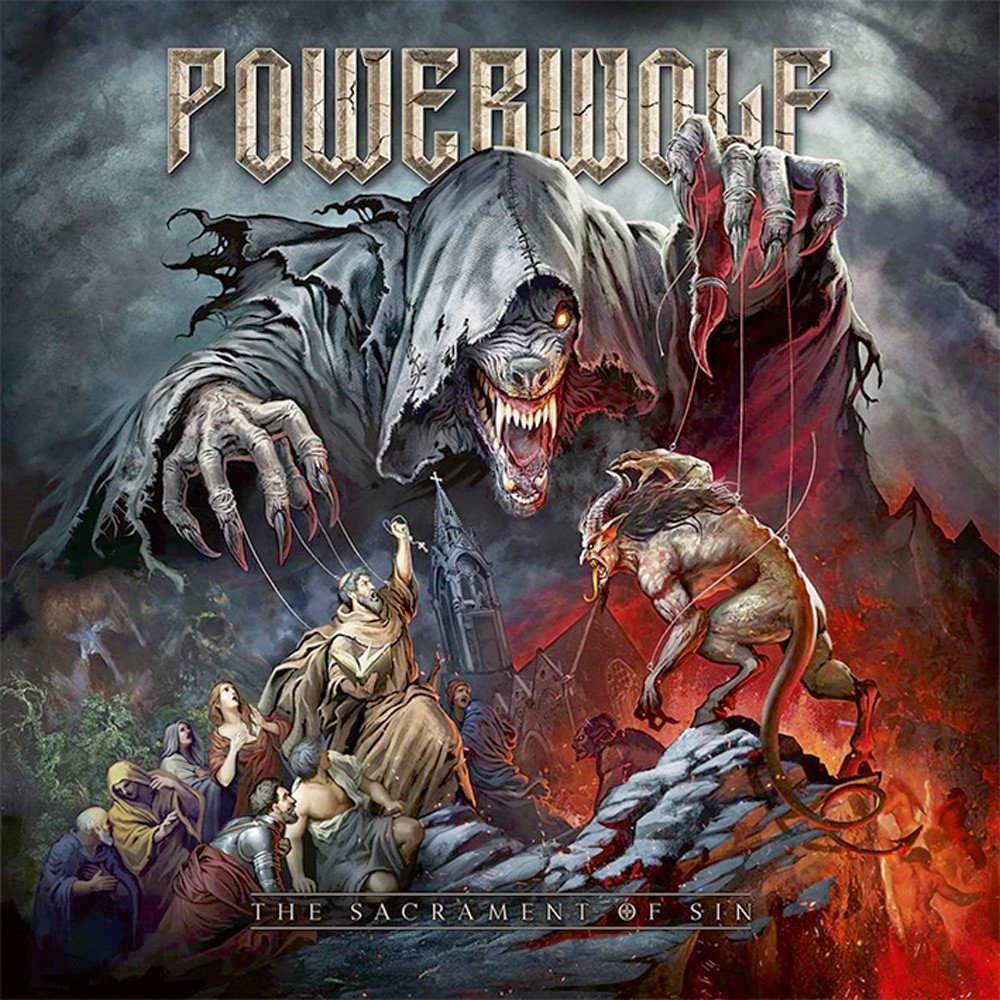
1095. Powerwolf / The Sacrament of Sin. 2018. 3.5/5

I have only come across Powerwolf over the last 18 months as Spotify continues to broaden my ability to take in new bands of genres that I enjoy, and given my penchant for European power metal bands this seems like a good fit. I had a choice to either go back to 2005 and check out the band from its beginning or instead take on their latest release and see what they have been producing in recent times. It is the latter path I have decided to tread, and thus I came to The Sacrament of Sin.

From the very beginning it has everything I like about this kind of music. Great vocals, fantastic double kick on the drums, terrific guitaring and soloing and the ever-present keyboards adding their support to the mix. It is the initial build up and then double-kick drumming of the opening track “Fire & Forgive” that lures me in, and it kicks off the album superbly with the anthemic vocals pushed along by the speed of the music underneath, encouraging you to sing along as well. “Demons Are a Girl’s Best Friend” has the first incantation of the “woah-oh-oah" that is inbuilt to have crowds singing along at the concerts, but is just as effective at home in the lounge room. “Killers with the Cross” drags the pace and beat back into a more traditional metal or hard rock frame, and it is the vocals again that make you feel like singing along, while the solo breaks are impressive as well. “Incense & Iron” follows a similar trajectory and is also good, allowing the chants and fist pumping vocals to drive their way throughout.
“Where the Wild Wolves Have Gone” is the power ballad of sorts, slower and resoundingly more introspective. As per usual when it comes to this type of song it is not in my sphere of entertainment, though I am well aware that it is (apparently) necessary to have at least of these songs on every power metal album. It’s done well, but it’s not my cup of tea. “Stossgebet” is a good song without being brilliant, perhaps trying too hard for that epic sound. “Nightside of Siberia” returns the album to the front foot with another song based on solid rhythm and chanting vocals. This is followed by the excellent title track “The Sacrament of Sin” where the fire and speed returns in full bloom. For me this is where the best aspects of the band come to the fore. When the double kick drives the guitars to full speed and the vocals are allowed to flow along in symphony the band sounds at its best. This is a great song, and is followed by “Venom of Venus” which continues the great thematic values of the album. The final two songs, “Nighttime Rebel” and “Fist by Fist (Sacralize or Strike)” finish off the album on a good note.

Five or six full rotation plays in and I have to say that Powerwolf have got me on board. It is all and well to utilise all of the aspects that comes with being a power metal band – using the word ‘power’ in your band name is a bit of a giveaway – but you still have to do it well to pull it off, because if it is less than great it will just be a turn off. Here on The Sacrament of Sin at least I think they have the mix right. The guitars dominate the keyboards which I am a fan of. I like the keyboard aspect in power metal but sometimes think it is overplayed. Here the guitars of Matthew and Charles Greywolf are the dominant feature which gives the songs more depth and strength. The drumming of Roel van Helden is terrific, and the vocals of Attila Dorn are pleasantly enjoyable.

While the start and end of the album outweighs what comes in the middle, this for me is a more than enjoyable first stop on the Powerwolf band wagon. There’s no doubt I will now have to work my way through the discography to see if they have been on this wavelength throughout their existence.

Best songs: “The Sacrament of Sin”, “Venom of Venus”, “Fire & Forgive” and “Killers with the Cross”.

Rating: “From their destiny they wake, bring hypocrisy and hate”. 3.5/5

Monday, October 22, 2018

1094. Judas Priest / Live in London [Live]. 2003. 4/5

It’s probably a sure sign of desperation, given you have only released two live albums in the first 25 years of your existence as a band, and then you release two in a startlingly short space of time. Ostensibly it seems like an effort to keep the band in the public eye, and show their relevance despite a struggle to get fans to accept two albums without your big time lead singer. Whereas '98 Live Meltdown was an audio release only, Live in London was filmed and released as a video as well as this audio contribution. But if you have one, do you need the other? And if the first did the job of introducing your new vocalist in a positive fashion, do you need another to try and shore that support up?

To be honest, I really enjoyed '98 Live Meltdown as a live album. It had a couple of rough pieces, but overall it was a good set list performed by a great band who can still do the job. It introduced new material effectively, and the energy throughout is excellent. And that is where this release falls down for me. The set list has a few necessary changes, incorporating a couple of songs off of Demolition and some other older songs, but for the majority it is the same songs that were played on the previous world tour and as such off of the previous live album. And – for the most part – they don’t sound as good here as they did then.
The first problem that is encountered is that the old songs completely outshine the newer material. There is a massive gap in the vitality and speed and overall metal value of the old classics than there is of the material from the Ripper era. “Hell is Home”, “Feed on Me” and even “One on One” sound slow, clunky and devoid of life compared “Electric Eye”, “Living After Midnight” and “Metal Gods”. They get completely shown up here and exposed badly for their deficiencies. “Blood Stained” and “Burn in Hell” don’t fare any better. It’s a disappointment, and one feels that they could have done a better job in promoting these songs good sides.
The second problem is that this doesn’t seem as energetic and exciting as the previous live album. It’s nice to hear a little bit of variety with songs such as “Desert Plains” and “Running Wild”, but neither of these two songs sound as good as Halford sang them, and the choice of “United” doesn’t work either. And as I said, I think '98 Live Meltdownsounds better overall.

This is still a good live album, and you can’t argue with the amount of material that you get for your money. It also serves as the finale for Tim “Ripper” Owens and his time in Judas Priest. He is a fine front man and he did his job in keeping Judas Priest alive, and I can vouch that seeing the band live with him out front was a worthwhile experience. As an epitaph for his time in the band, this is a reasonable tribute.

Rating: “Judas! Priest! Is! Back!!!”… but only for a short time. 4/5

Thursday, September 13, 2018

1093. Judas Priest / Jugulator. 1997. 2.5/5

Much has been made of the seven years that stretched between the release of the monster album Painkiller and of its follow-up Jugulator, which incorporated the leaving of Rob Halford from Judas Priest, and the eventual recruitment of the former singer of a Judas Priest cover band, Tim “Ripper” Owens. The lengthy period of time it took to get to this point has always been an interesting point of discussion. Many wondered if Judas Priest would ever record again in any form with Halford’s absence and no doubt this acted as an encouragement for the band to forge ahead. The danger given the length of time between albums was obviously inherent – would their music still be relevant in a world that had changed so much in that time?

I went into this album with a clear head and open mind. More than anything I wanted to like this album so I wasn’t going in with negative thoughts about it. The writing which forever had been composed by the trio of Tipton, Downing and Halford was now a writer short, and there was always going to be differences in the music because of it. Glenn wrote all of the lyrics while both he and Ken wrote the music, but if you take a third of your writing partnership away there is going to be a swing from the centre to one side or the other. And let’s face it, seven years is a long time between albums even if the band was settled, and the drastic swing between metal in 1990 and metal in 1997 created such a vast chasm that it was always going to be hard to overcome. Releasing “Painkiller II” would have been a disaster. Even so, the none-too-subtle change of musical direction between these two albums was a big gulf to accept.
One thing that wasn’t a problem was the vocals. “Ripper” came in with a great set of vocal chords and an uncanny ability to sound and sing like his predecessor, which for live performances was exceptionally handy as the live show barely missed a beat with the back catalogue of songs, something that is rarely the case when a band changes singers. What did have to be achieved was to find the right range for his vocals on the new songs being written, and given the slight change in this album’s direction that may not have been the easiest part to complete.
Despite all of this, what Judas Priest produced for their ‘comeback’ was like nothing they had ever recorded in their career, and that is where the major stumbling block was at the time, and remains to this day. The fact that they chose to record an industrial metal album at a time when industrial metal was at its prominence is not the issue. The issue is that it is so unlike a Judas Priest album that it becomes almost impossible to listen to. And even though as I said above that I went into this with an open mind, and that releasing “Painkiller II” would have been a disaster, you surely have to think that at least a few pieces of the past would make their way into the mix? But it is almost completely wiped away. This is a sound that has almost nothing to do with what Judas Priest had built their career on and it is somewhat shocking, even today. Honestly, to me it has the same mistakes that Dio made in writing and recording their Angry Machines album, in that there was no familiarity at all between that album and anything else they had released that it caused major fractions in the fan base. Much the same can be said about Jugulator.
And it comes from the very beginning. The opening track on a Judas Priest album is usually one of the highlights, the song that drags you willingly into the album. Think of “Freewheel Burning”, “Electric Eye”, “Sinner” and “Painkiller” as just a few examples. But, even though I like “Jugulator” as a song, it just doesn’t have that same drawing power. “Blood Stained” too has plenty of angst and drive to the song, and to be honest if you have made it through the two opening songs and not turned this off, and have also put completely out of your mind that this is a Priest album, you will be able to get more out of it. This album has more of a tame Fear Factory sound to it than any pretence of following the band’s previous doctrine, which is so very strange as it has more in common with the direction that Rob Halford took with two projects after leaving the band, Fight and Two. If both parties were heading down that path, then why part ways? Why remove the brilliant harmony guitars and great solos which act as the strength of the band to just side with the times? I don’t know the answers to these questions.

Anyone who saw the band live during this period knows full well that they were still just awesome, and that “Ripper” was great, but the new material just didn’t gel well with the old stuff. More than anything else that is what harms its overall appeal. There are still some terrific songs on this album, such as “Death Row”, “Burn in Hell” and “Bullet Train”, where when heard away from the rest of the album will garner a positive response. But the album as a whole just doesn’t work in a way that makes it a good Judas Priest album. It is so tied to the era because of the way the songs have been written and recorded that it doesn’t have a chance to stand on its own legs. That is a shame.

Rating: “Changing my course, blurred and scorched, breathing exhaust as we distort”. 2.5/5

Wednesday, September 12, 2018

1092. Judas Priest / The Complete Painkiller Tour [Live Bootleg]. 1991. 4/5

I didn’t become interested in tracking down bootleg concert recordings until the age of the internet, mainly because I had no way of finding a way into the network that went through such things in my pocketed little corner of Australia. Once the internet became an accessible thing it became something I was much more interested in, and especially from tours that we had not been fortunate enough to have seen here. Amid the reunited Judas Priest of the new millennium I began hunting for anything I could find from the tour promoting my favourite Priest album Painkiller, and that search eventually came up with this gem of a recording.
For the most part, what I was looking for was live recordings of the songs off the Painkiller album, and this doesn’t quite cover it, despite 
proclaiming to have every song from the tour.

As a matter of fact, both “Metal Meltdown” and “A Touch of Evil” were played but they don’t appear on either disc of this album. No big deal, but it still would have been good to have had them as a part of this collection.
Instead what we have here is two performances, one from the start of the tour and one from closer to the end. The first disc is compiled from radio broadcasts of the opening night of the tour in Los Angeles and as such is good quality. This includes the performance of “Better By You, Better By Me” that was at the centre of the court case that the band had spent much of the previous year fighting over the two kids who had claimed the song had backwards messages suggesting they commit suicide. It had delayed the release of the album and the start of the tour, and playing this song was no doubt a little stress reliever for them. Apart from this, the set list contains what you would expect, along with “Between the Hammer and the Anvil” and “Leather Rebel” from the Painkiller album. It’s a good listen.
The second disc is a great audience recording from their gig at Offenbach, Germany in February 1991. This is a true bootleg because the crowd are in the foreground and the band in the background, complete with the crowd nearby the recorder singing along in unison. This is what makes a great bootleg in my opinion, getting a great impression of how the crowd is enjoying the show, while still hearing the songs in there as well. The addition of “All Guns Blazing”, “Night Crawler” and “Painkiller” make this an excellent representation to what is a great disc.

This wasn’t exactly what I was looking for when I went searching for live performances of the songs of Painkiller, but it probably doesn’t exist anyway. What I found instead was an excellent bootleg of two complete gigs from the same tour, where Judas Priest are at the peak of their powers and showcasing their wares to the world. Those that enjoy bootlegs will get a lot from this double album. Those that prefer the crisp live recordings that comes from official releases will still be surprised just how good this sounds.

Rating: “Lightning in the dark!!” 4/5

Tuesday, September 11, 2018

1091. Alice Cooper / A Paranormal Evening with Alice Cooper at the Olympia Paris [Live]. 2018. 5/5

While Alice Cooper’s output of albums has been remarkably consistent given the length of his career as an artist, over the course of this time there have been less live albums released by his band than you may have expected. Given his legendary status as a live artist this may be construed as unusual, but the scarcity of them actually improves their output. Indeed, when this release was announced I found myself looking forward to it immensely to not only hear what he and his current band sound like live but what flavours we were likely to get from it.

Choosing any set list for any tour is a tough ask, trying to find the balance between the old and the new, the popular and the obscure, the songs you can’t possibly leave out and the ones that the fans really want to hear. There is nothing easy about it, and the longer an artist has been around the more difficult it is. Alice Cooper has 27 studio albums worth of material to choose from and only a finite time on stage in which to play, and given the amazing hits that have been produced over the years it must be a crazy decision to decide what to shoehorn in to that allowed time.
I have always loved A Fistful of Alice because it not only managed to put together a great set list comprising both the great hits from both the past and that present time, but it gave the whole show a modern sound without being detrimental to the source material. It is a great live album. The gratifying thing is that A Paranormal Evening with Alice Cooper at the Olympia Paris is exactly the same. It is a brilliant mix of all pieces of the Alice Cooper story, and every song sounds brilliant in its own way. The band and entourage sounds brilliant, a terrific ensemble of musicians and singers who do justice to every track.
From the very start this clicks into gear with a great selection of songs. Opening with the underrated “Brutal Planet”, you are then hit with three of Alice’s all time classics, the hard rocking trio of “No More Mr. Nice Guy”, the brilliant “Under My Wheels” and the timeless “Department of Youth”. It’s a nice touch having these legendary track opening the set, as well as having “I’m Eighteen” and “School’s Out” closing out the album in style. The way in which Alice mixes the lyrics from the other schoolkid rebellious song of that era, Pink Floyd’s “Another Brick in the Wall”, into the melody lines of “School’s Out” is a particularly effective way of closing out the show. Within the middle of the set we are also favoured with high energy versions of “Billion Dollar Babies”, “Cold Ethyl” and constant companion “Only Women Bleed”. All of these legendary tracks still hold their own after all of these years, and the versions played here are superb. Most fans know these songs off by heart and are crowd favourites from that era.
However, what makes this such a great live album is that there are plenty of surprises here from the first third of Alice’s career apart from those classic tracks, and each of them comes off superbly. “Pain” from Flush the Fashion, “Ballad of Dwight Fry” from Love It to Death , “Halo of Flies” from Killer and the duo of “Killer” the same album and “I Love the Dead” from Billion Dollar Babies are excellent reminders of the strength of much of the material from the 1970’s that doesn’t always get a look in when the best of Alice Cooper gets thrown around.
On the flipside the modern day material gets a fair showing. Along with the aforementioned “Brutal Planet” there are also excellent versions of “Woman of Mass Distraction” from Dirty Diamonds and “Paranoiac Personality” from his most recent release Paranormal. And as always the two big tracks from his modern day revival come in, with “Poison” and “Feed My Frankenstein”. However, for me the best track on this whole double album is the appearance of “The World Needs Guts” from the Constrictor album. I loved this album as a teenager, and hearing this song given the live treatment is a joy. It is a raucous version too which makes it even better. Thanks Alice just for this!

Do you need a new Alice Cooper live album? The answer is a resolute absolutely! At 70 years of age he shows no signs of slowing down, and this album reminds you of how huge his legacy is and how he has managed to continue to be relevant through so many decades of change in music. There is something here for everyone, for the old fans who have been around for the whole journey, and the young fans who have only cottoned on to the legend in recent times. This is a worthwhile addition to the catalogue.

Rating: “Hey you! Fighting for your life where you’ve never fought before!” 5/5

Thursday, September 06, 2018

1090. Judas Priest / Painkiller. 1990. 5/5

The decade of the 1980’s had had its ups and downs when it came to the popularity of Judas Priest. But perhaps more importantly, it had included a degree of differing styles in what Priest had chosen to infuse into their music at different times of that decade. Over the course of four albums in just over four years - “British Steel”, “Point of Entry”, “Screaming for Vengeance” and “Defenders of the Faith” - the band had ridden high on the wave of heavy metal that they had helped to create, and saw their style of dual guitar metal mayhem rise to the top of the echelons they were aiming for. Their decision to move in a similar direction to some of their contemporaries to include a synth sound in their mix for their 1986 album “Turbo” was no doubt seen at the time as a canny if brave move, and while it produced success in some areas along with a hit single, retrospectively it has not been seen to have aged well. Their response to this was to do a hard right turn and try to recover lost support with the “Ram it Down” album in 1988, purported to be a return to their more traditional style of heavy metal. More than anything else on these two albums, it was a combination of differing musical style along with lyrical content that seem slightly more ludicrous than Spinal Tap that was a major stumbling block, combined with the rapid rise in popularity of thrash metal in the form of Metallica, Megadeth, Slayer and other bands that was drawing attention away from Judas Priest and what they were producing.
At what point can it be conceived that the band decided that they needed to make a hard decision, and perhaps accept they had made a slight error in their direction? Synths had come in for “Turbo”, but were for the most part pushed out on “Ram it Down”, which was proclaimed to be a return to what Judas Priest did best. Even for someone like me, who enjoys every Judas Priest album and almost every era of the band, I found that the messing about with the ingredients over the previous four years had caused a change in the final product. Having taken the decision to try and run with the synth metal direction, they now found themselves approaching the new decade down the wrong garden path, ending up in the field of poppies rather than the thrash heavy populus of the Emerald City. They were not the only band to have found this fate awaiting them due to similar choices. But this was Judas Priest! One of the bands on which heavy metal had been formed! So the hard and difficult decision began to be made.
Somewhere, somehow, following the tour to promote the “Ram it Down” album, long time drummer Dave Holland was moved on. In his place they brought in the powerhouse of Scott Travis, whose powerful double kick drumming with the band Racer X had always been a prominent part of their music. They also decided to go in a different direction with their producer, with long time partner Tom Allom being let go and Chris Tsangarides coming into the chair. Now, the writing process had to begin for their next album, and given the adjustment and then over correction of their previous two albums, the discussion between the band and the writers and new producer must have been fascinating. Just what did they want and need to produce with their music in order to regain their position as one of the front runners of the heavy metal industry? Given the ground they appeared to have lost to the up and coming thrash metal elite, it would not be an easy task. So what did they do? They produced the album “Painkiller”, and absolutely crushed the fucking music world.

Way back in 1990, there was an absolute plethora of albums coming out that have become folklore in the world of heavy metal music. People’s opinions vary somewhat on them, but as a twenty year old trawling the record store shelves it was an amazing year of releases for this genre. While it is hard to go past albums like Megadeth’s “Rust in Peace” and Slayer’s “Seasons in the Abyss” and Anthrax’s “Persistence of Time” as the stand out albums of this year, one album in particular for me was the one that shepherded heavy metal music into the new decade. It also brought life back to the band in question, hurtling them to the top once again with another album that was a star attraction. The band was Judas Priest, and the album of course was “Painkiller”.
I had pre-ordered this album at the local record store, and came home from work one day to find my mother had picked it up for me. Having done the usual post-work things I took it to my room and put it on and, as I am sure occurred to almost every person who has listened to this album, was completely blown away by the opening drum fill from new Priest drummer Scott Travis. Having ben well informed of this ‘new guy’s’ previous work with Racer X, and that he was a beast of the drums, it shouldn’t have been a surprise, but that opening drum extension was just mind blowing from the outset. It is still as brilliant today, and then that magnificent guitar scream comes in over the top, before the song descends into the opening riff chords. And we are away – but everything you need to know about the album “Painkiller” comes in the opening fifteen seconds of the opening title track. You only got one chance to hear this opening to the album for the first time, but each and every time I play this album, I feel as exhilarated as I did the first time I heard it. It is almost unmatched in heavy metal music history. From there the song just continues into brilliance, as Rob’s vocals join the party, and sit in that high extreme phase of his range for practically the entire song, making it practically impossible to actually sing along with him. It is an incredible vocal feat, one that allows this song to remain as amazing as it has been for the past 35 years. It is a new Halford here, taking charge from the outset, making it known that Judas Priest is here to play with the so called youth brigade, and they are in no mood to relinquish their crown. The dual guitar solos in the middle of the song just tear it apart, and that scream to end the track is outstanding. What a way to open a new album.
What brought about this ‘revival’ in the band and its music? Was it really a revival? There are plenty of fast and hard tracks on the previous album “Ram It Down” along with a toning down of the keyboard and synth side of the recordings, something that makes a return in bigger and more bold direction here. No doubt the addition of Scott Travis on drums rekindles something that Dave Holland did not. Holland’s drumming was always precision and timing perfect and certainly never detracted from the music. Probably the difference here, as is evident from the opening of the album, is that Travis adds to the music and songs and isn’t just a part of the furniture. HIs drumming doesn’t just hold the rhythm, it becomes a bigger part of the picture, and this alone does make a difference in the songs produced.
The other factor changed here is the re-emergence of Chris Tsangaridis as producer, replacing Tom Allom who had produced every Judas Priest album since “Killing Machine”. Was his presence alone enough to create the changes that came with this album? Probably not, but the fact that he gave a fresh air of advice along with his success in those recent times with many other bands and artists surely added to the changes that came with the writing and recording of “Painkiller”.
What we got here was a mashing and melding of all of the greatest parts of Judas Priest, and then amplified beyond the normal. There is aggression in the lyrics and the vocals, there is fire in the guitars and bass, and there is speed and double kick to an extreme in the drums. Rob Halford’s vocals, often dormant in regards to his higher range over some albums, are at their most damaging here, so much so that it makes it almost impossible to sing along with him throughout this album. When Rob is reaching for the ceiling you know every effort is going into the song and it brings the roof down. The added power of the drumming of Scott Travis gives these songs a greater punch, and a harder and faster tempo than they would without it. Ian Hill’s bass is at its best too, providing the big bottom end that highlights the riffs it is backing while exerting its own rumbling influence over them, especially in songs like “All Guns Blazing” and “A Touch of Evil”. Sometimes maligned by those who aren’t fans of the band, Hill’s basslines on this album are a massive part of what makes them so great. Through it all, the magic of the twin guitars of K.K. Downing and Glenn Tipton rule all. The melodic interludes that then get ripped apart by their blazing and blistering solos are the culmination of years of brilliant songs and writing. Yes they have been a part of so many amazing interludes over so many albums, but it truly feels as though it was all building to what they produced on this album.
Everything here is a triumph. Those faster and heavier songs such as “Painkiller”, the rifling of “All Guns Blazing”, the almost speed metal tendencies of “Leather Rebel” and pure heavy metal of “Between the Hammer and the Anvil” are complemented perfectly by the slightly less speed influenced but more heavy groove influenced tracks such as the doom riding of “Hell Patrol”, the heavy hitting tones of “Metal Meltdown”, the creepy horror film soundtrack vibes of “Night Crawler” and the charging fist pumping victory anthem of “One Shot at Glory”. On the outlier is the moody brilliance of “A Touch of Evil” which is still perhaps the show stealer it always threatened to be, the one slight change in appearance with the drenching synth that only enhances the concept of the song and the darkening mood that it portrays, a template that could well have been the benchmark of Judas Priest writing sessions had that future panned out differently. There is not a weak song here. Everything clips together perfectly, segueing from one brilliant track to the next, exhorting you to sing, chant or scream along in unison while frantically playing those air guitars to a standstill.

It is ludicrous that although this album was recorded early in 1990, and indeed was completed by the end of March, that it was not released until six months after that date. This was due to the much publicised trial over the supposed subliminal messages that finally began in June of 1990, a civil trial over the alleged backward messages on the Judas Priest song “Better By Me, Better Than You”, that it is alleged encouraged the suicide attempt of two teenagers in 1985. The case was eventually dismissed on 24 August 1990, which allowed the band to finally release their new album.
As I alluded to earlier, I had pre-ordered this album from The Rock Factory at Shellharbour Square, one of our nearby record stores, and arrived home from work one day to find my mother had gone and picked it up for me and left it on my bed. And so that afternoon I put it on, and had my brains metaphorically blown out. And it did the same things for months afterwards, alongside those other several albums I have mentioned here that came out around this same time - “Rust in Peace”, “Persistence of Time”, “Seasons in the Abyss” and “Empire”. It was an incredible time in music for a 20-year-old headbanger.
This album defined for me where I thought metal was heading back in 1990, into the next decade. Along with those other brilliant albums from the same year, it felt as though this was going to be the new direction that heavy metal was going to take, the morphing of heavy and thrash and speed metal into a monster that bands like Priest, Megadeth, Anthrax and Slayer could paint the decade of the 1990’s with, that they would make this the next wave, the next generation, of the heavy metal story. Of course it all became a ‘final shot at glory’, as Priest had almost predicted with their closing track.
This album is rarely away from my stereo for a long length of time. It always seems to find a reason to be played, to find its way off the shelves and back into my stereo. When my friends from over the years get together to have a few drinks and reminisce on old times, this album always seems to be a part of the soundtrack. Everything about it brings back this moment in time, as most of us turned 21 years of age within months of its release, and that period of our lives has this rusted onto it.
Last year I was fortunate enough to be asked to be a guest on the wonderful podcast hosted by Jay and Jeff that is called the Judas Priestcast, and on this episode, we were asked to come up with a movie idea that incorporated Judas Priest songs as the soundtrack to that movie. I basically took the entire “Painkiller” album and built my story idea around it, so that I could use the album as the soundtrack. Yes, that was slightly obsessive, but that is exactly how I feel about this album. Also, if you haven’t done so already, check out the Judas Priestcast podcast, it is one of the best out there.
So as you can probably imagine, I have had this album out for the last couple of weeks, and once again I have been playing it to death once again. Somewhere between 15 to 20 times as I first bathed in its awesomeness, and then studied its characteristics intensely. It is an album I could have spent another hour or so praising its magnificence, outlining its every great moment in intense detail. For the most part I have avoided that, simply for the fact that you all know this album as well as I do, and you either agree with me or you don’t, and no amount of fanboying about that will change your mind. Which is not what I am here to do. My role on this podcast is to present you with the albums of my life, the good and the average, and offer to you my opinion for what it is worth. I hope you’ll agree with me, but I understand that won’t always be the case. When it comes to this album, suffice to say that it is one of the most important building blocks in my love of music, and also myself as a person. If you delve below my surface, you will find the hell patrol, you will find all guns blazing, all taking that one shot at glory.
As I mentioned, I truly believed this album was pointing towards the future of heavy metal in 1990. Not for the first or last time in my life, I would be proven wrong. Grunge had taken seed, and Metallica would further commercialise the genre with the release of the black album the following year, and bands began to change their sound away from this magnificence to something… less magnificent. Judas Priest of course went on a lengthy sabbatical after this tour, with Rob Halford leaving the band for other ventures, and what should have been the album that provided the springboard to further greatness for the band instead became a lasting monument to their memory and legacy instead, and for a long time looked as though it would be their final chapter. All in all, it would not have been a bad way to bow out.
Wednesday, August 29, 2018

1089. Judas Priest / Ram It Down. 1988. 3.5/5

When the decision came about to split the “Twin Turbo” double album idea into a ‘heavy’ and ‘light’ concept over two albums, there were a number of songs left over from Turbo that came to be used here on Ram It Down. And there are noticeable differences in the songs of both albums. A lot of the synths used in Turbo have been moved out or placed in the background here, allowing this album to go back to being a guitar and drum based track list. The lyrics for the most part are a simplified version of recent albums, trying to return to a different time. It is an effort to make a heavier album than the last, whereas perhaps making a ‘better’ album may have produced something that was more significant.

It holds up with the opening track, the title track “Ram it Down” which screams out of the speakers at you with fire and speed, the best elements of the Judas Priest juggernaut. Perhaps it is somewhat simplistic in lyrics and base set, but there are any number of great Priest songs that you could name that are like that, and this is another great version of that. Why it is maligned so much I don’t know, because “Ram it Down” is a great metal song. This is followed by the perhaps metaphorically titled “Heavy Metal”, but again it has what you want. Halford’s vocals are in his upper range almost all the way through, while the magnificent guitars of Downing and Tipton shred away in style. As it is obviously written as an anthem, it is strange that it has been used so infrequently live since the end of this tour.
We head into a section of the album where the words ‘double entendre’ come into play most significantly. “Love Zone” is a strange concept song for this band, or at least so I would have thought. Perhaps in the end it just confirms the groupie situation for the touring band is the same for everyone, but it wasn’t a direction I thought Judas priest would cover. I was mistaken. This is followed by “Come and Get It” which for all intents and purposes is just about the music and if you want it… well, you know… but I’m sure if you put your mind to it you could come up with a way that the lyrics here could be interpreted another way. This then leads into “Hard as Iron” (yeah I know, pretty easy to laugh at…) which again lyrically doesn’t point in the way you might initially think but you could certainly make a case that it does. Beyond this lame attempt at breaking down the lyrics of these three songs, each continues in the heavy vein of the album, with a greater push to emphasise the guitars and vocals on this scale.
“Blood Red Skies” is a beauty. Without even trying to compare them for fear of being seen as ludicrous, “Blood Red Skies” is in a similar vein to past gems such as “Beyond the Realms of Death” and “Victim of Changes” in its composition. It’s moody subtleness throughout emphasises its difference to the other songs on the album, and as a result I think it is one of the standouts on Ram It Down. “I’m a Rocker” retains the slower tempo as the follow up which is probably slightly strange considering the title and lyrics, but it again looks the chanting anthem qualities between the twin solos of Downing and Tipton.
One of the songs that I am not sure about even today is the cover version of Chuck Berry’s “Johnny B. Goode”. Done for the soundtrack of the comedy film of the same name, it was then shoehorned onto this album and released as a single as well. Yep okay, it’s good that they did their own version of the song, and didn’t stick to a note by note revision of the original, and the band sounds great here, but I often just think is it necessary? Another song, “Thunder Road” was bumped from the album in order to fit this on, and I believe it is a superior and better song. It was eventually released as a bonus track on the remastered version of Point of Entry. To be honest, “Thunder Road” could have replaced either of the last two songs on the album too, as I think it is also better than them. “Love You to Death” and “Monsters of Rock” are both really only average songs that perhaps lengthen the album longer than it needed, and are both just a little too slow in tempo after the first half of the album for my liking.
For many Judas Priest fans, this album over-corrected what they felt wasn’t quite right with the previous album. There was a fire-and-brimstone quality that perhaps it didn’t have and they wanted more of that. In essence there is plenty of that here on Ram It Down, but it is missing the pure rocking anthem that songs like “Turbo Lover” and “Locked In” provided from that album. Many probably felt that a mixture of the two – the harder, heavier edge of Ram It Downalong with a fissuring of the keyboard and synth sound from Turbo to influence the feel of the songs – may produce the album that they were looking for. This indeed is what came to pass with the following album which opened the new decade in the most amazing style.

In many ways like Point of Entry this album gets lost in the discography of Judas Priest, more from the album that followed than from any real distaste of the album itself. It may never be considered one of the great releases, but it isn’t quite the disappointment that some make out they believe it is. Taken on its merits it still has plenty that should be better regarded than it is.

Rating: “Can you feel the power, blinded by the light.” 3.5/5

Monday, August 27, 2018

1088. Judas Priest / Priest... Live! 1987. 5/5

Back in 1979 Judas Priest released their initial live album entitled Unleashed in the East: Live in Japan, which was praised and loved in most circles but also somewhat derided in a small circle because of the re-recording of the vocals after they were trashed on the original tapes. As such some believed it could never be considered as a true live album, which didn’t stop it being extremely popular. Thus with the announcement and release of the band’s second live album, the double vinyl opus Priest... Live!, those thoughts could be put to rest, and the fans could enjoy a live album with no foibles and great songs. So you’d think.

I’m not going to lie to you. When I got this album, even though it was a couple of years after its release, I was excited. I love and loved Unleashed in the East: Live in Japan and I was looking forward to hearing another live album. As it turned out, at the time I hadn’t heard any of the Turbo album apart from the title track, so given it was recorded on the Fuel For Life tour to promote that album there were obviously songs that I hadn’t heard before. My enjoyment of them allowed me to go back in search of that album after the fact and probably helped me to enjoy it more than many did at that time.
The album has no songs on it from any album prior to the previous live album. The band played songs on that tour from their 1970’s era but chose not to put them on this live release, which in the long run I think was a great idea as we instead heard only songs which to that point had not been released as live versions. I also meant that a lot of songs that didn’t get played live too often after this tour were caught for future posterity here.
So what we get here is not necessarily the definitive selection of Priest tracks from the 1980’s, but it is an impressive and enjoyable selection. The triumvirate of “Electric Eye” into “Turbo Lover” and then into “Freewheel Burning” is a high energy speed-fest that highlights the best part of the album with three of the era’s best songs. I still enjoy the opening of “Out in the Cold” moodiness that leads into the anthemic “Heading Out to the Highway” and the ground shaking “Metal Gods”. And not forgetting the awesomeness that is “The Sentinel”, with Halford at his glass shattering best in his vocals. Some will see the missing space that comes with not having songs like “Screaming For Vengeance” and “Rock Hard, Ride Free” on the album, though this was rectified with the remastered version of the CD some years later.
In the live setting, the band sounds spectacular. Dave Holland on drums is as metronomic accurate as ever and does a great job, with his rhythm partner Ian Hill on bass keeping the bottom end perfectly sound. The dual electrifying guitars of K.K. Downing and Glenn Tipton are just fantastic, searing and scene stealing between them, while Rob Halford shows that he can carry his pipes live just as well as he does in the studio.

Priest... Live! is a terrific live experience and a great recording of Judas Priest the band in their element. It may not be as energetically satisfying as Unleashed in the East: Live in Japan was, but it perfectly captures the 80’s decade of this great band in their defining moment.

Rating: “It’s Friday night and the Priest is back!”  5/5

Friday, August 24, 2018

1087. Judas Priest / Screaming for Vengeance. 1982. 4.5/5

Whether or not Point of Entry was considered to be an experiment of sorts, an effort to write an album that would search for commercial success, is hard to pin down. Whatever the debate of it has become, one can only assume that during the writing for the follow up, which became Screaming for Vengeance, that there was a committed effort to return the band to a heavier sound, one utilising all of the talents of the band rather than just moving along in third gear. Anyone who listens to both albums back-to-back will no doubt come to the conclusion that something had changed, because chalk and cheese does not even begin to describe how different those two albums are.

Any doubts of Judas Priest’s validity in the world of music are eradicated within the first 60 seconds of putting this album on. The ripping instrumental attack of “The Hellion” screams out of the speakers. In fact, it is almost the ultimate opening stanza of a Priest album, probably only topped by the opening to their 1990 album down the track. This shoots straight into “Electric Eye” which in turn is of the highest quality opening tracks in Priest history. It has it all, speed, screams and sensational twin guitar solos to lock in the middle of the song. It is still one of my all-time favourite songs from this band. This is followed by “Riding on the Wind” which continues in the same vein, a hard and heavy opening from the rhythm that sets off Halford in his higher range vocal strains, something that certainly wasn’t stretched on the previous album, and it immediately makes this better because of it. “Bloodstone” finds that perfect mid-tempo heavy rhythm and settles in for the distance, leaving Halford to sing mightily along with the chorus of guitars playing underneath him. A terrific opening to the album.
“(Take These) Chains” has different bent than the other songs here, certainly because it was in fact written by Bob Halligan Jr and not the band itself. It circles a more commercial property and perhaps veers into a soft metal or hair metal sound than the rest of the album has. It has those ‘sing-along’ qualities but not of a fist-pumping variety that would normally be the case with great Judas Priest tracks. “Pain and Pleasure” is a song right out of context with the rest of the album. It’s a throwback to the 1970’s and doesn’t fit in here with the faster and more energetic 1980’s sound, but more than anything else, it is just quite boring and unattractive. It closed out the first half of the album, but perhaps not in a way that enhances the album. Don’t get me wrong, these two songs are fine, but they are in a different setting than the three that preceded them.
This is recovered in full with the title track “Screaming for Vengeance” which opens the second side of the album in scintillating style. Fast and strong once again with the best parts of the Downing/Tipton combination, Halford’s vocals again are the star attraction, reaching for heights that he makes sound so easy. This is followed by the anthemic drive of the classic “You’ve Got Another Thing Coming”. Built around the same style that songs like “Breaking the Law” and “Living After Midnight” drew on, this became the song that finally saw them break into a commercial setting and receiving radio airplay around the world. It’s funny as this occurred once the band had returned to writing songs that had a real metal edge to them, unlike the more commercial bent that they had been looking for on Point of Entry which for the most part seemed to put fans off.
“Fever” is another track that just differs slightly from the central themes of the music on the album. The clear and quieter sections of the song, all held together by the constant and consistent rhythm of Dave Holland and Ian Hill, makes for a completely different atmosphere within the song to the rest of the album. I found that it took some getting used to, and to find how it related to the other songs surrounding it. “Devil’s Child” then wraps up the album in style, harking back to the first two songs on the second half of the album, taking on a hard edge beat and energy while Halford spits out the lyrics in the way you would expect.
Apart from the songs that have been written for this album, the band is in fine form throughout. Dave Holland’s excellent steady timekeeping perhaps doesn’t appear flashy in any sense of the word, but it is perfectly effective and holds the songs together. Ian Hill on bass is his laconic self, and again while he mightn’t be flashy in comparison to others around, his bass lines are important and perfectly suit the way the songs and other players in the band utilise them. The duelling and complementing guitars of K. K. Downing and Glenn Tipton are at their best here and highlight the great songs on the album, while the return of the full range of Rob Halford’s vocals is one of the highlights.

Many consider this to be the pinnacle of Judas Priest’s career, and while I believe it is one of the highlights it isn’t quite in that category for me. If I had been just a little older and had gotten this when it was released instead of some five or so years later then perhaps my feelings would be different. This still hits all the right areas though and set in place a template that could be followed to find the best Priest releases – speed, energy, brilliant guitar licks and Halford screaming from the rafters. A winning combination.

Rating: “You think you've private lives, think nothing of the kind, there is no true escape I'm watching all the time”. 4.5/5

Wednesday, August 22, 2018

1086. Judas Priest / Point of Entry. 1981. 3/5

Judas Priest’s leap from the 1970’s to the 1980’s had come with the greatest commercial success of their career, something that perhaps surprised the band as much as it did their support crew and their fans. The album “Killing Machine” had the single release of the song “Take on the World” which rose to #14 on the UK charts, the band’s first track to do so. This was followed by the live album “Unleashed in the East” which also garnered commercial success, being the first Judas Priest album to go platinum. This then led in 1980’s “British Steel” which sold over a million copies in the US alone and saw the singles “Living After Midnight” and “Breaking the Law” both go to #12 on the UK charts. At a time when the heavy metal scene in the UK was seeing a renaissance and a surge in popularity, Judas Priest was able to find the right combination of retaining their ethos musically while attracting a growing audience in the same instance.
It is generally accepted that for their follow up album, the band’s label was hoping to build upon the commercial success the band had begun to achieve, and that they encouraged the band to write an album full of songs that would be similar to those that had brought chart success over the previous two albums. It is also true that following the minimalistic way that the band had approached the recording of the “British Steel” album, that they were hoping to explore their own creativity more on their follow up album, bringing a more melodic element to their music to combine with the more straight forward hard rock elements that had come with “British Steel”. The band recorded the album at Ibiza Studios in Spain, and was almost all completely written in the studio, which was a change for the band who would usually have written the majority of the songs for a new album prior to entering the studio.
One of the interesting things I found when it came to researching this episode is the general lack of interviews and quotes from the label, the producer Tom Allom and the band themselves ABOUT this album, how they went about writing it, and what they thought of the album then and what they think of it now. You can find dozens of articles and interviews about “British Steel” and the follow up to this album “Screaming for Vengeance”. In many ways, that perhaps speaks more about “Point of Entry” than anything else could.

The opening track of a Judas Priest album is often the one that defines it. Think about the truly great Judas Priest albums, and the opening song is one that sets the tone for what follows and is considered to be a classic in its own right. And “Point of Entry” does actually open up that way, with “Heading Out to the Highway” being that calibre of song. It doesn’t have the out and out speedy tempo of some of those other tracks, but it opens with that recognisable guitar riff and Halford’s determined forceful vocal that then draws the anthemic qualities once he reaches the chorus. It is a more subdued arrangement than one might imagine from the band, and that is an indication of what is to follow with the way the album was being directed. It still ranks as one of their best known songs. What is more curious is that it was the third single released from the album, especially when the first two single are the next two songs on the album. “Don’t Go” has the slow, staccato stop/start tempo to it, based on the drums and bass guitar, one that sounds as though it is aiming for a crowd chant or participation of some sort, a structure that doesn’t really work here. What are the qualities of this song that led the record company to believe it was a single? I’ve never worked that out. This is followed by the opening single release of “Hot Rockin’” Now HERE is a song that sounds as though it was composed solely for the purpose of being released as a radio friendly single. The more up-tempo vibe about the track, the energetic pace, and Rob’s vocals matching that enthusiasm chanting the ‘hot rockin’ lyrics, all encasing the guitar solos from Downing and Tipton that offer a fairly comprehensive showcasing of al of the best parts of Judas Priest. Except, it is a fairly bland and lame boxing of those elements. It’s okay but it isn’t exceptional. These two songs were no “Living After Midnight” or “Breaking the Law”.
“Turning Circles” fits the concept and structure that the band was utilising here for this album, but in doing so is really quite bland. Even the solo breakdown in the middle of the track seems misplaced, more of an early Judas Priest sound than the more modern the band had progressed through the albums since. This could easily have come off “Rocka Rolla”, but not in a positive way. I guess the chorus of the song is quite apt - “I’m turning circles, so stay away, We’ve all got something wrong to say”. We have indeed Rob. And yet, a similar mood exists in the following song, the one that closes out side A of the album, but it does so in a much more convincing and enjoyable fashion. “Desert Plains” is a moody song that opens in its quiet fashion, and yet it is a slow burn build throughout the track, the rhythm gradually building up, Rob’s vocals increase with power. We reach the middle solos which also add to the perpetually of the track, with Dave Holland’s drumming and Ian Hill’s bass guitar coming to the fore and being the driving engine. The constant build of the track is also imperceptable, and yet that is the beauty of the song. All of this results in arguably the star attraction of the album.
The second side opens with “Solar Angels”, and you will never be able to convince me otherwise that this was not an effort to cash in on one of the previous album’s biggest and best songs, “Metal Gods”. The opening to this track is more or less a small shift from that riff and progression, so much so that I begin to sing the lyrics to “Metal Gods” almost every time I hear the intro to this song. Here again though, the song barely gets out of second gear. It’s a very slow tempo throughout, it moves along at a snail's pace and has trouble offering much that brings this to the fore of the album.
As for the back half of this album, it too has several problems that do not seem to have been thought out by the band during the sessions to record this album. “You Say Yes” shifts ominously between a jaunty blues verse and chorus before another moody breakdown in the middle of the track that then builds back to some noisy energy and reverts back to the same formula as the front half of the song. It’s very clunky. Then comes what I consider to be Judas Priest’s Van Halen medley, three songs that sound as though they could either have Roth on vocals or Van Halen on guitar, such is the rhythm of the riff and the way the vocals come out. “All the Way” is the main perpetrator of this, the sound at the beginning of the song is very reminiscent of that band, and the lyrics don’t help much later on. The chorus vocals on “Troubleshooter” sounds as though they were designed for Roth and Michael Anthony to cry away to while both jump around the stage like overblown teenagers. And “On the Run” completes the album i the same way. All I can see in my mind when I hear this sing is Van Halen on stage, and tight spandex outfits and jumping around and the song being played in a fun atmosphere. And it comes across that way on the album too – it's just that I don’t often imagine Judas Priest as that kind of band. It doesn’t fit with my image, and overall, that’s what the album feels like too.

My introduction to Judas Priest came in my final years of high school, when my Heavy Metal Music Dealer recorded the first side of their live album “Unleashed in the East” for me at the end of another album he was putting on cassette for me. And yes, that was surely the most awesome way to be introduced to Judas Priest. Then followed the videos on “Rage”, such as “Freewheel Burning” and “Turbo Lover” and “Breaking the Law”, and I was immediately on board.
When it came to this album however, that was a longer journey. I think I had collected just about every other album that existed to that point in time before I got “Point of Entry”. I knew “Heading Out to the Highway” but that was it, as I bought all the other albums from the 1980’s along with “Stained Class” and “Killing Machine”, while this one hung on the vine. It was mostly just availability in the record stores I walked into. I don’t recall seeing “Point of Entry” anywhere during those years. Eventually, it came to pass that I bought it on CD, and so was the grand unveiling, the first listen to this Judas Priest album, that I assumed would be brilliant. And that was not what I got. I got an album that had some okay songs on it, but a lot that I wasn’t jumping out of my skin about. It didn’t have the hooks that pretty much every other Judas Priest album offered me. Disappointed would be an accurate description of my feelings about the album in those days. I still listened to it sporadically but usually in an effort to find what perhaps I had been missing on all of those other listens.
About fifteen years ago, for my blog that is also called “Music from a Lifetime”, I went through and reviewed every Judas Priest album, pretty much following the formula I now use for this podcast, putting on the album and listening to it multiple times to asset my true feelings for it and then offering them up in print. And it was during that period that I discovered a different appreciation for it. On heavy rotation during that time, I was able to... find a place for it in my listening heart. I wrote at that time that when I put the album on and turned it up LOUD, it actually worked far better for me than if I just had it on at a ‘normal’ volume. That probably works for most albums, but I did say at the time that that did improve it for me.
This week, I have brought out “Point of Entry” again for its turn in the rotation. It isn’t an album I play often still. There are a lot of better Judas Priest albums on offer. And my opinion largely hasn’t changed. This album has its niche, and moments of songs here do adhere to what the band has advertised they were hoping to achieve when composing this album. It isn’t as regimented as “British Steel” and it doesn’t have the speed or upward energy of “Screaming for Vengeance”, and in places it has an easy listening feel to some of the songs, certainly in relation to previous albums. In fact, “Point of Entry” is quite unique in the Judas Priest discography, because although their stated claim was to write for commercial success it didn’t really succeed in that. Once again Rob Halford has kept his vocal range on the album in check, for the most part eschewing any major extension of his famous vocal cords, and in the main sticking to a range more within normal human hearing. A lot of the songs have periods within them that are deliberately quiet and soft, mirroring a reflective air which in turn shows a different side of the band than what we have seen on previous albums. Most of this to me has created the metaphorical vacuum that “Point of Entry” has seemed to fall into. Following the success of the “British Steel” album and the singles that were released from it, I guess it was a no brainer that Judas Priest would stick to the same formula for their next album and try to replicate that commercial success. Whether or not that was a good idea – and whether or not they achieved that – is a question that is still without a definitive answer. Is it purely because it just doesn’t have many songs on it that are considered classics, or is it because it is believed to have been out of step with the other albums that were released around it? The opinions are wide and varied.
Take away “Heading Out to the Highway”, “Desert Plains” and “Solar Angels”, and this album is very run of the mill. And yet, for all of its misses and failings on some levels, for all of the misgivings I have with the album on most levels, and despite the fact that it doesn’t rate in the top two-thirds of the band’s catalogue, I still can’t help but enjoy it. For the MOST part. I won’t lie that on occasions at work over the past couple of weeks I have been silently hoping for this album to end so that I could get to the next album in my rotation. Mostly after “Solar Angels” it must be said. But when I have been at home, and I close the door to the Metal Cavern and the volume up, I have still enjoyed the album. Up to a point. Not to LOVING it levels. It doesn’t measure up to their great albums, and that’s okay, because I think this album at least taught the band a lesson. I think it probably ended up proving to the band that they needed to redefine the direction they were heading in if they wanted to make a bigger impression in the new decade. While the album did well enough at the time there’s no doubt in hindsight that it wasn’t exactly what their fan base was looking for. And while it will never rank as one of their best albums, it by no means is the worst offering. Different, yes. Out of character, yes. But for all of that it is still a good listen. I’m sure our very good friends Jay and Jeff from the Judas Priestcast podcast – and if you aren’t listening to their podcast, WHY aren’t you? - will tell you that this album is far better than “Turbo” and “Ram it Down”. Whether they are right or not is a determination that will have to wait for those episodes of THIS podcast a little bit further down the track.