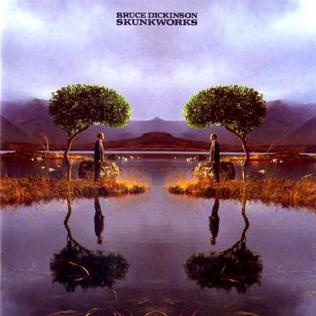
Bruce Dickinson had moved on from Iron Maiden, and with the help of Roy Z and his band Tribe of Gypsies had released his second solo album “Balls to Picasso” to a mixed response. His first solo album, “Tattooed Millionaire”, had been a n effort that simply looked to offer a style of song that was not a mirror reflection of his music in Iron Maiden. Once he had cut ties with the band, he could write music in his own sphere without having to compromise to anyone else’s ideas. Well, Steve Harris. In Roy Z he found a collaborator that worked, and while “Balls to Picasso” had confronted those same changes in music mentioned earlier, it had at least given Dickinson an outlet to be his own man. After the album was recorded the Tribe of Gypsies moved on to do their own album, and Bruce put together a band to help support that album with three new musicians – the excellent Alex Dickson on guitar, the equally excellent Chris Dale on bass and Alessandro Elena on drums. This four piece toured the album, which was recorded and released as the double live album “Alive in Studio A”, which you can hear about on episode 19 of this podcast. It was also during this tour that the band did their drop in concert in war torn Sarajevo during the Bosnian War, which was filmed and released in the documentary ‘Scream for Me Sarajevo’.
The original process was to call the band Skunkworks, but the record label was having none of it and insisted it be released under his solo name. Dickinson however, often referred to himself as the lead singer of Skunkworks in interviews of the time. Perhaps the label hadn't listened to the album before it was released, because the music here is nothing like anything Bruce had ever recorded and released before, and perhaps by doing it under a band name rather than his own it would have found its place in the world. The band produced 22 songs in a 7.5 week period, after which thirteen were chosen for the album itself. In an interview at the time, Dickinson was asked about Iron Maiden’s first album without him, “The X Factor”, which had been released several months earlier, and he replied that he thought that it was a decent album, but that Maiden should change musical styles to fit Blaze Bayley's vocal style, just as they did when Bruce replaced Paul Di'anno. The significance of that statement not only says a lot about what his former band was doing at the time, but also of the direction that he himself headed with the release of his next project which carried the name “Skunkworks”.
The one thing that you cannot deny on this album is the musicianship. The rhythm section of Chris Dale on bass guitar and Alessandro Elena on drums is rock solid throughout, providing the platform that set this album in solid rock. Or alt-rock, if you will (a little pun there for you). Alex Dickson’s guitaring is without question, something he proved very capably on the “Alive in Studio A” live album. And Bruce is... well... Bruce. But yes, it is a different Bruce here.
The album is a mix of a grunge vibe that mixes with the alternative rock and metal that was the growing genre of the time. Dickinson has made a conscious effort to move away for the ‘air raid siren’ vocals of his Iron Maiden past and looked to lock into what was happening around the band at the time this was conceived. He and Alex co-wrote all of the songs on the album, with Chris Dale getting a co-write for “Innerspace” towards the end of the album. So this album is their baby, their concept of what they wanted to achieve. That includes utilising songs in a very mid-tempo range. “Space Race” immediately sets the tone and platform, meandering along with a guitar sound that offers similarities to the remaining grunge elements of Soundgarden and Pearl Jam within its musical context. In interviews at the time Bruce was quoted as suggesting he was trying to mirror similar strengths shown by Soundgarden vocalist Chris Cornell on this album, and those similarities do pop up in places. The single released from the album, “Back from the Edge” pushes up the ante a little, the harder double time drums and bass increase the feeling of tempo along the way, and Bruce looks to push his vocals a tad more, stretching out the song title in the chorus. Dickson’s solo channels the same musical tones and Bruce’s dualled layered vocals into the end of the track give it a satisfying conclusion. “Inertia” follows a similar path, Bruce again stretching the title through the chorus in the closest we will hear him truly pushing his range vocally. It feels as though his vocals here have been designed especially for the output of what is achieved. Overall, there is a softer alternative, a narrower vocal range with the stripped back sound of the guitars, not dominating but happy to be heard underneath the rhythm for the most part. The melody in “Faith” does provide a welcome change, and the change up to a slightly heavier tone in the middle of the track for Dickson’s solo also adds a different flavour to this song that doesn’t always exist elsewhere on the album. The tempo of the songs and the album itself rarely seem to change too much. “Solar Confinement” isn’t heavier in the sense of metal, but heavier in that it is more present, booming through the speakers with a moody atmosphere. It sounds good, and Bruce sings it well. But here like the other tracks that open the album, there is a nagging feeling that it is missing something.
“Dreamstate” is a real departure musically and in mood especially. Exploring the blurred line between reality and imagination, that is what the track explores musically as well, a softer tone that sets the mood of the lyrics. It is followed by “I Will Not Accept the Truth”. Chris Dale’s bass line drives this song throughout, leading the song through its various stages as the connecting thread with a wonderful winding tale about it. Lyrically one wonders if this was prophetically talking about this album and its resulting emotional outpouring for Bruce. His vocals morph through quiet and serene into an outlandish outpouring by the song’s conclusion. “Inside the Machine” returns to the mid-tempo style of the opening tracks, replete with nice solo from Dickson, and Bruce once again stretching out the title of the song in the chorus. And this does tend to become a bit of a template for what is occurring here. A structure of track that, even though not all songs here have every similarity about them, there is a pattern that emerges.
“Headswitch” emerges from this with musical standard but plays it on the edge of the heavier version of alt-metal, the rollicking rhythm holding the song together, Bruce singing in a restrained lower vocalised medium, while Alex offers us some differing lick and solo. It sounds like a song that is being held back by the reigns, not allowing it to break into the canter that it dearly wants to break into. “Meltdown” draws back the tempo into the album template with a great drum beat from Elena Being the driving force of the track, while “Octavia” offers almost the complete opposite, a quieter introspective song with the Dickinson melody returning for one of its few appearances on this album. On the other hand, “Innerspace” returns to the rollicking-type musical background heard on “Headswitch”, which rolls on with a perpetual drum and bass track that keeps the song moving nicely. And then we come to the concluding track, “Strange Death in Paradise”. Is this an epic type of song that Bruce was looking for? As the finale to the album? I’m not sure. It swirls with an ever changing atmospheric feel about it that never quite nails down what it is trying to achieve. There is a latter-day Tony Iommi feel to parts of it, and Alex’s moody solo leads to the bang-for-your-buck build to the big band conclusion, with Dickson’s guitar soling under Bruce as he repeats the title numerous times with perhaps the most passion he shows on the album. Does it work? Or is it a bit too little too late? To be honest, even after all of these years, I’m not sure of the answer myself.
My discovery of “Skunkworks” was very probably not conducive to me getting the most enjoyment out of the album. I had fallen away from Bruce after the “Balls to Picasso” album, not having found what I was looking for with what it offered. “Skunkworks” passed me by completely. It wasn’t until a mate of mine in early 1999 exposed me to “The Chemical Wedding” that Bruce came back into focus for me, about the same time as it was announced he would return to Iron Maiden. And even then, I didn’t actually listen to “Skunkworks” until around 2002, when I first discovered it actually existed.
With this in mind, consider what I’ve been exposed to prior to listening to this album. I had found “The Chemical Wedding” and was blown away by it. I had gotten “Brave New World” and was so excited about the return of the band I loved. I had found “Accident of Birth” and freaked out about what I found there. All three of these albums for me were so far in front of the last Bruce solo album I had heard that I had begun to think that perhaps it had just been an aberration, so much so that when I discovered “Skunkworks” I just assumed this was going to be another giant win in my recent discoveries of Bruce Dickinson related albums. Error.
I got the album, and was completely thrown by its content. Utterly. It was unlike anything I had heard from Bruce. Of course, it still is. I was unprepared for the grungy alternative mix that the songs on this album offered up. And that is what I meant when I said that the timing of my discovery of this album was what hurt my first impressions immeasurably. Because it wasn’t 1996, it was 2002, and the music world had changed again, and this was not what I was expecting. I was looking for riffs and fast tempo and heavy undertones and soaring vocals. Not what I was offered here. I persisted with the album for a while, and then moved off to the power metal and progressive metal that was beginning to dominate my listening at that time, and left “Skunkworks” to sit on the shelves.
Over the intervening years it has come out occasionally to be listened to, and while I have become accustomed to its charms over that time, there continued to be that nagging pull at the back of my head directing me to listen to something else. And over the past week I have probably listened to this album more in one hit than I have at any other time since I’ve owned this album. At work, at home in the Metal Cavern, in the car.
Prior to this episode, my thoughts on the album were succinct. For me, it is not as though I hated this album, or that I even disliked it. It's just that at no time during listening to this album over the years, no matter when or where or how many times I listened to it, did I ever get excited about any of it. There isn't a song that makes me stop what I'm doing and sing along, or air guitar or air drum to - not a riff or a fill or a lyric. It just seemed so bland, right across the board. And for me I admit that alternative material can be a bit that way, unless there is a hook that drags me in.
In assessing its impact, I imagined taking away the vocals. What are you left with? Some fairly formulaic, straight forward drums, bass and guitar. For me there are no hooks, no tantalising riffs to drag you into the song. It has a mellow Soundgarden or Pearl Jam kind of feeling to it, but without their characteristic bursts of energy and innovation that creates defining moments in the music and the album. “Skunkworks” fails to deliver any of that. I hesitate greatly and for a long period before saying this, before I can no longer ignore the fact that, for the most part, this album for me is just plain boring. I have sat in the Metal Cavern with this on my stereo as I was doing some other work, and as a part of the background music it was fine, but at no stage did it drag me away from what I was doing to insist that I be listening more carefully, to encourage the aforementioned air guitaring or singalong.
Bruce is a brilliant artist, a fantastic singer, who has been at the forefront of music for a long time. This album is a real change from just about anything he has produced in his career – before or since. And the band is excellent. Their performance on the album is sound.
Looking back now from a safe distance, I can totally understand why Bruce wrote and performed an album like this. When you read interviews of the time, read his autobiography and feel the passion in his words that he had about what he produced on this album, and how gutted he was when it did not receive the kind of appreciation that he felt it deserved, you know that it was done for all the right reasons, that he held nothing back and gave this album everything that he had at that moment in time. And I truly want to love this album just for that fact, that someone has put so much of themselves into an album that it deserves to get that kind of recognition and adulation. As you have probably guessed by now, I can’t seem to muster that up.


1 comment:
Hello Bill!
Just been looking at some of your album reviews and they are very well-written, your writing being of a standard we look for when identifying music bloggers to invite onboard as Reviewers at Alltime Records!
So I hope you don't mind me dropping by to let you know about our service, and invite you to check out the Alltime Records site as a way for your writing to reach a wider audience.
Thank Q!
Simone
Helpdesk
www.alltime-records.com
Site Features detailed at:
http://alltime-records.com/public/menu_summary.php
Post a Comment