Podcast - Latest Episode

Sunday, June 17, 2012

614. A.S.a.P. / Silver and Gold. 1989. 2.5/5

The seeds of what eventually became Adrian Smith’s solo project, and indeed began germinating his eventual departure from Iron Maiden when the band was at its theoretical peak, can be traced back to the downtime the band took following the enormous World Slavery Tour in 1984 and 1985, which had been to promote the band's “Powerslave” album. During this six month hiatus from all band activities, drummer Nicko McBrain found himself at a loose end, and so hiring a rehearsal studio he invited fellow band member Adrian Smith to come along and jam. This then extended to other mutual friends being asked along to join in, including Adrian’s former bandmate from their band Urchin, Andy Barnett, guitarist Dave Colwell and bass guitarist Martin Connolly. The band jammed covers along with some original music, and eventually Nicko booked two gigs for the band to play together, one under the band name The Entire Population of Hackney and the other under the name The Sherman Tankers. The first show became a heavily distributed bootleg recording, with the other three members of Iron Maiden coming on to play three songs at the end of the set. While this filled time for both Smith and McBrain, it also provided three songs that would become B-sides of singles released from Iron Maiden’s follow up album “Somewhere in Time”. The song “Reach Out”, written by Colwell, appeared on the B-side of the “Wasted Years” single, notable because it was Adrian who provided the lead vocal for that tracks recording. Also, the songs “Juanita”, co-written by Connolly from his band Marshall Fury, and “That Girl”, co-written by Barnett from his band FM, appeared on the B-side of the “Stranger in a Strange Land” single. Perhaps more importantly going forward, a friendship and professional relationship had been re-established, and another song from these sessions written by a combination of those artists, called “Silver and Gold”, would be a different catalyst.
Flash forward four years, and after another two seminal albums, Iron Maiden are again on a break after their “Seventh Tour of a Seventh Tour”. This time around it is Adrian who is looking to fill in his time, although on this occasion it is to write and record an album outside of the Iron Maiden scope. In recruiting members for what would become Adrian Smith and Project, shortened to A.S.a.P, he decided to go with the core of those who had been a part of those session four years earlier – Andy Barnett and Dave Colwell on guitars and support vocals. Robin Clayton came on board to play bass, while another former member of Urchin, Richard Young, took on the keyboards. Adrian had wanted Nicko to retain his place as drummer of the band, but as he was in the process of getting married, he was unavailable to join up. Instead, Adrian found a willing ally in Zak Starkey, son of another reasonably famous drummer from another band, Richard Starkey. Adrian himself, along with playing guitar, also became lead vocalist of the project. And so was born he side project and the album that became “Silver and Gold”

Here is a little bit of free advice. Don't come looking for this album if you are looking for an Iron Maiden album, or anything like an Iron Maiden album. In the same way that another solo project that was recorded in 1989, Bruce Dickinson's “Tattooed Millionaire”, is a step away from the style of music that Iron Maiden was pursuing at that time, this is also on a different plane - except that it is a big giant moon step away from that. Iron Maiden had certainly used synths and keyboards in a much greater way in their music over their previous two albums, but there is a greater use of both here than anything Adrian had tried before. The songs themselves move in a more progressive rock kind of theme than anything else. The tunes, the majority of them at least, are catchy enough and are as such enjoyable. No doubt the fan enthusiasm with the three songs that had proliferated the Iron Maiden B-sides gave Adrian and his band hope that they could replicate it in their own project. And the material written and performed on this album is directed more to the AOR/hard rock side of music than the blazing heavy metal of Smith's then-main band.
The first three songs on the album, although immediately bringing to the fore the synth/keyboard aspect of the band which sets it apart from the true heavy metal genre, are good hard rock songs, which show off the best of the band. "The Lion" immediately showcases Adrian’s lead vocal in its best aspect, energetic, forthright and with enough emotional toughness to be the highlight of the track, lifted by a solid riff and great solo in the middle of the song. As an opener it is a great start. The title track “Silver and Gold” follows, a less guitar and more keyboard standout song, which given the three guitarists in the band does seem a little odd. The three part vocal melodies during the song can be slightly off-putting as well. “Down the Wire” is the second single released from the album, settling into a mainstream rock theme flavoured again with synth, though not as overpowering. Adrian’s vocals at times through the track have a Springsteen character about them, though in a harder fashion that The Boss’s music. All three of these tracks showcase Adrian's lead vocals in a band setting, and really do show his singing ability away from short opportunities in a backing role in his other band, and his guitar work is instantly a stand out from partners Barnett and Colwell. These three songs are by far the best on the album.
"You Could Be a King" is one of the weaker songs on the album, not really offering anything musically and the vocals just don't produce anything to build some strength. It settles into its rhythm early and doesn’t sprout any wings vocally or musically. Adrian's guitar solo on "After the Storm" is the best part of this song, one that feels like a missed opportunity to make it a far more epic song than it comes across as. It is a slippery path. “Misunderstood” channels the Joe Lynn Turner era of Rainbow in trying to make a rock song with dicey lyrics work as a song to draw in fans of all genres. Everyone gets a chance to contribute a vocal line in the song, and while intentions seem to be good, the application is questionable.
The album from this point descends into a motley of slide guitar, synth programming and rock ballad-type songs that they simply are unable to pull off. The middle of "Kids Gone Astray" and "Fallen Heroes" are almost comical in their strict adherence to the bland rock playbook, but without the strength of musicianship or vocals to give them any semblance of credibility in this regard. “Wishing Your Life Away” and "Blood on the Ocean" then complete the album. “Blood on the Ocean” in particular comes in a wash of piano and synth keyboards melodrama, almost wishing itself to be a Whitesnake ballad. By the time this song closes out the album, some would begin to wonder exactly what it was that had Adrian believe that this was worth leaving Iron Maiden for. Once you’ve listened to this, you can truly understand why Adrian parted with Maiden because of differences in the opinion of where the music was heading, because they were absolutely poles apart.

Time travel back to 1990, and let’s watch as young Bill makes a fatal mistake. I head to Sydney to Utopia Records, looking for new albums to add to my collection. And there, in the racks, is a new album by Adrian Smith and Project. You beauty! And then – even better! In the cheaper second hand racks, I find a copy of the album as well! So I take it to the counter, pay my cheaper price and make the two hour journey home... only to find that despite the cover, the album on the CD is NOT the titled album, but a pirated version of some other band that I never discovered who it was. Dammit! It wasn’t until the next opportunity I had to go to Sydney with some dollars in my pocket that I was able to purchase said A.S.a.P album, and bring it home – REASONABLY confident I had the right album this time.
But then I put it on my stereo... and I’m not really sure again. Because what I get immediately is an awful lot of synth coming out of the speakers at me, and that can’t be right... can it?! And then the vocals begin, and I think, ok, that’s Adrian... it MUST be the right album! And I play it to the end, reach the conclusion, and find myself in one of those quandaries we all find ourselves in at certain times of our lives. Could it be that I hate an album by one of my favourite artists? Of course, this can’t be, and over several months, I continue to listen.
Has there been an album that I have tried more to love than this one? I recently did an episode on the debut album by Blue Murder and expressed during my epilogue on that album that had tried very hard over a number of different instances to find a way to get into that album. But I can confirm that I tried far harder with this album. I wanted to love it unconditionally. How could you not, with Adrian doing his thing? Not only playing guitar, but singing, just like he had on “Reach Out”, which I loved from the first time I heard it. I just wanted to adore this album – and I couldn’t. I could like a few songs; even go out of my way to suggest they were ‘excellent’ to friends... but that was about the best I could do. And over the years I gave it any number of opportunities to graft itself on to me, and all with the same lack of success as before.
So, it has come out of its CD case once again over last month, and I was looking forward to it no matter what the end result was going to be, because I know I enjoy the album’s opening. And I have once again, each and every time. It has been fun to listen to, overall. And I certainly enjoy it more now than I did when I was 20, but the question remains as to do I like it more now because I am old and more tolerant of these kinds of albums, or is it just the nostalgia aspect that gives me these feelings? There’s a bit of truth in both aspects. The answer probably lies to the question ‘how often would I choose to listen to this album ahead of anything else in my collection’? That answer remains, ‘not often’.
Even taking into the fact that this album never had any pretence of being a heavy metal album, it does eventually come to disappoint. It has a few moments of clarity, where you can hear some good coming into the world, but overall this just doesn't cut it. Fans of all ages - 1989 and 2024 included - will see that the story hasn't really changed much over time. As an historical antiquity, it is worth experiencing. Beyond that, there are a lot of better albums out there.

Saturday, June 16, 2012

613. McAuley Schenker Group / Perfect Timing. 1987. 3.5/5

Michael Schenker had had a fairly turbulent decade throughout the 1980’s, one that had come following his decision to quit UFO after a successful five album stint, and form his own Michael Schenker Group. Four albums had followed, along with two live albums, all with different and revamped line-ups as players discovered the difficulty in dealing long term with Schenker’s volatile personality. The content of each of those four albums by the Michael Schenker Group seemed to change along the way as well. The band and material had morphed from guitar-based hard rock songs on the first album to something akin to more radio-friendly based songs on the “Built to Destroy” album. In fact, the US mixed version of that album certainly slanted the songs that way compared to the UK mixed version (which to me is a much better version).
With the members of that version of the band moving on, along with twice spurned lead vocalist Gary Barden, Schenker went out searching for another partner in crime. In the process he met Robin McAuley, an Irish vocalist who had been in bands such as Grand Prix and Far Corporation. Such was the strong bonding between the two in the initial stages of their writing partnership, they even decided to form a new group that was now called the McAuley Schenker Group, that retained the same initials and therefore band motif of MSG. With the partnership now bonded in name as well, other band members needed to be recruited. It was an eclectic bunch, all hard working musicians in lesser known bands through the early 1980’s, drawn together at the prospect of being involved in a new band that had commercial success as its aim. And being led by the wonderful vocals of Robin McAuley, and driven by the legendary guitar of Michael Schenker, what could possibly go wrong?

From the outset this is a different album from what has come before it in the Schenker discography. Do you want more keyboards infused into the songs? You got it. Do you want a downplaying of the guitar in the songs? You’ve got that too. What? Hang on. Michael Schenker is a guitar god. Why on earth would you downplay the guitar here? Well, it’s the 1980’s mate. And if you want commercial success in the 1980’s, you have to make sure that the songs have verses and choruses, that they have singalong lyrics, that those lyrics are mainly based around the subject of boy meets girl or love itself, that the keyboards are more dominant because that’s the sound they want on radio, and that if you have to have guitar in the songs make sure it blends with all of that around it.
Now, are things THAT desperate on this album? No, but the style here is definitely a change, and that needs to be stated from the outset. Offsetting this is the excellence of Rocky Newton’s bass guitar riffs and lines on this album, because that bottom end is excellent, and along with Bodo Schopf’s drums provide an integral part of making this album as good as it is. And it becomes more important given the songs here are generally at a fast walk rather than a sprint or a stroll. The bass and drums keep that pace nicely, and the bass rambling up and down in the songs is a dominating facet.
And yes, for the most part, Schenker’s guitar is left holding time with the keyboards and rhythm guitars of Mitch Perry. There’s no Guitar Hero stuff going on for the most part of this album, Schenker’s standout parts are kept strictly in check. They aren’t struck out completely. He has great moments in songs such as “No Time for Losers” and “Get Out” and “Rock Til You’re Crazy”, and he is prevalent within the framework of all the songs. But it’s not dominant like it was in the past.
Does any of this detract from the album? No. Come in and listen to this album like it was a Ratt album or a LA Guns album or other hair metal bands of that era, and it will still well on top of that pile. Because that’s the style they have gone for here, the hair/glam metal that was popular at the time and charting, which is what the band wanted. And Robin’s vocals across the album are sensational, and worthy of recognition. He sings a hard rock anthem as well as he sings a rock power ballad, such as “Follow the Night” and “Time” are the two best examples on this album. And while the album itself only managed to reach 95 on the charts on the US, it provided Schenker and McAuley their first charting single in the US, with “Gimme Your Love” riding high on MTV airplay by making #40 on the US charts. So in their eyes, the album achieved what they were looking for.

This album was released four days after my 18th birthday, but I didn’t hear it until a couple of months later, when my well known heavy metal dealer procured me a copy on cassette. I actually heard it first at his house, not long before Xmas that year, and loved it from the outset. And through those months that stretched between the end of my final year exams and the beginning of university in the early months of the following year, this album became one of my main listening experiences. Early on, I didn’t really notice the difference in musical output from the band. It just slipped right in and was enjoyable from the start. And as I believe I have mentioned earlier, the style of the album is much more hair or glam metal than what Schenker had done before, which I enjoy anyway so it didn’t deter my love of it. I always notice the lack of real ripping guitar solos compared to what I had been used to from Schenker in the past, and yeah the songs when you look back on them now are a bit cheesy. But for me it is still a great listen, and I still love it. If you wanted me to sit down and critique it as a review then I would have to raise some points as per the above. But I don’t have to do this, all I have to do is present it to you, the listener of this podcast, offer you the cuts I have chosen, give you a bit of the history of the album and a bit of my own history with the album. It is tied to the time by its genre and certainly by the hairstyles on the front cover. But for me, none of that matters in this instance. This is a great start for the McAuley Schenker Group, one that didn’t last for long but gave us some great songs during its short existence.

612. Deep Purple / ABandOn. 1998. 2/5

Despite the changing landscape of music throughout the 1990’s decade, and the fact that the band had now been playing for thirty years, Deep Purple had still found a way to be relevant in the era that they had arrived in, and were still drawing sell out crowds to their shows around the world. The split with Ritchie Blackmore had achieved a couple of things. Firstly, the relationship between all of the members of the band settled down to the point that they could all work with each other without the tension and the bickering that had taken place over years with the Mark II lineup. And that was clear on their first album together “Purpendicular”, where a different sound was incorporated into the album, differing styles that caught some fans unawares, and which was attributed to the new guitarist Steve Morse. And this was the second point of the departure of Blackmore. He had always advocated for remaining in the rock to hard rock spectrum, incorporating melodic song structures more in the way that had been the latter-day Rainbow albums (thus his preference in trying to keep Joe Lynn Turner on vocals after the “Slaves and Masters” album), whereas Ian Gillan was trending towards a different type of singing and therefore musical sound. And this is certainly more of the direction that “Purpendicular” took against “The Battle Rages On”.
Coming into the writing and recording for this new album, Morse was now a core member of the band, and no doubt would have been more comfortable in the writing department. And it was an important album in the history of the band. The late 1990’s, as has been discussed on many podcast episodes of albums released in this era, was a turbulent melting pot of changes in the hard rock and metal genre, and for a classic band such as Deep Purple, the trappings had to be negotiated as well. Finding a way of writing an album that the band loved and wanted to perform, and yet finding a way to keep themselves relevant in the current music climate, was never going to be an easy task.

Reviews over the years have suggested that “Abandon” is a return to a harder place than what the band produced for “Purpendicular”. Overall I tend to disagree with that. For me, this album has been the transition that the band truly wanted to make after the removal of Blackmore from the band, the transition to a more conservative groove oriented band rather than the bastions of the wild and crazy days of hard rock from the early 1970’s.
The opening of “Any Fule Kno That” into “Almost Human” works well enough for those that have followed the course of the past few albums. And “Seventh Heaven” has some nice guitar pieces woven in to the framework of the song that overall does appear like it is trying to find where it sits in the world, while “Watching the Sky” moves between the thoughtful and the hard core throughout the song.
“Don’t Make Me Happy” is a very bluesy, almost lounge-club act-like song, that first taste of what is to come. “Fingers to the Bone” is the template for me as to where Deep Purple were heading with this album and the way they wanted to sound in the future. It’s a very easy listening type song, which Gillan sings well and the band plays well... but with zero ferocity or true type of instruments. Lord’s organ is in piano tinkling mode, Paice’s drumming stays in neutral, Morse and Glover are barely present. And you can add a few more songs like that into this category. “Jack Ruby” is, like “Don’t Make Me Happy”, more a lounge club act song, in a seedy blues club in a basement somewhere. “She Was” and “Whatsername” travel along the same slow tempo easy listening path that “Fingers to the Bone” takes.
The end of the album does brighten up proceedings. “’69” brings us back to the tempo that we know from Deep Purple in their modern era, a more enjoyable mix of pace and energy from Gillan’s vocals, as well as duelling solos from Lord and Morse that finally allows us to feel comfortable in the band again. “Evil Louie” isn’t quite the same energy output but does have a nice Morse guitar piece to showcase what can actually do as apart from what he mainly showcases on this album. And, just to prove that the band seem to be making a course change in their music but still want to retain their older fanbase, there is a reworking of the song “Bloodsucker” that originally appeared on “Deep Purple In Rock” as the final track. And yet, all it proves is that Ian Gillan cannot and doesn’t try to hit those notes that he did 25 years previously, and that the original is not only a brilliant track but a difficult one to re-examine.

Deep Purple toured Australia for the first time since the Mark II reunion tour back in 1984. On that tour I was lucky enough to see them twice, first at the Sydney Entertainment Centre, and then for a secret gig they did at Selina’s on Anzac Day, which was just amazingly awesome. They even played a tweaked and extended setlist at that gig at Selina’s, and being the smaller venue, and being able to be right up close to this amazing band doing their thing, it was an amazing experience.
On this tour, they played only three songs from this album in their setlist - “Almost Human”, “Watching the Sky” and at the secret gig they played “Seventh Heaven” in the encore. Well, they played “Bloodsucker” as well, but you can’t count that, can you? And given the back catalogue of material that the band has, and that they are expected to play every night, you can understand why there were only a couple from their newest album. But, in some ways, it also highlighted the difference in the material from this album to what most people wanted to hear.
I had a copy of this album prior to seeing them in concert, and to be honest it just hadn’t grabbed me at the time. A few listens in, and I was already turning back to “Perfect Strangers” and “The House of Blue Light” and “Slaves and Masters”. And for me it was the first indications that the band was looking to become less raucous, less heavy, less loud, and create a different spectrum to reside in. And I couldn’t begrudge them that. And in the albums that have come since, more of that has been obvious. And, those albums I still like, as I still do this album. But it is very much a different band from the one that had been around until 1976, and then again from 1984 onwards. This album for me is where the metamorphosis began in earnest, to a sound that suited the slowly greying members of the band. It also signalled the final album that founding member Jon Lord played on before he moved in another direction in 2001. The changes were continuing for Deep Purple, and this album was just the beginning.

Thursday, June 14, 2012

611. Bon Jovi / 7800° Fahrenheit. 1985. 2/5

While the band had had inauspicious beginnings at a time when the marketplace was beginning to be flooded by bands that were going for the same sound and look that Bon Jovi was hoping to crack into, the hard work of the band and their manager Doc McGhee had brought them to the attention of Derek Schulman, leading to them being signed by Mercury Records. From here they had recorded their debut album, the eponymously titled “Bon Jovi”, and on the back of the top 40 single “Runaway” the album reached #43 on the US charts. This also led to the band getting some prime opening concert slots for some of the biggest bands of the day, including opening for Scorpions on their US tour and then for Kiss on their European tour through 1984.
After this, they returned to the studio in January of 1985 to start writing and recording the follow up to that debut album. And though the process took just six weeks, it appears that not everything was working as harmoniously as it could have. The album was produced by Lance Quinn, who had co-produced the debut album with Jon Bon Jovi’s cousin Ton Bongiovi. This album, on his own, seemed to cause some ructions within the group. On the release of the band’s next album, “Slippery When Wet”, Jon Bon Jovi was quoted in an interview as saying "All of us were going through tough times on a personal level, and the strain told on the music we produced. It wasn't a pleasant experience... Lance Quinn wasn't the man for us, and that added to the feeling that we were going about it badly. None of us want to live in that mental state ever again. We've put the record behind us, and moved on." He also added in another interview years later in 2007 that "I always overlook the second album. Always have, always will. We had no time to make it and we didn't know who we were... We did whatever producer Lance Quinn said. He was a brilliant guitarist and had made records with Talking Heads, so you listened."
Apart from this, the pressure on the band to follow up their debut album, as well looking to make a big impression on the music scene at the time, would have added to the tensions within the group and in the studio. The band’s style of glam hard rock and hair metal had found a footing especially in the US, and they would have been aware of trying to strike while the iron was hot. The end result of all of this was their album coming out within just two months of the start of recording, and the release of “7800° Fahrenheit”, a name that apparently references the melting point of rock. Could the album live up to the title?

The best way to attack a new album and capture the markets attention is to have a bouncy pop rock song that has all of the attributes required to get played on the radio and then drag in the audience from that point. And that is what “In and Out of Love” is, with Jon’s bright vocal call followed by the punchy chorus with singalong backing vocals, and replete with conversational lyrics in between, and then Richie Sambora’s guitar solo to top it all off. It’s the perfect opening track to this album. “The Price of Love” changes things up immediately, musically at least. This isn’t an anthem so much as a hyped-up rock ballad, looking to hit all the right heart strings to gain a song that draws the right fan group to the band. This goes into overdrive on the actual power ballad that follows, “Only Lonely” which has Jon’s vocals changing to the style required for such a journey, and the music softening with more emphasis on the keys and the chorused backing vocals. In the space of three songs, the album has gone from teenage rock groupies anthem through the delving deeper to a rock ballad into the actual rock ballad. It’s quite a journey to be faced with in the opening third of the album.
“King of the Mountain” climbs its way back into look for an anthemic tome, the almost chant like rendition of “Oh - King of the mountain!” looking for fists raised in rhythm with the drumbeat. It struggles to retain the energy of the opening couple of tracks but settles into the volume of the album.
Then we are back with the second power ballad of the album in quick succession with “Silent Night”, a real honest to goodness dive into the depth of that style of song. The tempo slows, Jon draws out his honeyed emoting vocals, the acoustic guitar and keys come out and even Richie’s solo mirrors the style of the gerne of the track. Through to this point of the album, classifying this as having anything to do with hard rock would be a slight error in judgement.
A bit of energy and enthusiasm creeps back in with the arrival of “Tokyo Road”, a more enthusiastic guitar riff and determined vocal line, still supported by the chorused vocals through those lines. Jon actually sounds like he is invested in his singing at moments through this song which isn’t always the case on this album. Even so, the child’s toy like tinkling at the start of the track and the breakdown in the middle of the song does tend to halt the momentum that builds within it. This is followed by “The Hardest Part is the Night”, and if Roxette didn’t have this song as the inspiration to their track “Listen to Your Heart” then I am a very bad judge. That song however possesses more energy and inspiration that this from Bon Jovi does. It follows a trend of the album, that really tends to reside in the 1980’s soft rock category of song than any pretence at hair metal or even harder forms of music. And none of the band members are extending themselves here. Everything seems to be comfortably set between the bookends without any danger of pushing them over to see what might be beyond that barrier.
“Always Run to You” settles into its mid-tempo from the outset, its mid-range riff and mid-sized vocals, finds its rhythm and clicks along until the end of the track. Richie’s solo break offers the only point of difference in the whole song. “(I Don't Wanna Fall) To the Fire” really ramps up the synth from the outset, which offers something different from this set of tracks through the middle of the album. It doesn’t last forever however, with the song caught in a loop by the middle of the track of lyric repeating and synth overload. “Secret Dreams” is the concluding song on the album, doubling down on the keys and synths here in a way that is heavily anchored to this era of music. Listening to this song makes you think you are watching a teen movie from the mid-1980's and this is the soundtrack. Because this is how all of those songs sounded in those movies. The soundtrack of the era, which is immediately noticeable and for the most part immediately shunned.

For those of us who were busy growing up in the 1980's, at least those of us that I was in the process of growing up with, this album passed under most of our noses. Sure, there was the catchy opening song "In and Out of Love" which most of us caught on the radio at some stage, but it was not an album or band that was on our radar. I know I didn’t become aware of Bon Jovi the band until their following album was released, and both it and the singles released from it caught the imagination of the whole world. And after it did, it was only then that I went back to find and listen to this album.
To be honest, that is probably this album's biggest problem. Because to go backwards after listening to “Slippery When Wet” and experience this album is a tough sell, even back in 1987 when it was still relatively new. The opening track is tolerable, and even into “Price of Love” is fine, thou9gh it does help if you are drinking or at a party while doing so. But once the very VERY 1980's keyboard and synth beginning of "Only Lonely" starts , you very quickly get brought back to reality. This song brings the truth to the equation, that this album is firmly anchored to the time by its very production and instrumental arrangement, let alone the background gang vocal chorus on most songs. Truly, this song is one that you expect to see cheesy bands playing at high school proms in bad teenage films from the mid-1980's. That’s the level we are at. And it doesn't really get much better. The synth at the start of "Silent Night" kills the song before it starts, not that it could have saved this soft ballad trash. And again, the start of "Hardest Part is the Night". Wow. So very very very 1980's soft metal. Tragic. Then the start of "(I Don't Wanna Fall) To the Fire". More of the same. Does it stop?!? No. Literally it doesn’t.
This really is quite an amazing album. Every trick that was being used in recording music in 1985 can be found on this album - overuse of synths and keyboards, terribly weak and doused-out backing vocals, a complete lack of real guitar strength, and Bon Jovi's lead vocals at almost a monotone level. In 1985 the hair metal scene was being dominated by Motley Crue, Ratt and W.A.S.P, and Poison and LA Guns weren’t far away. And they were all doing it better and harder than this. It was a lesson that Bon Jovi soon learned and rectified quickly. And it isn’t hard to understand why the band has written this album off when it comes to their live set lists and their discography in general. Because of everything I’ve pointed out here. It just isn’t great. To be honest, if someone in the modern day picked up this album, having never heard it before, and listened to it and got past the first couple of songs without already feeling as though they should turn it off, I’d be very surprised.
It is funny listening back to this album, especially when you think about the direction the band took in the 1990’s. Because the basis behind that music can be found on this album. “Silent Night” is the template for the power ballads the band produced after their hard rock albums of “Slippery When Wet” and “New Jersey” had succeeded and they were looking to write material for their next genesis. It is no wonder this album sold so many copies once they brought out “Keep the Faith” and further on than that, because they are very much based on what was being produced here.
I have spent the past week indulging myself once again in this album, and it has been a punish. It was one that I review for my blog some years ago and I found the same roadblocks to stumble over this time as I did back then. In the main, this is an uninspiring set of songs set in concrete of the era they were released and with no hope of revitalisation. And though I have not done a definitive ranking of Bon Jovi albums, this doesn’t make the top four but could well be a chance again the albums of the modern era, which are just as disappointing. The good news for now is, at least I can move onto something more entertaining to listen to than this. Practically everything.

Wednesday, June 13, 2012

610. Hughes Turner Project / 2. 2003. 2/5

After an interesting and listenable debut for this pairing and their band, and then the live album Live in Tokyo that really showcased their quality, this is their follow up, one that would attempt to prove their were not a one trick concept.

Now, as long as you are a fan of AOR and/or soft rock music, I think you'll find what you are looking for here. As someone who much prefers the heavier style of music, I found this rather dull, quite repetitive and just not in my taste. Apart from perhaps two songs, Glenn Hughes barely uses that amazing vocal range of his, preferring to just settle for a single tune melody. Joe Lynn Turner does much the same. The music itself is very much looking to be closer to the style of bands like Foreigner than the bands that I love them from, like Deep Purple and Rainbow. Another criticism I have is that not only do the songs not really grab hold of you, they are far too long in length, which does not help when you just aren't enjoying them. If they wre 3-4 minnutes songs, maybe you could get past them. When they are 5-6 minutes long, it's just too much.

This album was really aimed at a certain audience, and despite my love and appreciation of both these men and their work, and the fact that their band once again does an excellent job, this album does almost nothing for me.
Of course, you won't know what you think of it until you hear it.

Monday, June 11, 2012

609. Primal Fear / 16.6: (Before the Devil Knows You're Dead). 2009. 3/5

Given the super start this band had when they formed in the mid-1990's, I still look forward to each new album when they are announced. In recent times before this was released however, you couldn't really be sure what sound the band was going to go for. They were a band whose music was in flux, and the cocoon this time was even darker and dimmer than it had been.

The assortment comes straight at you from the very beginning. The album kicks off with the power metal standard of "Riding the Eagle", which is well done and includes a nice solo and melodic vocals from Scheepers. This is then followed by the heavier and harder "Six Times Dead (16.6)", whose influences are much better defined than "Black Rain", which isn't sure whether it wants to be a power metal ballad or a guitar experimental Spanish serenade. In the end, it tries to be both. Very unusual, and I don't think it works.
Perhaps the problem lies in that the band itself isn't sure in what direction it wants to go. There is none of the sheer power and sponteneity of their earlier releases. the drumming is metronome-like, but in some songs it could just as well have been replaced by a machine, such is the lack of variety (see "Under the Radar" as an example).

Overall, they have moved away from any definition of speed metal that they might once have had, and in its place is a combination of melodic and power metal tunes that, on the whole are not bad songs, but likewise they do not have anything that sets them apart from each other. Songs like "Smith & Wesson" and "The Exorcist" are like that for me on this album. I like the songs, but they just feel like they have missed a trick with them! Scheepers does not extend his vocal range at all, Black's drumming could have been played by just about anyone on the planet, while the guitars are efficient without being scintillating.

It is disappointing more for the fact that the band itself are better than they have produced on this album. It is average, middle-of-the-road fare that only offends those of us who expect more from them. Such is the standard timing and beat throughout, you could almost send yourself off to sleep listening to it. Probably not the greatest compliment for a metal band.

Sunday, June 10, 2012

608. Slash featuring Myles Kennedy / Apocalyptic Love. 2012. 2.5/5

I must admit that I was curious as to what this album might hold. After the demise of Velvet Revolver after two albums (one surprisingly good, the other deadbolt average) and a solo album a couple of years ago, this felt as though it was more of a collaborative effort, with vocalist and guitarist Myles Kennedy coming in to provide assistance both with his previously stated talents as well as song writing. It was probably the closest that Slash will come to a band again, so I was hoping for good things.

Initial listens have proven unsurprising, though with a dash of disappointment. The songs aren't bad, but they are overall uninspiring. There is a monotreme hard rock groove running through the entire album, without a great deal of variety or thrill. It just feels like it has all been done before, mainly because it has. Slash and Kennedy have gone for a middle-of-the-road stock standard selection of hard rocking tracks and slower soft rock ballad tracks. There is nothing particulary wrong with that, and they do it well. Kennedy's vocal range is very well represented on the tracks here, and he again proves his mettle. However, Slash is the one we wanted to be showcasing his talents, and for the most part it just doesn't show at all. Where are the trademark licks and solos? They are non-existant. Instead, we have a range of songs when the guitar is played very well, but without inspiration.

In many ways, this is like a hard rock version of the Seattle bands such as Alice in Chains, Soundgarden and Nirvana. Strip out the Seattle grunge, and throw in a hard rock guitar instead, and that's what you have here. Hey! Isn't that what they tried in Velvet Revolver? Hmmm.
There is some good enough stuff here, but songs like "Not For Me" and "Bad Rain" and "Far and Away" are just so cliched in their arrangement that it is a little embarrassing. Other songs though, like "Hard & Fast" and "Standing in the Sun", give you hope that there is better around the corner.

I'm sure all of this would stand up better in a live environment. In the long run here though, it just sounds like yesterday's news, and that is the biggest disappointment of all.

607. Joe Satriani / Satchurated: Live in Montreal. 2012. 4.5/5

There's not a whole lot you can say about Joe Satriani that hasn't been said everywhere before. The man is a genius on the guitar, and his sound is as instantly recognisable as soon as you hear it as Eddie Van Halen's is. His songs are as entertaining and enjoyable as those of bands who carry around an extra person in their group to spurt out lyrics in a cacophony of varied tones.

This double disc live opus recorded in Montreal brings together an amazing array of songs from his long and varied career. Supported and surrounded by his talented bandmates, Satch puts on a show worthy of listening to time and time again.
My favourites all come more from his early albums, if for no other reason than I know them all intimately, and far better than I do his more recent efforts. Songs like "Ice 9" and "Flying in a Blue Dream", and "Satch Boogie" are still as good now as they ever were. "Always With Me, Always With You" is also still great. But come on... where is "Surfing With the Alien"? And personal all-time Satriani favourite "Crushing Day"? OK, it was fun to hear "Big Bad Moon" again, but surely those two were worthy of inclusion.

This is a terrific showing of Satch and his band's ability to play live, and for anyone who does not know his worth in the whole scheme of things, is a great way to discover his brilliance.

Thursday, June 07, 2012

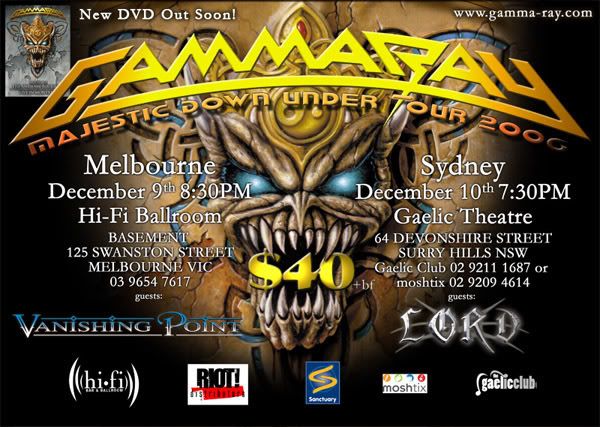
606. Gamma Ray / 10-12-2006, Gaelic Club, Sydney, Australia [Bootleg]. 2006. 5/5

One of the best moments of the musical side of my life was when I finally got to see Gamma Ray live. To be honest, I never thought it would happen. It's a long way to come from the other side of the world. It was almost unheard of for European power metal bands to travel Down Under (Edguy being one exception), no doubt with the expense of doing so to bring all of their gear.
Then out of nowhere, they announced a fly-by stop over, and Sydney was one of only two gigs.

Flash forward six years, and out of nowhere, I discover a bootleg of the gig on my favourite bootleg site at Guitars101, and I am excited all over again. To hear the actual gig I went to once again!
This bootleg quality is amazing. Someone had some good equipment and a great position. It has it all. It has the minute mistakes, the minutest off keys, the crowd at its excited best. Just magnificent.
The band is truly on song, and Kai's vocals soar to the ceiling. The setlist is a wonderful combination of  songs from almost all of the Gamma Ray catalogue. It kicks off with the magnificent "Garden of the Sinner" before moving into a cacophony of newer tracks, "New World Order", "Man On A Mission", the brilliant "Fight", "Blood Religion" and the crowd pleaser "Heavy Metal Universe".
For the oldest fans, the Helloween trilogy follows. I almost wet my pants in excitement when they broke into "Ride the Sky", which was then followed by the staple sing along songs of "Future World" and "I Want Out".
"The Silence" is almost a rest period in this set list, but it is soon cranked back up to ridiculous levels with "Rebellion in Dreamland" and "Land of the Free", before they return with the encore of "Valley of the Kings", "Somewhere Out in Space" and "Send Me A Sign", which closes out the evening.

This is still very close to the best gig I have ever seen, and this bootleg is a magnificent testament to how good the band is in general, and how magnificent they were on this evening.

Now... when are you coming back again?!?

Guitars101 Forum - Gamma Ray, Sydney, 10-12-06

605. The 12th Man / 12th Man Again! 1990. 5/5

Billy Birmingham returns with more laughs in his third release in the series. Whereas It's Just Not Cricket was like a highlights reel of a cricket match, and Wired World of Sports much like the theme of the TV show, this combines the on air and off air commentary and antics of the cricket.
While Richie, Tony, Max and Ian have appeared in the previous releases, 12th Man Again! introduces for the first time Birmingham's impersonation of Bill Lawry to the mix, and with hilarious outcomes.

Any Australian who grew up watching the cricket knows these commentators and players. Birmingham's impersonations are brilliant and accurate, his mock up of cricketing names intelligent and masterful, and the whole scenario outlandish and side-splittingly funny.
It is still a terrific half hour to spend even to the modern day. Top shelf.